When Mitsubishi Ruled the World Rally Championship in the 1990s
The 1990s are often considered one of the wildest and most iconic eras in the history of the World Rally Championship (WRC). During this period, the rally world was dominated by intense battles between major Japanese and European manufacturers, all competing to build the fastest, toughest, and most advanced rally machines.
The WRC in the 1990s was not just about speed. It became a golden era where manufacturers showcased legendary cars such as the Subaru Impreza, Toyota Celica GT-Four, Ford Escort RS Cosworth, Peugeot 306 Maxi, and Mitsubishi Lancer Evolution.
However, any discussion about Mitsubishi’s success in WRC during the 1990s would be incomplete without mentioning the Japanese manufacturer with the iconic three-diamond logo.
Mitsubishi became one of the most feared forces in rally racing. With the perfect combination of the Mitsubishi Lancer Evolution and legendary driver Tommi Mäkinen, the brand achieved one of the greatest periods of dominance in WRC history.
Using the Evolution III through Evolution VI generations, Mitsubishi won four consecutive World Rally Championship drivers’ titles from 1996 to 1999.
During that golden era, the name Lancer Evolution became synonymous with victory. The car earned a reputation as a brutal, fast, and incredibly durable rally machine capable of conquering every type of terrain, from the asphalt roads of Monte Carlo, the snowy stages of Sweden, to the extreme gravel conditions of the Safari Rally Kenya.
But in motorsport, no dynasty lasts forever. Mitsubishi’s dominance eventually began to collapse when WRC entered a new technological era.
The 1997 WRC Regulation Change That Started Mitsubishi’s Decline
In 1997, the FIA introduced a new regulation known as the World Rally Car (WRC) specification. This rule change completely transformed how manufacturers developed rally cars.
Unlike the previous Group A era, where manufacturers were required to build production-based cars and meet strict homologation rules, the new WRC regulations allowed teams to create cars specifically designed for competition.
Rival manufacturers immediately took advantage of the new rules.
Subaru, Ford, and Peugeot began developing purpose-built WRC machines such as the Subaru Impreza WRC, Ford Focus WRC, and Peugeot 206 WRC.
Meanwhile, Mitsubishi decided to continue using the same formula that had already delivered four consecutive world titles.
At first, this decision seemed logical. The Lancer Evolution had proven itself as a championship-winning machine. However, motorsport is a world where technology evolves constantly, and past success does not guarantee future victories.
While competitors developed completely new platforms, Mitsubishi continued relying on an aging Group A-based chassis. This created major limitations in suspension development, weight distribution, aerodynamics, and overall vehicle design.
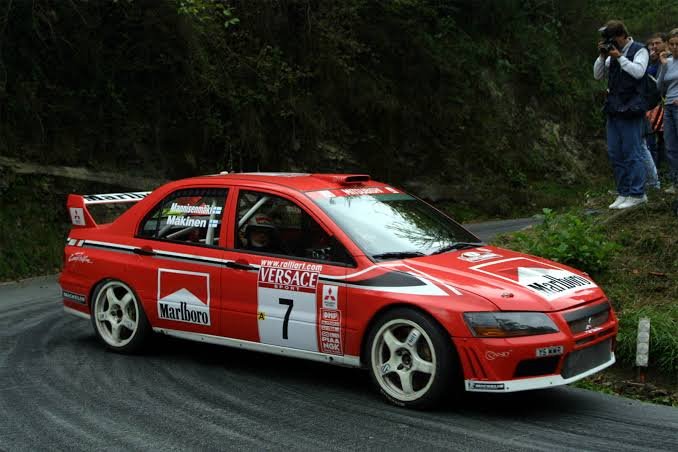
The result was the birth of the Mitsubishi Lancer Evolution VII WRC, a car that was supposed to continue Mitsubishi’s legacy but instead became one of the biggest disappointments in the company’s rally history.
Why Did the Mitsubishi Lancer Evolution VII WRC Fail?
1. Falling Behind in WRC Technology Development
When the WRC regulations arrived in 1997, teams like Subaru, Ford, and Peugeot immediately started designing cars specifically for the new era.
Mitsubishi, however, remained committed to the older Lancer Evolution platform.
By the time FIA regulations forced Mitsubishi to fully embrace the WRC specification, the team was already years behind its competitors. Ralliart had to catch up with rapidly developing technology in a very limited timeframe before the Evo VII WRC made its debut at the 2001 Rally Sanremo.
The result was a car that entered competition before it was truly ready.
2. The Problematic Lancer Cedia Chassis
One of the biggest weaknesses of the Evo VII WRC was its chassis foundation.
The car was based on the Mitsubishi Lancer Cedia, a platform originally designed as a larger and more comfortable family sedan rather than a lightweight rally weapon.
Compared to previous Evolution models, the Cedia-based platform was heavier and less agile.
This became a serious disadvantage against rivals such as the compact and nimble Peugeot 206 WRC and the well-balanced Subaru Impreza WRC.
Although Ralliart engineers heavily modified the aerodynamics and suspension, the final result still failed to match the performance level of its competitors.
3. Outdated Drivetrain Technology
The WRC regulations allowed teams to use advanced electronic active differentials that could control power distribution between the front, center, and rear axles in real time.
This technology provided major advantages, especially when accelerating out of corners and adapting to changing road surfaces.
However, due to limited development time, Mitsubishi chose to continue using a more conventional drivetrain system.
The Evo VII WRC became heavily dependent on advanced driving techniques, especially left-foot braking, a method mastered by Tommi Mäkinen.
Without a driver who fully understood the car’s unique behavior, extracting maximum performance became extremely difficult.
4. Losing Tommi Mäkinen and Reliability Problems
One of the biggest blows for Mitsubishi was losing Tommi Mäkinen at the end of the 2001 season.
Mäkinen was not only a world-class driver but also someone who deeply understood the character of the Lancer Evolution.
When replacement drivers such as François Delecour and Alister McRae attempted to drive the Evo VII WRC, they struggled to adapt to its difficult handling characteristics.
The car also suffered from reliability issues, including electrical failures and transmission problems, which resulted in disappointing finishes and numerous DNF (Did Not Finish) results.
The 2002 Season Became Mitsubishi’s Lowest Point
The 2002 WRC season became one of the darkest chapters in Mitsubishi’s rally history.
According to official team records, Mitsubishi managed to score only 9 constructors’ points throughout the season.
For a manufacturer that had dominated the championship only a few years earlier, the result was considered extremely disappointing.
The failure of the Evo VII WRC damaged not only Mitsubishi’s competitive image but also confidence within the company’s management.
Mitsubishi attempted to recover with further developments such as the Evo WRC2, WRC04, and WRC05, but the damage had already been done.
After the 2005 season, Mitsubishi officially withdrew from the World Rally Championship.
The Irony of the Mitsubishi Lancer Evolution VII
The Mitsubishi Lancer Evolution VII WRC proved that past success in motorsport does not guarantee future victories.
By failing to adapt quickly enough to new technology and regulations, one of rally racing’s greatest champions lost its place at the top.
However, the biggest irony is that while the Evo VII failed on the WRC stage, the road-going version became one of the most iconic JDM performance cars ever created.
The Lancer Evolution VII gained worldwide fame through tuning culture, video games, and appearances in movies such as 2 Fast 2 Furious.
It may not have become a symbol of victory in WRC, but it remains a symbol of Japan’s golden era of performance cars.
Ultimately, the story of the Evo VII WRC serves as a reminder that in motorsport, innovation, adaptation, and technological progress are the keys to staying at the top.

Adhe is part of the 88 Eight Box Editorial Team, covering JDM culture, motorsport, automotive technology, and industry news. The team focuses on delivering original automotive stories, reviews, and insights for enthusiasts worldwide.