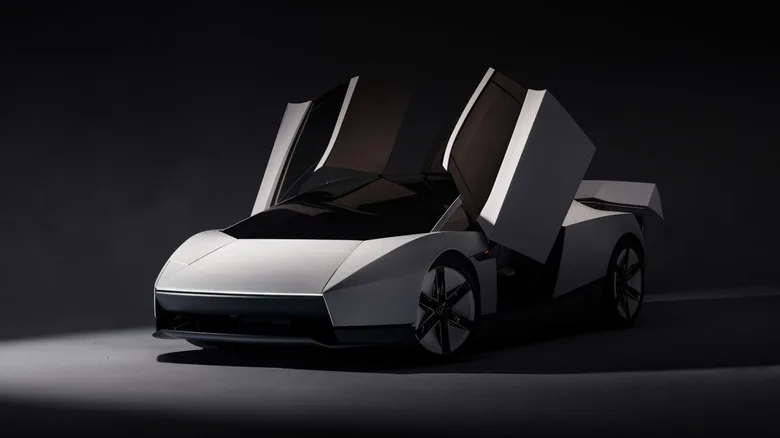
Tesla has unveiled a radically redesigned version of its long-awaited next-generation Roadster, promising extraordinary acceleration, rocket-inspired propulsion technology developed with SpaceX, and production in 2028. The electric sports car represents a significant evolution of the concept first introduced in 2017, with ambitions that extend far beyond those of a conventional supercar.
The latest presentation puts the spotlight on the Roadster’s futuristic styling, experimental flight capabilities, and extreme performance targets. However, after years of delays, questions remain about its final specifications, production schedule, safety, and whether all the promised technologies will make it into the customer-ready vehicle.
A COMPLETELY NEW DESIGN INSPIRED BY AEROSPACE TECHNOLOGY
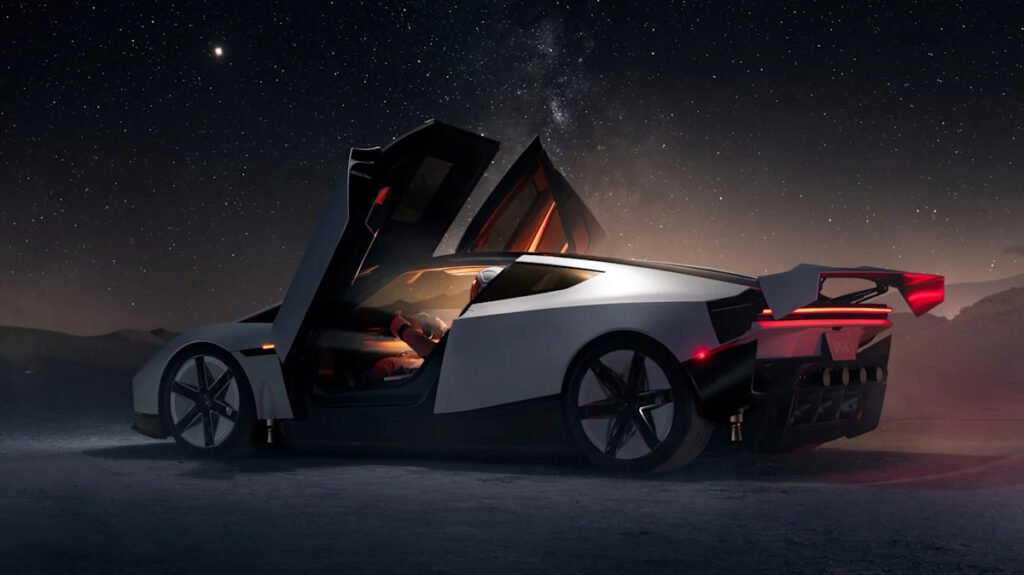
The redesigned Roadster features a low-slung silhouette, sharp bodywork, and a futuristic appearance that reflects Tesla’s evolving design language. Its exterior incorporates a wedge-shaped profile, gold-tinted glazing, a wide rear light bar, and an aggressive rear section designed to accommodate specialised propulsion hardware.
Compared with the original concept unveiled in November 2017, the latest design appears more radical, with a stronger emphasis on advanced technology and aerodynamic performance.
Tesla chief designer Franz von Holzhausen presented the new styling as an evolution of the company’s design philosophy. The project also draws inspiration from aerospace engineering, with aircraft such as the Lockheed Martin F-35 and SR-71 cited as design influences.
The result is a vehicle that looks considerably different from traditional electric sports cars. Rather than relying exclusively on conventional aerodynamic elements and electric motors, the Roadster is being developed around a combination of electric propulsion and experimental thrust-generating technology.
However, the displayed vehicle should not automatically be considered the final production specification. With production targeted for 2028, further engineering and design changes remain possible.
THE ROADSTER’S MOST UNUSUAL FEATURE: FLIGHT CAPABILITIES
The most extraordinary aspect of the Roadster is its proposed ability to leave the ground using specialised propulsion technology.
Tesla demonstrated the vehicle performing a series of manoeuvres involving a specially constructed ramp, including travelling upside down, rotating in mid-air, and returning to the ground.
The demonstrations relied on two principal technologies: an underbody suction system and rocket-inspired thrusters developed with assistance from SpaceX.
An Underbody Suction System
The Roadster’s proposed fan-based suction system is designed to generate additional downforce by creating a pressure difference beneath the vehicle.
Downforce pushes a car towards the road, helping its tyres maintain grip during acceleration, braking, and cornering. Conventional sports cars generally generate downforce through aerodynamic wings, splitters, diffusers, and carefully shaped bodywork.
A fan-assisted system takes a different approach by actively controlling airflow beneath the vehicle.
Similar principles have appeared in motorsport, where fan-generated suction has been explored as a way to increase grip beyond what conventional aerodynamics can provide.
In the Roadster’s case, Tesla has demonstrated the system as part of a much more unusual concept involving travel along a specially constructed surface.
However, the practical effectiveness of the technology will depend on the final design, operating conditions, and the amount of downforce it can generate. Tesla has yet to establish that the system will deliver all its claimed benefits under ordinary road-driving conditions.
SpaceX-Inspired Rocket Thrusters
The second technology is even more unusual.
Tesla has worked with SpaceX to develop a propulsion system incorporating cold-gas thrusters. These devices produce thrust by releasing stored pressurised gas through nozzles.
Unlike conventional rocket engines, cold-gas thrusters do not require combustion. Instead, they use the pressure of stored gas to generate a directed flow that produces a reaction force.
Depending on their positioning and configuration, thrusters can produce forces that change a vehicle’s orientation or movement. Similar technology is used in spacecraft to control their attitude.
For the Roadster, the proposed system is intended to provide additional acceleration and help control the vehicle during specialised manoeuvres.
Nevertheless, the ability to lift off briefly using thrusters does not automatically make the Roadster a practical flying car.
Tesla has not established that the vehicle can perform sustained, independently controlled flight comparable to an aircraft or helicopter. Nor do the demonstrations prove that its propulsion system will be legal or safe for routine use on public roads.
The flight capabilities should therefore be understood as experimental technology rather than evidence that Tesla has solved the broader engineering and regulatory challenges associated with flying vehicles.
TESLA CLAIMS 0–60 MPH IN LESS THAN ONE SECOND
Performance remains central to the Roadster’s appeal.
During the presentation, Tesla vehicle engineering chief Lars Moravy discussed the car’s ability to accelerate from 0 to 60 mph in less than one second, equivalent to approximately 0–97 km/h.
The demonstration reportedly recorded a time of around 0.81 seconds, although the precise testing conditions and configuration are important when interpreting the result.
For context, even the fastest conventional production sports cars generally require more than one second to reach 60 mph.
Achieving acceleration below that threshold is extraordinarily difficult because the available tyre grip, road surface, vehicle weight, and power delivery all influence how quickly a car can accelerate.
A vehicle equipped with additional thrust-generating hardware could potentially produce acceleration beyond what its tyres alone can transmit to the road. However, the actual contribution of such a system depends on its design and operating conditions.
Tesla has not yet provided sufficient independent test documentation to establish that the claimed acceleration can be reproduced consistently by a production vehicle.
The company has also discussed a top speed exceeding 230 mph, equivalent to approximately 370 km/h.
Elon Musk has suggested even more ambitious possibilities, including speeds approaching half the speed of sound. At sea level under standard atmospheric conditions, that would be approximately 383 mph, or 616 km/h.
That figure should be treated as an aspiration rather than an established production specification.
The Roadster’s eventual top speed will depend on factors including aerodynamic stability, tyre capabilities, power delivery, cooling, and safety limitations.
For now, the headline performance figures remain manufacturer claims awaiting verification through independent testing.
BATTERY RANGE: MORE THAN 300 MILES
While the Roadster’s acceleration figures have attracted considerable attention, its projected driving range is another important consideration.
When Tesla introduced the second-generation Roadster in 2017, it advertised a range of approximately 620 miles on a single charge, alongside a claimed top speed exceeding 250 mph.
Those figures helped establish the original concept as one of the most ambitious electric sports cars announced at the time.
The latest presentation indicated a projected range of more than 300 miles, equivalent to approximately 483 kilometres.
That is substantially below the original advertised figure.
However, the comparison should be treated cautiously because the final vehicle specifications and testing procedures have not been fully established.
Tesla has yet to publish a complete production specification covering battery capacity, charging performance, vehicle weight, energy consumption, and independently verified driving range.
These details will be essential in determining how competitive the Roadster will be as an electric vehicle beyond its headline acceleration figures.
Developing an electric supercar involves more than installing a powerful motor and a large battery. Engineers must balance energy storage, thermal management, aerodynamic efficiency, structural strength, and weight.
Tesla will need to demonstrate that the Roadster can deliver its promised performance without sacrificing range, reliability, or everyday usability.
THREE VERSIONS: PERFORMANCE, THRUST, AND ROCKET
Tesla’s reservation information outlines three configurations with different levels of performance and propulsion technology.
The proposed lineup suggests that the company intends to offer a conventional road-focused model alongside more specialised versions featuring additional thrust-generating hardware.
Roadster Performance
The Performance version is intended to serve as the more conventional road-going configuration.
Tesla’s published information describes a model focused on high performance and aerodynamic technology, with the underbody suction system among its proposed features.
The company lists a reservation deposit of $50,000 for this version.
However, the deposit should not be confused with a confirmed final purchase price. Tesla has not yet established every detail of the production specification, and the final equipment could change before manufacturing begins.
Roadster Thrust
The Thrust version adds acceleration thrusters intended to deliver performance beyond what the conventional electric drivetrain can achieve alone.
Tesla lists a reservation deposit of $250,000 for this configuration.
The additional hardware could make this version particularly appealing to buyers interested in the Roadster’s most extreme acceleration capabilities.
However, its practicality will depend on the final propulsion system, operating requirements, maintenance needs, and any restrictions governing its use.
Roadster Rocket
The Rocket configuration is the most radical version described in Tesla’s reservation information.
Presented as an invitation-only, single-seat model, it is intended to feature a full flight system.
Unlike a conventional two-seat sports car, this configuration appears to prioritise experimental performance over everyday usability.
Tesla has not established a widely available final price for the Rocket version.
Its invitation-only status also means prospective customers should not assume that it will be available through the same purchasing process as the other configurations.
The differences between these versions are significant. They suggest that the most extraordinary capabilities may be restricted to specialised configurations rather than offered across the entire Roadster range.
Final equipment, prices, delivery arrangements, and the legal status of the different versions remain important unanswered questions.
PRODUCTION TARGETED FOR 2028 AFTER YEARS OF DELAYS
Perhaps the most important announcement for prospective buyers is Tesla’s latest production target.
Elon Musk confirmed during the October 15, 2026, presentation that production is scheduled to begin in 2028.
That would place the start of production approximately 11 years after the second-generation Roadster was originally unveiled in November 2017.
When the original concept appeared, Tesla presented it as an electric sports car capable of challenging established supercars through extraordinary acceleration, high top speed, and long-distance driving range.
However, the programme experienced repeated delays as Tesla concentrated on other vehicles, expanded manufacturing operations, and developed additional technologies.
The latest redesign adds another layer of complexity by incorporating SpaceX-inspired propulsion systems and experimental flight capabilities.
Unveiling a demonstration vehicle is very different from preparing a car for mass production.
A production vehicle must undergo extensive validation, including crash testing, durability assessments, thermal management testing, manufacturing development, and regulatory approval.
The Roadster’s proposed propulsion technology creates further questions about passenger protection, emergency procedures, maintenance, and whether every advertised feature can be operated legally outside controlled environments.
Tesla must also determine how to manufacture the car consistently while maintaining its ambitious performance targets.
Although 2028 is the stated production target, it should not be interpreted as a guarantee that customer deliveries will begin on a specific date.
Given the project’s history, the schedule will remain an important milestone to watch as Tesla moves towards production.
A DIFFERENT KIND OF TESLA IN AN EV MARKET THAT HAS CHANGED
The Roadster’s return comes at a time when Tesla’s priorities extend well beyond conventional passenger cars.
The company has increasingly focused on autonomous-driving technology, robotaxis, artificial intelligence, and robotics.
Its Cybercab programme, for example, centres on a purpose-built autonomous vehicle rather than a traditional car designed primarily around a human driver.
Against this background, the Roadster occupies a different position in Tesla’s portfolio.
It is a technology showcase intended to demonstrate the company’s capabilities at the extreme end of vehicle performance.
Musk has described the Roadster as the last manually driven car Tesla would make, although the demonstration itself used autonomous operation for safety reasons.
That creates an interesting contrast with Tesla’s broader direction. While the company invests in vehicles designed to operate with less human involvement, the Roadster is being presented as a celebration of driving performance pushed to extraordinary limits.
Nevertheless, the Roadster is unlikely to have the same direct impact on overall vehicle sales as a mass-market model.
Its more immediate value may lie in attracting attention, demonstrating engineering capabilities, and reinforcing Tesla’s reputation for ambitious technology.
The challenge is translating that attention into a vehicle customers can purchase, drive, and maintain.
CAN TESLA TURN THE ROADSTER’S PROMISES INTO REALITY?
The latest Roadster reveal is considerably more ambitious than the original presentation in 2017.
Its redesigned exterior, claimed sub-one-second acceleration, and SpaceX-inspired propulsion technology distinguish it from conventional electric sports cars.
However, the most important test will come when Tesla moves beyond demonstrations and delivers a production-ready vehicle.
Several questions remain unanswered.
First, Tesla must establish the final performance specifications and demonstrate that its acceleration and top-speed claims can be achieved consistently under clearly defined testing conditions.
Second, the company must explain how the propulsion system will operate safely, particularly if customers are expected to use it outside controlled environments.
Third, Tesla must confirm the production vehicle’s final price, battery specifications, driving range, charging capabilities, and delivery schedule.
Finally, it must clarify which features will be available on road-legal versions and which will remain restricted to specialised configurations.
These details will determine whether the Roadster becomes a genuinely usable electric supercar or remains primarily an engineering spectacle.
Expectations have also grown considerably since the original concept was announced. The vehicle must now compete in an electric-performance market that has evolved substantially since 2017.
The new propulsion technology gives Tesla a distinctive selling point, but novelty alone will not establish the Roadster as a successful production vehicle.
The Roadster’s biggest achievement will not be making a car briefly fly during a demonstration. It will be delivering a production car that fulfils its extraordinary promises without compromising safety, reliability, and usability.
With production targeted for 2028, Tesla still has considerable engineering work ahead before buyers can determine whether its most ambitious sports car lives up to the spectacle.
The new Tesla Roadster is one of the most unusual performance-car projects in recent memory. Its combination of electric propulsion, aerodynamic technology, and SpaceX-inspired thrusters could push the boundaries of what people expect from a road-going sports car.
However, the difference between an impressive demonstration and a commercially viable product is enormous. Tesla must prove that its headline performance figures can be achieved consistently and that the additional propulsion technology can be integrated into a safe, practical vehicle.
After years of delays, the 2028 production target is an important milestone, but it is not the finish line.
Would you spend supercar money on a Tesla Roadster with rocket-inspired thrusters, or would you rather have a conventional supercar with proven performance and technology? Share your thoughts in the comments.

Adhe is part of the 88 Eight Box Editorial Team, covering JDM culture, motorsport, automotive technology, and industry news. The team focuses on delivering original automotive stories, reviews, and insights for enthusiasts worldwide.