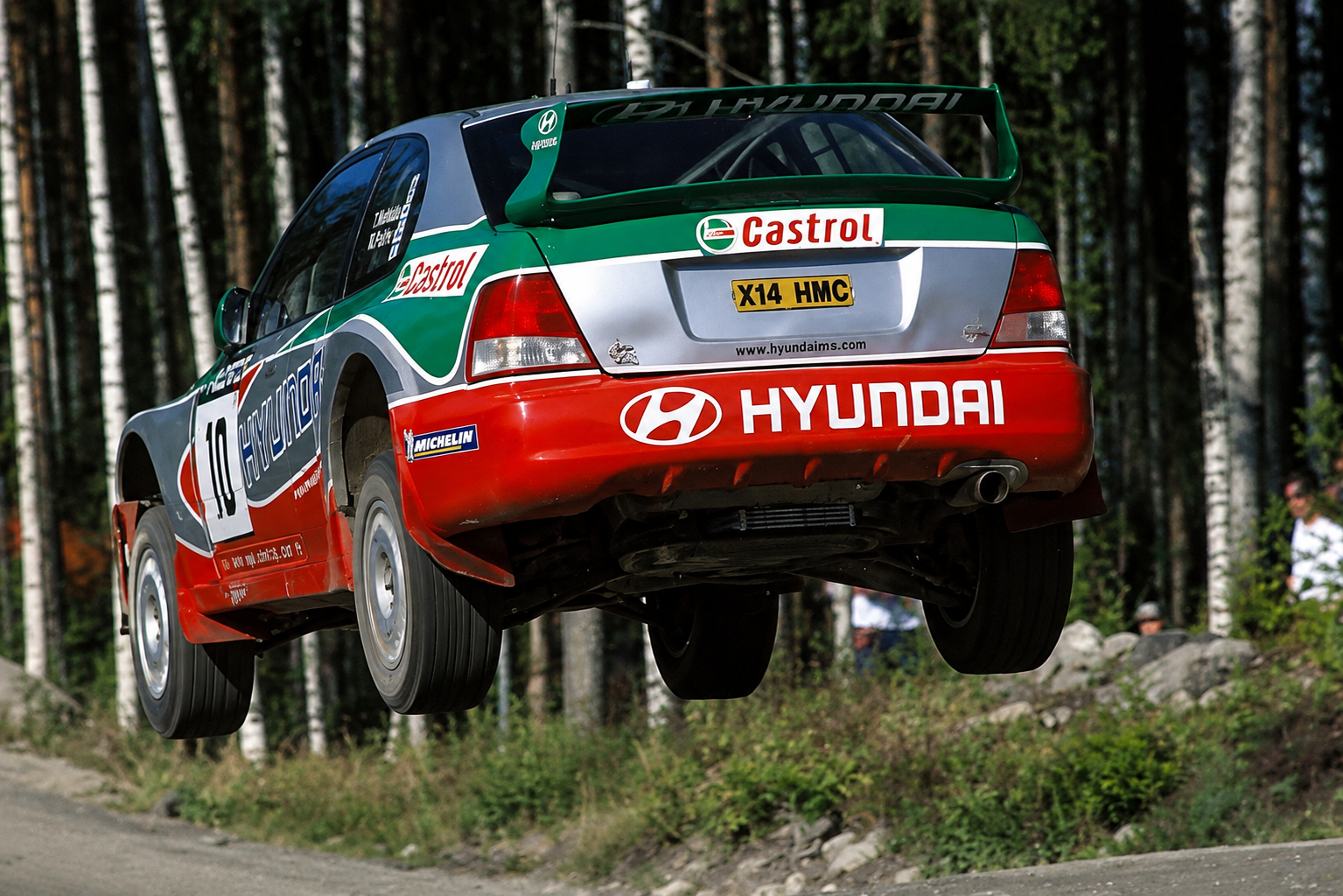
Hyundai Accent WRC remains one of the most interesting yet often overlooked chapters in Hyundai’s motorsport history. Built by the factory-backed Hyundai Castrol World Rally Team in collaboration with British rally engineering specialist Motor Sport Developments (MSD), the car represented Hyundai’s first serious attempt to compete in the top category of the World Rally Championship (WRC).
Competing from 2000 until 2003, the Accent WRC marked Hyundai’s transition from the lower F2 Kit Car category with the Hyundai Coupe (Tiburon) into the brutal world of World Rally Cars, where it faced legendary machines such as the Peugeot 206 WRC, Subaru Impreza WRC, and Ford Focus RS WRC.
From Road Car to WRC Machine
The Accent WRC was based on the three-door Hyundai Accent (LC), but almost nothing remained standard. The production car was transformed into a full-spec rally machine built to meet FIA World Rally Car regulations.
Under the hood was a Hyundai G4GF 2.0-liter DOHC four-cylinder engine fitted with a Garrett turbocharger. The engine produced around 300 horsepower and approximately 520 Nm of torque, sending power through a six-speed sequential gearbox with Xtrac technology and active differentials.
Key specifications:
- Engine: 2.0-liter turbocharged inline-four (G4GF)
- Power: ±300 hp at 5,500 rpm
- Torque: ±520 Nm at 3,500 rpm
- Transmission: 6-speed sequential manual
- Drivetrain: All-Wheel Drive (AWD)
- Minimum weight: 1,230 kg
Despite being developed with a much smaller budget compared to established WRC giants, the Accent WRC had a reputation for being agile, especially on loose gravel surfaces and snowy stages.
Three Generations of Accent WRC Evolution
During its four-year WRC campaign, Hyundai developed three major versions of the car.
Hyundai Accent WRC (Evo 1 – 2000)
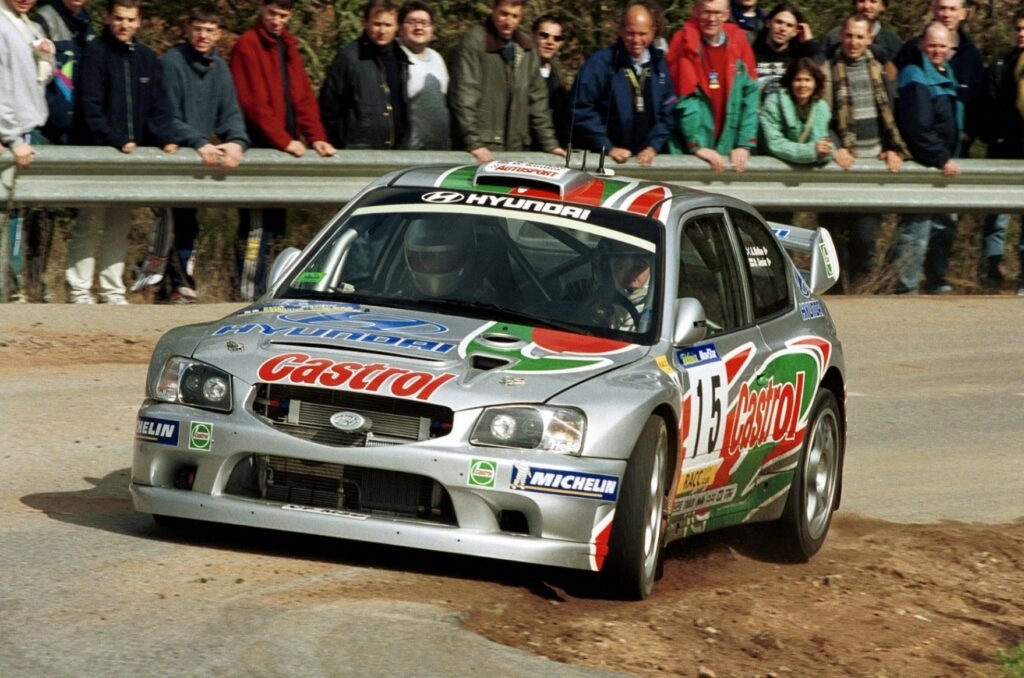
The first version made its competitive debut at Rally Sweden 2000.
Development focused mainly on:
- Improving chassis balance
- Increasing engine reliability
- Understanding the demands of WRC competition
The early Accent WRC was still a learning project, but it showed potential against more experienced rivals.
Hyundai Accent WRC2 (Evo 2 – 2001)
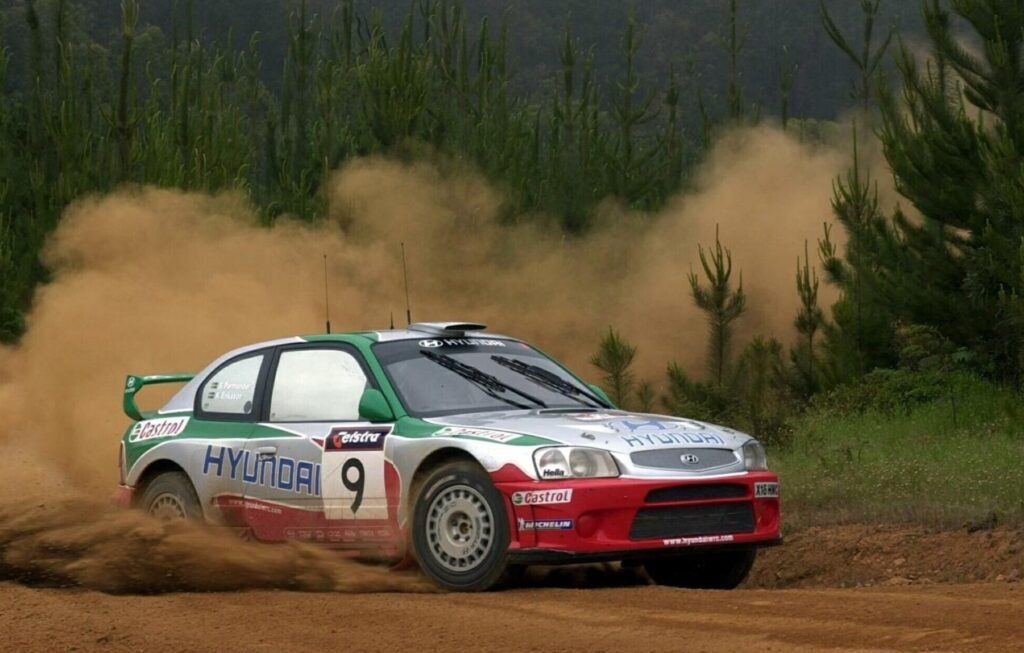
The second evolution introduced several improvements:
- Updated aerodynamic package
- Improved front active differential
- Revised suspension geometry
- Longer suspension travel for rough rally stages
These upgrades helped the Accent become more competitive, especially on gravel rallies where chassis performance was crucial.
Hyundai Accent WRC3 (Evo 3 – 2002–2003)
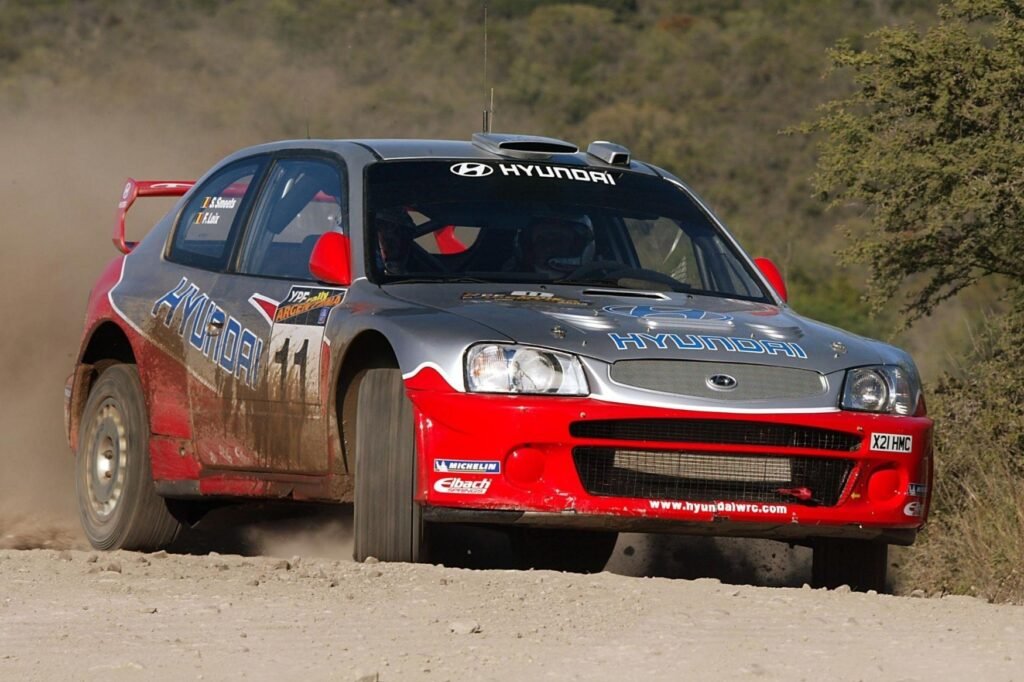
Introduced at Rally Tour de Corse 2002, the final evolution was the most advanced version.
Major changes included:
- Improved engine breathing system
- New electronic management system
- Reinforced suspension mounting points
- Stiffer chassis structure for extreme gravel conditions
The WRC3 was considered the most promising version of the Accent program before Hyundai’s sudden withdrawal.
Experienced Drivers Behind the Wheel
To accelerate development, Hyundai recruited several experienced rally drivers, including former champions and WRC veterans.
Main drivers included:
- Kenneth Eriksson (Sweden) – 2000–2001
- Alister McRae (United Kingdom) – 2000–2001
- Juha Kankkunen (Finland, four-time WRC champion) – 2002
- Armin Schwarz (Germany) – 2002–2003
- Freddy Loix (Belgium) – 2002–2003
- Piero Liatti (Italy) – asphalt rally specialist in 2001
Their experience helped Hyundai develop the car, even though the team lacked the resources of established manufacturers.
The Best Moments of Accent WRC
The Hyundai Accent WRC never achieved a WRC victory, but it delivered several impressive performances.
Its best overall results were:
Rally Australia 2000
Kenneth Eriksson secured 4th place overall, becoming the best WRC result achieved by the Accent.
Rally New Zealand 2001
Alister McRae matched that achievement with another 4th-place finish.
Rally Great Britain 2001
Hyundai produced one of its strongest team performances:
- Kenneth Eriksson finished 4th
- Alister McRae finished 5th
The Accent WRC also managed several individual Special Stage victories in events such as Rally Sweden, Rally Finland, and Rally Australia, proving that the car had genuine pace despite its limitations.
Why Did Hyundai Leave WRC?
The Accent WRC project ended abruptly in 2003.
Financial difficulties and disagreements between Hyundai Motor Company management and development partner MSD caused the manufacturer to withdraw from the championship after Rally Australia 2003.
The decision ended Hyundai’s first WRC adventure, but the knowledge gained from the Accent program became extremely valuable.
The Legacy of Accent WRC
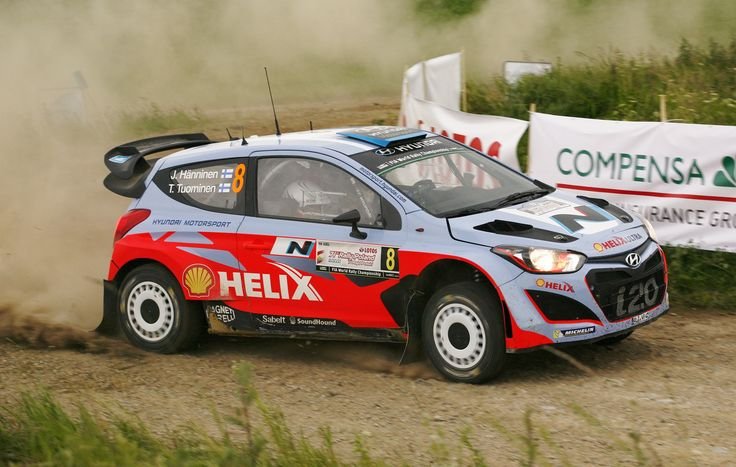
Although it was never a championship-winning machine, the Hyundai Accent WRC played a crucial role in shaping Hyundai’s future in motorsport.
More than a decade later, Hyundai returned to the WRC in 2014 with Hyundai Motorsport GmbH, based in Alzenau, Germany, entering the championship with the Hyundai i20 WRC.
The Accent WRC may have been an underdog, but it was the car that proved Hyundai could compete on the world rally stage — and it became the foundation for Hyundai’s modern WRC success.
The Hyundai Accent WRC is a fascinating example of how a racing project should not always be judged only by the number of trophies it wins. While it never became a world champion or dominated the WRC scene like the Subaru Impreza WRC, Mitsubishi Lancer Evolution, Peugeot 206 WRC, or Ford Focus RS WRC, the Accent WRC represented Hyundai’s courage to challenge the biggest names in rallying.
Considering its limited budget and Hyundai’s lack of experience at the highest level of rally competition, the Accent WRC was actually a remarkable achievement. The car managed to surprise many people by delivering several strong performances, including multiple top-four finishes and individual Special Stage victories against much more established rivals.
Unfortunately, the project ended before Hyundai could fully unlock its potential. If the manufacturer had continued developing the Accent WRC for a few more seasons, the car could have become a much more serious contender during the golden era of early 2000s WRC.
For motorsport fans, the Accent WRC may not be remembered because of championships or legendary victories, but because of its importance in Hyundai’s racing journey. This car became the foundation that helped Hyundai understand the demands of global rally competition and eventually paved the way for the successful return of Hyundai Motorsport with the i20 WRC years later.
The Hyundai Accent WRC was never the fastest car on the grid, but it proved that determination, engineering ambition, and a willingness to compete against the best can create something truly special.
What do you think about the Hyundai Accent WRC? Was it one of the most underrated World Rally Cars ever built, or do you think Hyundai should have continued the project and pushed it further? Share your comments.

Adhe is part of the 88 Eight Box Editorial Team, covering JDM culture, motorsport, automotive technology, and industry news. The team focuses on delivering original automotive stories, reviews, and insights for enthusiasts worldwide.