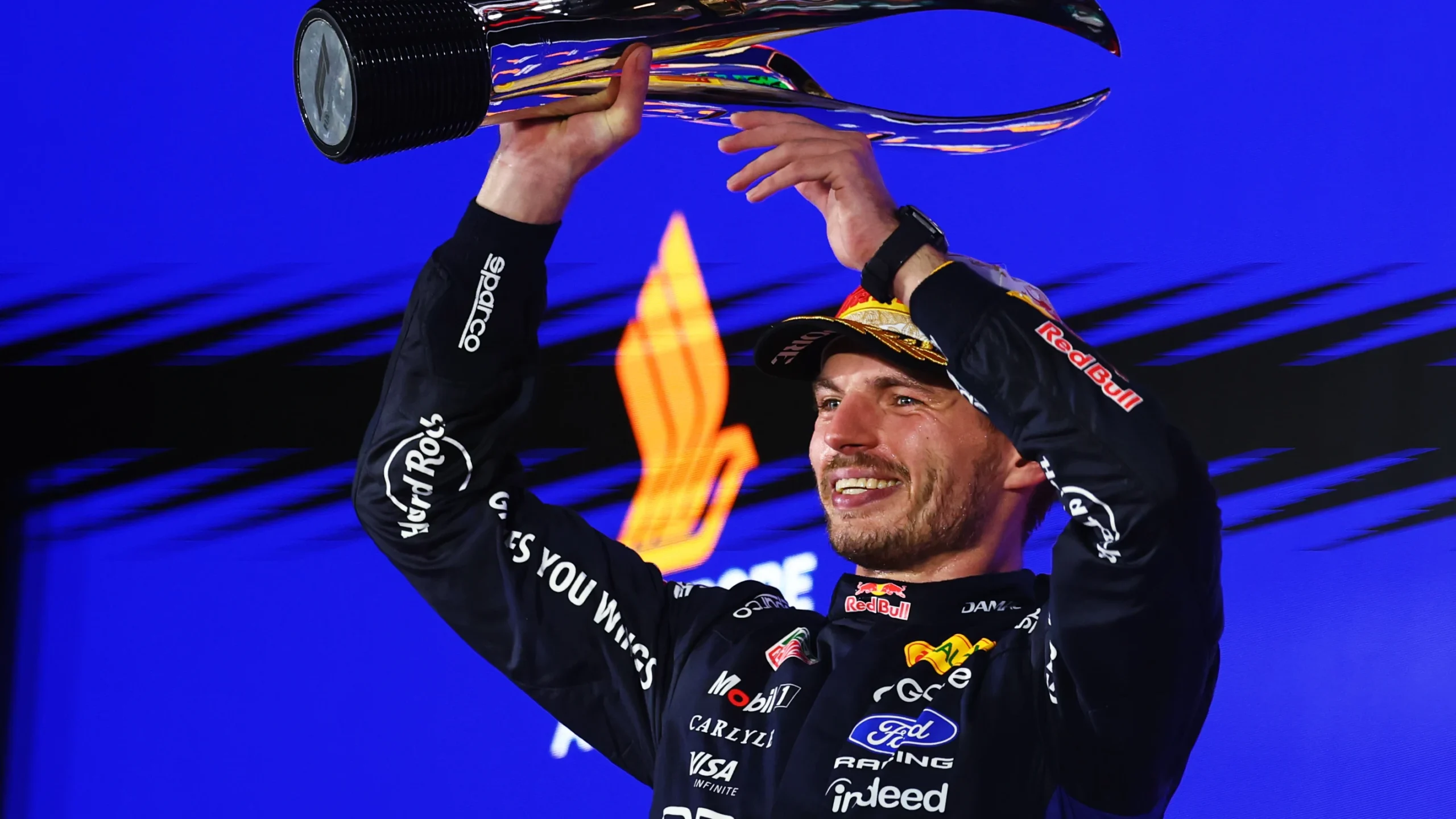
In modern motorsport, engineers are constantly asking one simple question: “Is this part legal?”
Does this component comply with the regulations? Is the car still within the technical limits? Is this aerodynamic solution permitted?
But what if there were a racing series where engineers could ask a completely different question?
Not “Is this legal?”
But rather:
“How far can we push this race car before it becomes completely ridiculous?”
It sounds almost impossible. Yet, for a brief and spectacular period in motorsport history, a championship actually encouraged engineers to think that way.
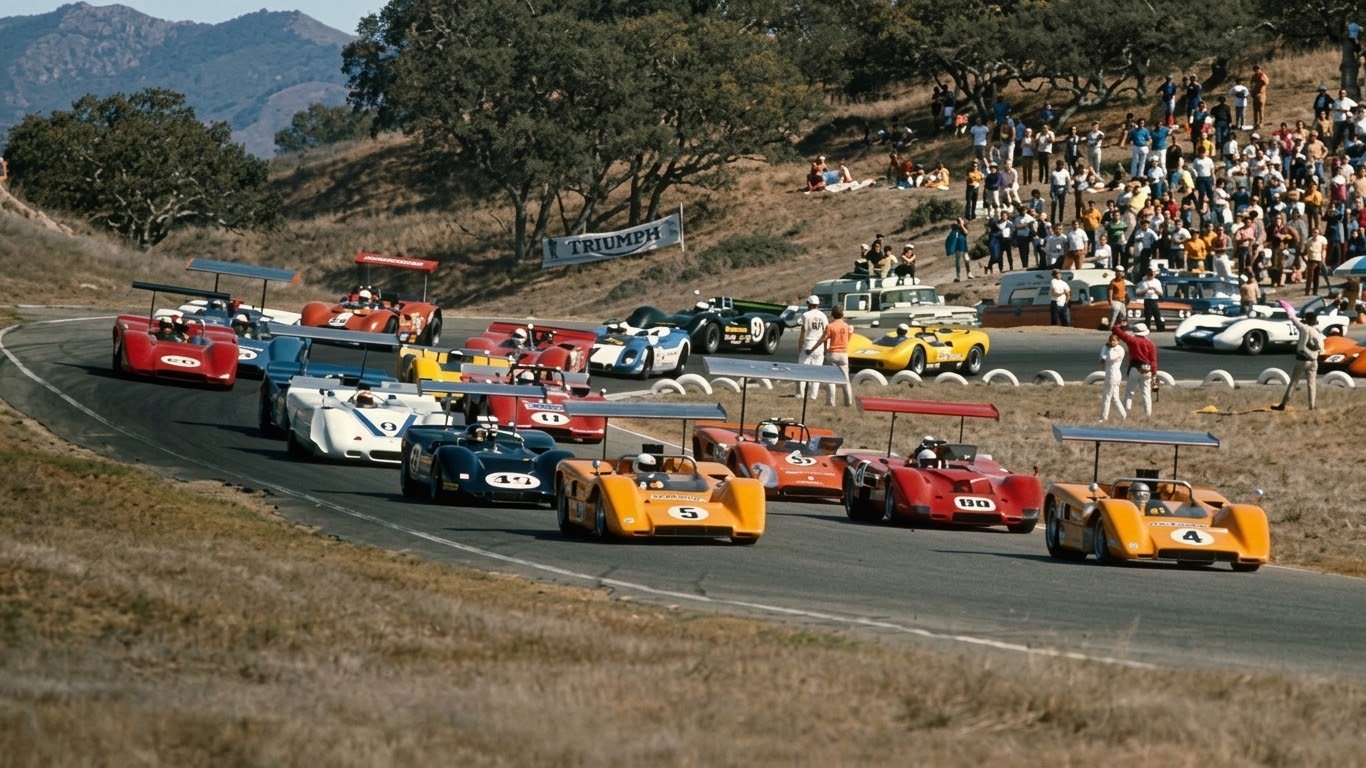
Its name was the Canadian-American Challenge Cup, better known as Can-Am.
First contested from 1966 to 1974, the original Can-Am became famous for having some of the most liberal technical regulations in motorsport. The series later returned in a different form in the late 1970s and continued into the 1980s, but it was the original Group 7 era that created the championship’s legendary reputation.
Can-Am was often described as a “no-limits” sports car racing series.
And once engineers were given that much freedom, they did what engineers do best.
They went absolutely crazy.
THE ENGINE RULES WERE WILD
One of the biggest areas of freedom in Can-Am was the engine.
The original Group 7 regulations established a minimum engine capacity of 2.5 liters, but there was no meaningful upper displacement limit. Teams and manufacturers were therefore free to choose whatever engine size they believed would give them an advantage.
That opened the door to enormous V8s from manufacturers such as Chevrolet and Ford, with some engines reaching well beyond 7,000 cc.
McLaren became one of the most famous examples of this philosophy.
Its Can-Am cars used large-displacement Chevrolet V8 engines, initially ranging from around 4.5 liters to 7.0 liters, with capacity continuing to increase as the cars evolved.
By the time McLaren introduced the M8D, the engine had grown to approximately 7.6 liters, producing around 680 horsepower. Its successor, the M8F, pushed displacement to roughly 8.1 liters and produced around 740 horsepower.
And if McLaren’s giant V8s already sounded insane, Porsche was about to take things to another level.
PORSCHE 917/10: TURNING AN ENDURANCE CAR INTO A MONSTER
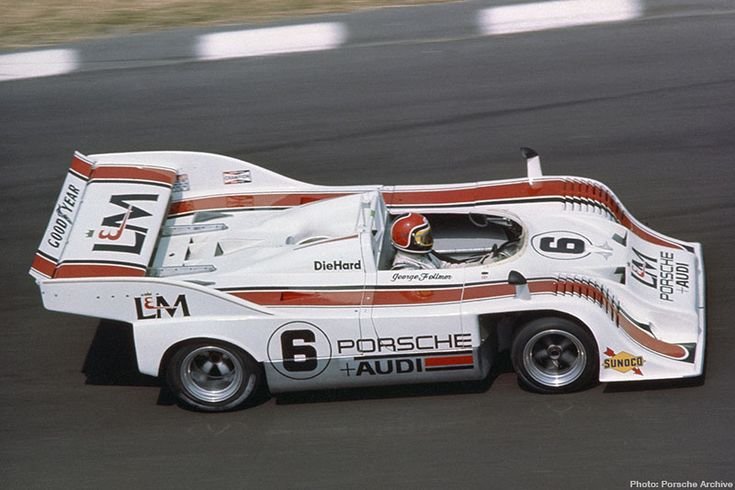
Porsche entered Can-Am with a weapon based on the legendary 917, a car originally developed for endurance racing.
For 1972, Porsche transformed it into a dedicated Can-Am machine called the 917/10 Turbo.
The car used a 5.0-liter flat-12 engine equipped with turbocharging and could produce well over 1,000 horsepower in racing trim.
It was an outrageous amount of power for a lightweight open-cockpit race car.
The Porsche 917/10 immediately proved its potential. With George Follmer driving for Team Penske, Porsche won six of the nine races in the 1972 season and captured the Can-Am championship.
But Porsche was still not finished.
PORSCHE 917/30: WHEN 1,000 HORSEPOWER WASN’T ENOUGH
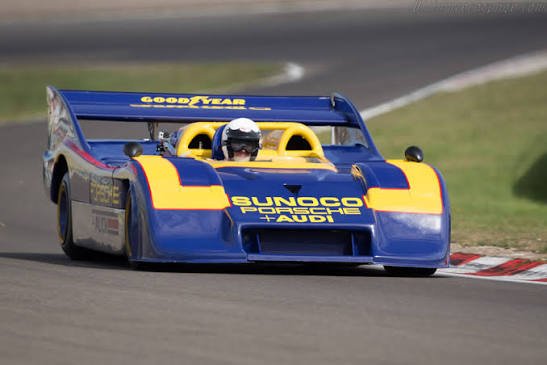
For the following season, Porsche introduced an even more extreme machine: the 917/30.
The engine remained a flat-12, but displacement increased to around 5.4 liters, while the addition of twin turbochargers pushed output to roughly 1,100 horsepower in racing configuration, with even higher figures possible under certain boost settings.
And there was another brilliant piece of engineering.
The driver could adjust the turbo boost from inside the cockpit.
Boost could be increased during the start to unleash maximum power, then reduced during the race to lower engine stress and improve fuel consumption.
The result was one of the most dominant cars in Can-Am history.
In 1973, Porsche won the championship again, while the 917/30 took six consecutive victories and demonstrated just how far the regulations could be exploited.
This was no longer simply a fast race car.
It was a four-wheeled engineering experiment with an absurd amount of horsepower.
THEN THE AERODYNAMICS GOT EVEN CRAZIER
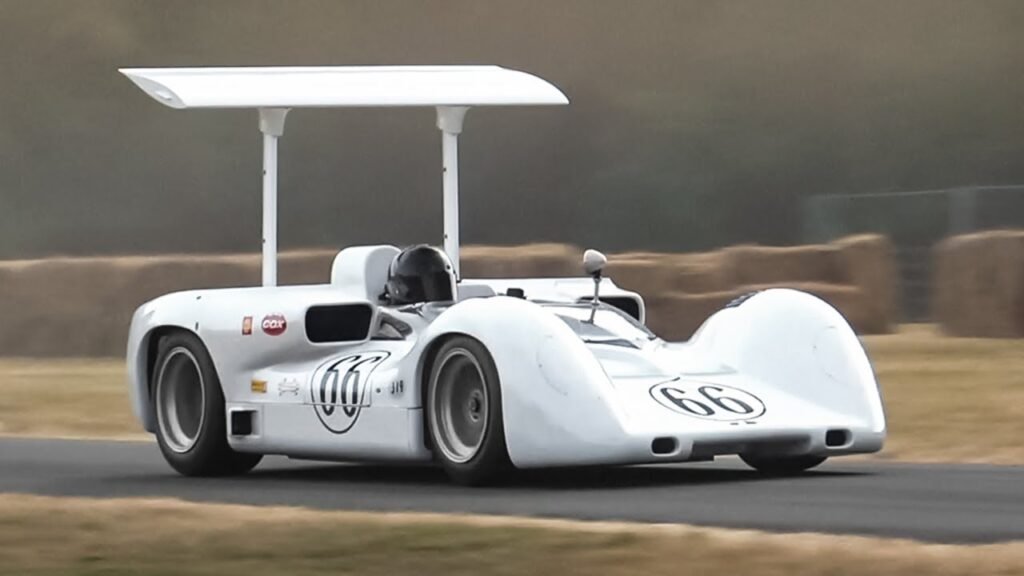
But Can-Am’s technical freedom was not limited to engines.
As engineers began to understand that horsepower alone was not enough, the battle quickly moved toward aerodynamics and downforce.
And one name became synonymous with extreme experimentation:
Chaparral.
Led by the legendary Jim Hall, Chaparral became famous for challenging conventional ideas about how a race car should generate grip.
The Chaparral 2E, for example, used a high-mounted aerodynamic wing positioned far above the bodywork.
But even that was not extreme enough.
Then came the Chaparral 2J.
CHAPARRAL 2J: THE CAR THAT SUCKED ITSELF TO THE TRACK
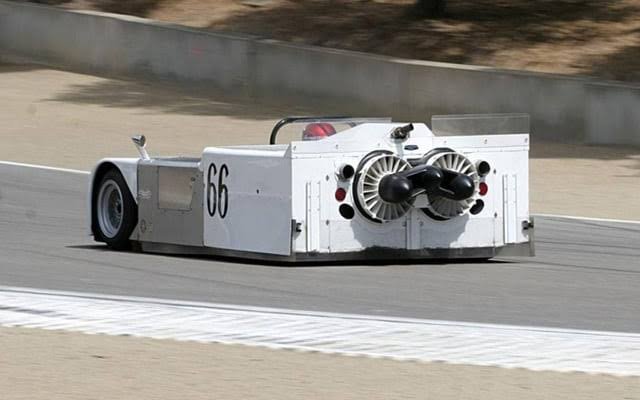
The Chaparral 2J remains one of the strangest race cars ever built.
Instead of relying entirely on conventional wings to generate downforce, the 2J used two large rear-mounted fans to extract air from underneath the car and create a low-pressure area.
In simple terms, the car effectively sucked itself onto the track.
The system was supported by skirts around the underside of the car, helping maintain the low-pressure zone beneath it.
The concept was revolutionary.
Unlike conventional aerodynamic downforce, which generally increases with speed, the 2J’s suction system could generate significant aerodynamic grip even at relatively low speeds.
But extraordinary technology often comes with extraordinary problems.
The fan system suffered from reliability issues, while debris and dust from the track could also create problems. The car’s complexity made it difficult to operate consistently over a race distance.
Despite its incredible concept, the 2J never achieved the success its engineering promised.
But its idea became one of the most unforgettable experiments in Can-Am history.
FREEDOM IN BODYWORK AND MATERIALS
The freedom of Can-Am extended beyond engines and aerodynamics.
Teams and constructors were also given enormous creative freedom when it came to bodywork, construction methods and materials.
The basic requirements were remarkably limited compared with modern racing categories.
As long as the car satisfied the fundamental rules, constructors could decide how they wanted to approach weight, rigidity, aerodynamics and packaging.
That opened the door to advanced materials, lightweight structures and unconventional engineering solutions.
The result was a grid filled with cars that could look completely different from one another.
Every constructor had its own philosophy.
Some focused on massive engines.
Others focused on aerodynamic efficiency.
Others chased minimum weight and exotic construction techniques.
Can-Am effectively became a laboratory where engineers could test ideas that would have been impossible in more restrictive racing categories.
BUT “NO LIMITS” HAD A PRICE
The greatest strength of Can-Am eventually became one of its biggest weaknesses.
With so much freedom, development costs began to explode.
Teams were no longer simply buying an engine and building a chassis. They were developing specialized engines, aerodynamic systems, lightweight structures, suspension solutions and materials at the same time.
The result was an increasingly expensive arms race.
And when there are very few technical restrictions, teams with the biggest budgets naturally gain an enormous advantage.
McLaren dominated the championship for several seasons.
Then Porsche arrived and dominated 1972 and 1973 with its turbocharged 917s.
The competitive gap was becoming increasingly difficult to ignore.
THE OIL CRISIS CHANGED EVERYTHING
In 1973, the world was hit by an oil crisis, and its impact eventually reached Can-Am.
For the 1974 season, organizers introduced fuel-consumption regulations in an attempt to control the increasingly powerful cars and address Porsche’s dominance.
But the timing could not have been worse.
Fuel was becoming more expensive and more difficult to secure, while teams and sponsors were already under financial pressure because of the wider economic situation in North America.
Porsche, which had dominated the previous two seasons, entered only one race during the 1974 season.
The combination of rising development costs, the oil crisis, declining sponsorship and the increasing dominance of factory-backed teams ultimately contributed to the collapse of the original Can-Am era.
After the 1974 season, the first and most famous chapter of Can-Am came to an end.
CAN-AM RETURNED BUT IT WAS DIFFERENT
Can-Am eventually returned in 1977, but the championship was no longer the same.
The cars used during the second era were increasingly based on single-seater machinery, particularly Formula 5000-derived designs.
The technology, philosophy and competitive environment were very different from the giant Group 7 monsters of the late 1960s and early 1970s.
The legendary era of enormous engines, extreme aerodynamics and engineering freedom was gone.
But its legacy remained.
THE REAL LEGACY OF CAN-AM
Can-Am was never simply a racing series about building the most powerful car.
It was an experiment in what happens when engineers are given an enormous amount of freedom.
Give them fewer restrictions, and they will find ways to make engines bigger.
Give them more aerodynamic freedom, and they will invent systems that seem impossible.
Give them enough room to experiment, and eventually someone will build a car with two giant fans underneath it.
That is what made Can-Am so fascinating.
Its greatest strength was also its greatest weakness.
The freedom created some of the most innovative and outrageous race cars in motorsport history. But that same freedom also drove development costs higher, widened the gap between wealthy and less-funded teams, and made the championship increasingly difficult to sustain.
In the end, Can-Am became a perfect example of the double-edged sword of technical freedom.
Too many regulations can kill innovation.
But too little regulation can make innovation so expensive that only the richest teams can afford it.
And perhaps that is why the original Can-Am era remains so fascinating decades later.
It was a rare moment when motorsport effectively told its engineers:
“Here are the rules. Now show us how crazy you can get.”

Adhe is part of the 88 Eight Box Editorial Team, covering JDM culture, motorsport, automotive technology, and industry news. The team focuses on delivering original automotive stories, reviews, and insights for enthusiasts worldwide.