When people talk about the fastest vehicles on the planet, names like Bugatti, Koenigsegg, Lamborghini, or even MotoGP machines often come to mind. Hypercars can break the 400 km/h barrier, while MotoGP bikes can exceed 360 km/h on long straights.
At first glance, Formula 1 cars seem to fall behind. Modern F1 cars usually reach a maximum race speed of around 330–350 km/h, far below the top-speed figures achieved by some road cars.
But judging an F1 car purely by its maximum speed is a huge misunderstanding.
The true secret behind Formula 1’s incredible performance is not how fast it can travel in a straight line, but how quickly it can accelerate, brake, and attack corners while maintaining extreme speed.
Beyond Top Speed: The Real Secret Behind Formula 1’s Unmatched Speed
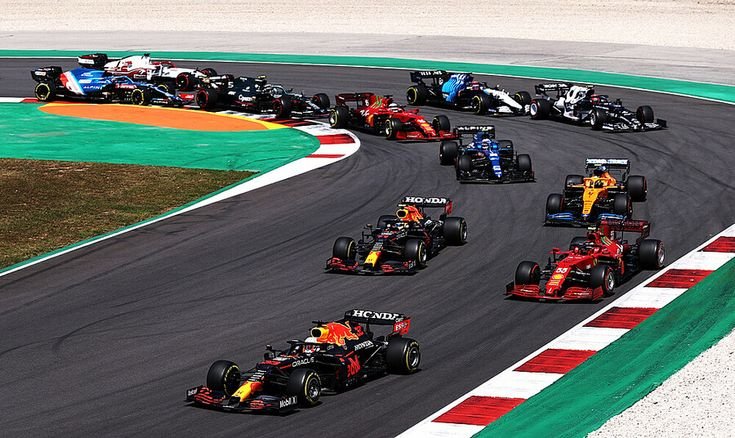
A Formula 1 car is built around one philosophy: maximum performance around an entire lap.
A modern F1 car can accelerate from approximately 100 km/h out of a corner to more than 330 km/h in only a few seconds, before immediately attacking the brakes and slowing back down below 100 km/h within just a few hundred meters.
This ability to repeat brutal acceleration, braking, and cornering forces lap after lap is what separates F1 cars from almost every other vehicle on Earth.
A Small Engine With Supercar-Level Performance
One of the most fascinating aspects of modern Formula 1 technology is the engine itself.
Unlike many people expect, F1 cars do not rely on huge-displacement engines. Instead, they use a highly advanced 1.6-liter V6 turbo hybrid power unit—a size smaller than engines found in many performance road cars.
However, combined with the Energy Recovery System (ERS), which captures energy from braking and exhaust heat, the power unit produces close to 1,000 horsepower.
That incredible output is paired with:
- A lightweight carbon-fiber chassis weighing around 800 kg
- An advanced 8-speed semi-automatic gearbox capable of shifting in milliseconds
- Extremely efficient power delivery and energy management
The result is one of the highest power-to-weight ratios ever created in motorsport.
F1 Speed Records: Faster Than It Looks
Although straight-line speed is not the main priority, Formula 1 cars have achieved astonishing speed records.
During the 2016 Mexican Grand Prix, Valtteri Bottas reached an official race speed of approximately 372.5 km/h with the help of slipstream and the Drag Reduction System (DRS).
Meanwhile, in a special non-race speed attempt in 2006, a modified Honda RA106 reached nearly 397 km/h at the Bonneville Salt Flats.
These numbers prove that F1 cars are capable of extreme speeds—but their true advantage lies elsewhere.
Aerodynamics: The Technology That Makes F1 Unbeatable
The biggest difference between Formula 1 cars and other racing machines is their aerodynamic philosophy.
Massive Downforce
F1 wings and aerodynamic surfaces generate enormous downforce, pushing the car onto the track surface.
This allows drivers to carry incredible speed through corners where normal cars would have to slow dramatically.
The Price of Downforce: Drag
However, there is a compromise.
The more downforce a car produces, the more aerodynamic drag it creates. This resistance slows the car down on straights and limits maximum speed.
F1 engineers constantly search for the perfect balance between cornering grip and straight-line performance.
DRS: The Top-Speed Booster
To reduce aerodynamic drag, Formula 1 uses the Drag Reduction System (DRS).
When activated in designated zones, the rear wing flap opens, allowing air to pass more freely and increasing top speed by around 10–15 km/h, helping drivers attempt overtaking moves.
At circuits with long straights such as:
- Autodromo Nazionale Monza
- Baku City Circuit
- Las Vegas Street Circuit
- Mexico City
teams often choose lower-downforce wing configurations to maximize straight-line speed.
Why Don’t Formula 1 Cars Go Beyond 400 km/h?
With today’s technology, it is possible to create an F1 car capable of exceeding 400 km/h under certain conditions.
So why doesn’t Formula 1 simply chase higher speeds?
The answer is safety.
Speeds beyond 400 km/h would create enormous challenges:
- Braking distances would become significantly longer
- Tires would experience extreme loads
- Brake systems would face greater temperatures and stress
- Crash forces would increase dramatically
The FIA continuously balances performance with driver safety through strict technical regulations, advanced safety systems, and modern circuit designs.
Formula 1 Is Not About Being the Fastest in a Straight Line
A Formula 1 car is not the fastest machine because it has the highest top speed.
It is the fastest because it combines:
- Extreme acceleration
- Unmatched braking ability
- Incredible cornering speed
- Advanced aerodynamics
- Cutting-edge hybrid technology
- Human control at the absolute limit
Formula 1 represents the ultimate challenge in automotive engineering: creating the fastest racing machine on Earth that can still be controlled by a human being.

Adhe is part of the 88 Eight Box Editorial Team, covering JDM culture, motorsport, automotive technology, and industry news. The team focuses on delivering original automotive stories, reviews, and insights for enthusiasts worldwide.