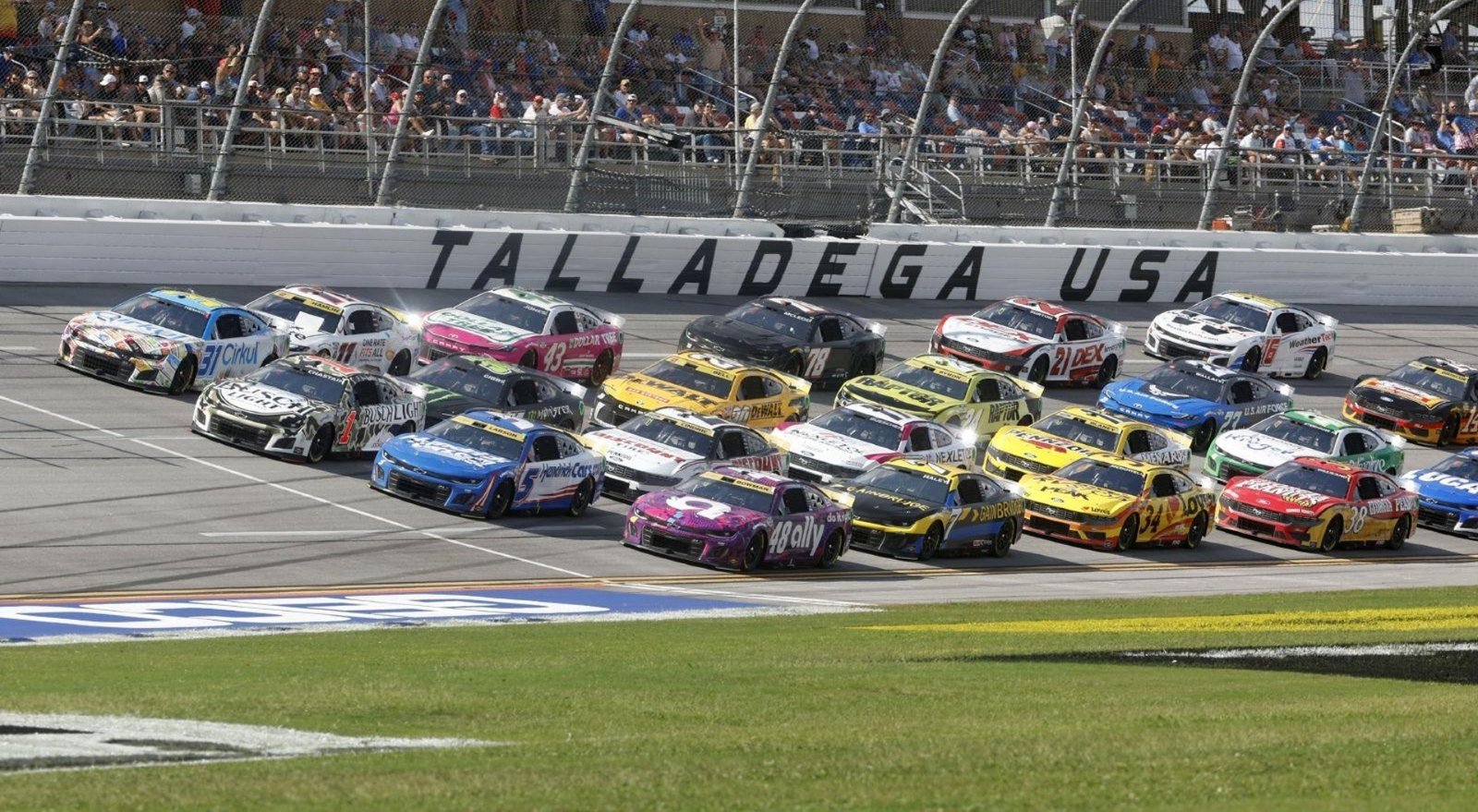
Imagine dozens of race cars travelling at more than 300 km/h, running almost bumper-to-bumper with barely a few centimetres separating them. Drivers fight for every inch of asphalt, make aggressive moves to gain positions, and sometimes bang doors with their rivals in battles that can decide the outcome of an entire race.
This is the world of NASCAR, one of the most distinctive forms of motorsport on the planet.
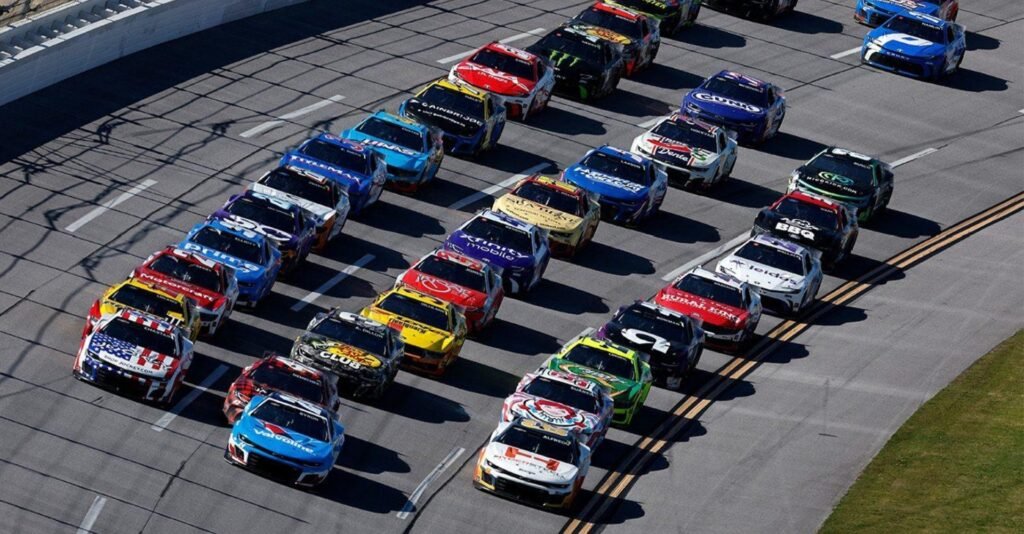
At superspeedways such as Daytona International Speedway and Talladega Superspeedway, high-speed pack racing creates an atmosphere that is difficult to replicate in other racing series. Cars run in tightly grouped formations, using the aerodynamic advantage of drafting to gain speed while constantly defending their positions. Contact is common, although deliberately causing a dangerous crash can still result in penalties.
But the racing action is only part of what makes NASCAR so fascinating. Its cars also follow a philosophy that differs significantly from many other modern racing machines.
While several international racing categories have embraced electrification and increasingly sophisticated powertrain technology, the NASCAR Cup Series continues to rely on a naturally aspirated 5.86-litre V8 engine with a traditional pushrod-operated overhead-valve design. The engine has a displacement of 358 cubic inches and does not use a turbocharger or supercharger.
That does not mean NASCAR has abandoned modern technology altogether. Its Next Gen cars feature sophisticated engineering, electronic engine management and modern safety systems. However, the conventional V8 remains at the heart of the experience.
NASCAR’s character is built on a combination of close-quarters competition, powerful engines, distinctive race formats and traditions that have survived for decades.
Interestingly, some of its most unusual characteristics come from the rules themselves. Certain regulations may seem strange to fans familiar with Formula 1, the World Endurance Championship or other circuit-racing series. Yet these rules have specific purposes, whether they are intended to improve safety, maintain competitive excitement or preserve NASCAR’s distinctive racing culture.
Here are four of the most unusual rules and unwritten traditions that help make NASCAR different from almost every other major racing series.
1. NASCAR DRIVERS MUST CONTROL PIT-LANE SPEED WITHOUT AN AUTOMATIC PIT LIMITER
In many modern racing series, controlling pit-lane speed is relatively straightforward. In Formula 1, for example, a driver can activate an electronic pit-lane speed limiter, which helps prevent the car from exceeding the permitted speed while travelling through the pits.
NASCAR takes a different approach.
NASCAR Cup Series cars do not use an automatic pit-speed limiter. Instead, drivers must control their speed themselves, typically by monitoring engine RPM and using the appropriate gear. Dashboard indicators can help them judge whether they are approaching the permitted speed, but the driver remains responsible for controlling the throttle.
The challenge is particularly demanding because the pit-lane speed limit varies between circuits. Drivers must adjust their engine RPM and driving technique to suit each venue.
The real difficulty is finding the right balance between accuracy and speed while under pressure.
Approach the pit lane too quickly and a speeding violation can cost valuable track position. Drive unnecessarily slowly, on the other hand, and the driver may lose several seconds to rivals during a pit-stop cycle.
NASCAR monitors pit-lane speed using electronic timing systems. Transponders on the cars trigger timing loops at designated points, allowing officials to calculate the average speed over a measured section of pit road. This means the system does not simply rely on measuring the car’s speed at one particular instant.
The consequences can be significant. A speeding violation can result in a pass-through penalty during green-flag conditions or a restart at the back of the field in applicable caution-period situations. Either outcome can destroy a driver’s strategy, particularly when the field is running closely together.
So why not simply install automatic speed limiters?
The key distinction is that NASCAR makes the driver responsible for managing pit-road speed rather than relying on an automatic limiter to do the job. Electronic indicators can provide useful assistance, but they do not automatically control the car’s speed.
That creates another skill for drivers to master. They must understand their engine’s RPM, select the correct gear, judge their speed and execute the pit entry without losing more time than necessary.
It might sound like a minor detail, but pit-road execution can have a major impact on the final result. A driver who gains or loses a few seconds during a pit stop can emerge in a completely different position, changing the entire strategic picture of the race.
In NASCAR, even travelling down pit road can become a competitive battle between the driver’s precision, instinct and willingness to take risks.
2. THE LUCKY DOG RULE CAN GIVE A LAPPED DRIVER A FREE LAP
One of NASCAR’s most unusual race procedures is known as the Free Pass, commonly called the Lucky Dog.
To understand why it exists, it is necessary to understand what happens when a NASCAR race is interrupted by a yellow flag.
A caution period is declared when an incident or another condition requires the field to slow down. The pace car enters the circuit, and drivers must follow the appropriate caution procedures instead of continuing to race at full speed.
However, the race does not suddenly become equal for everyone. Some drivers may already be a lap or more behind the leader because of earlier incidents, mechanical problems or differences in pace.
This is where the Lucky Dog rule comes into play.
Under the Free Pass procedure, the highest-running eligible car that is one or more laps behind the leader can recover one lap when a caution is called. The beneficiary is instructed to pass the pace car under the designated procedure and rejoins the field at the rear of the lead-lap cars.
In other words, the driver receives an opportunity to recover a lap without having to overtake the race leader on the circuit.
However, the benefit is not available to every lapped driver simultaneously. NASCAR normally awards the Free Pass to one eligible car per caution period, and certain restrictions apply. For example, a driver who caused the caution or is under an applicable penalty may be ineligible. The procedure also remains subject to NASCAR officials’ instructions.
At first, the idea of giving a driver a lap back for free might sound unfair. After all, a driver who has fallen behind the leader ordinarily has to work hard to recover that lost ground.
But the rule was introduced primarily to address a much more dangerous situation.
Before the Free Pass procedure was introduced in 2003, NASCAR permitted drivers to race back towards the start-finish line after a caution was called. Depending on their positions, competitors could continue pushing hard to gain positions or recover a lap before the caution period officially took effect.
The problem was that an incident triggering a yellow flag could leave damaged or stationary cars on the track while other drivers were still racing at high speed.
One particularly significant incident occurred during the 2003 race at New Hampshire International Speedway, when Dale Jarrett’s car stalled on the frontstretch. Casey Mears came close to Jarrett’s stranded car while competitors were racing back to the line.
Although the incident did not result in a collision, it highlighted the danger of allowing drivers to continue racing at full speed when a caution had already been declared.
NASCAR subsequently introduced the Free Pass procedure, providing an alternative way for an eligible lapped driver to recover a lap without encouraging the entire field to race towards the finish line under dangerous conditions.
The principle behind the rule is simple: safety officials need drivers to slow down promptly when a caution is called, allowing marshals to respond to incidents without the additional danger of competitors racing past at full speed.
The Lucky Dog therefore serves as a compromise. It gives an eligible driver a chance to recover lost ground while eliminating the need to race back to the caution flag.
And there is another reason why it remains strategically important.
Recovering even one lap can completely change a driver’s prospects. A car that was previously struggling several positions behind the leader may suddenly be able to compete on the lead lap again, giving its driver a better opportunity to gain positions during subsequent restarts.
It does not guarantee a victory, of course. The driver still needs sufficient pace, a competitive car and a good strategy to make the most of the opportunity.
Nevertheless, the Free Pass is an excellent example of how NASCAR uses unusual rules to balance competitive opportunities with safety considerations.
3. NASCAR OVERTIME TRIES TO AVOID AN ANTICLIMACTIC FINISH UNDER CAUTION
Imagine watching an entire race only for the final moments to unfold behind a safety car.
The drivers can no longer fight freely for position, overtaking opportunities disappear, and the finishing order may be decided without the expected final-lap battle.
This situation can occur in Formula 1 when an incident happens late in a race and there is insufficient time to complete the necessary safety-car procedures before the chequered flag.
NASCAR has a different mechanism designed to give fans a better chance of seeing a competitive finish.
It is called Overtime, traditionally associated with the Green-White-Checkered finish.
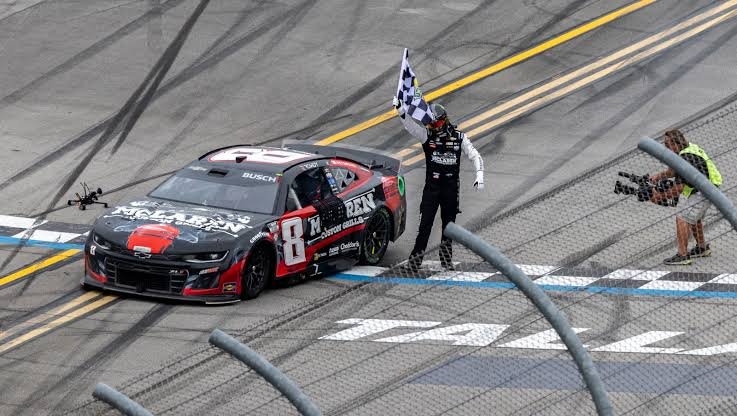
When a caution period interrupts the closing stages of a race, NASCAR can extend the contest through an overtime restart. The aim is to allow the drivers to settle the result under green-flag racing rather than simply following the pace car to the finish.
In a typical green-white-checkered finish, the field receives a restart followed by the white flag on the final lap and then the chequered flag. The precise procedure depends on NASCAR’s rules governing the restart and the circumstances of the caution.
However, Overtime does not guarantee that the race will finish under green.
NASCAR introduced an overtime-line system in 2016 to clarify when an overtime restart could be considered valid. Each track has a designated line that the leader must pass after the green flag is displayed.
If a caution occurs before the leader reaches that line, the attempt is not considered a clean restart, and NASCAR can arrange another overtime attempt.
Once a valid restart has been established, however, another caution during the closing attempt can end the race under yellow, with the drivers scored according to the applicable procedures. The system is intended to create a genuine opportunity for a green-flag finish, not to guarantee unlimited restarts regardless of safety.
This distinction is important.
Suppose the field restarts with two laps remaining. The drivers accelerate, jostle for position and begin fighting for the lead. If a crash happens before the leader reaches the overtime line, another attempt may be possible.
But if the leader has already crossed the designated line and a major crash then occurs, NASCAR can end the race under caution rather than continually restarting the field.
The logic is straightforward: NASCAR wants to give its drivers a chance to finish the race through competition, but it must also protect competitors and track workers.
Without such a mechanism, a caution just before the scheduled finish could eliminate the opportunity for a final-lap battle altogether.
Overtime therefore provides a distinctive balance between sporting entertainment and safety. It encourages drivers to fight for the win while establishing a clear point beyond which another restart is no longer guaranteed.
For fans, this can produce some of NASCAR’s most dramatic moments. Drivers must balance the desire to attack with the risk of being caught in an incident, and a restart can completely transform the outcome of a race in a matter of seconds.
Yet the most important detail is that NASCAR does not promise that every race will finish under green. Its rules simply provide a structured opportunity to avoid an anticlimactic finish whenever circumstances allow.
4. THE UNWRITTEN RULE OF NASCAR FIGHTS: TAKE YOUR HELMET OFF
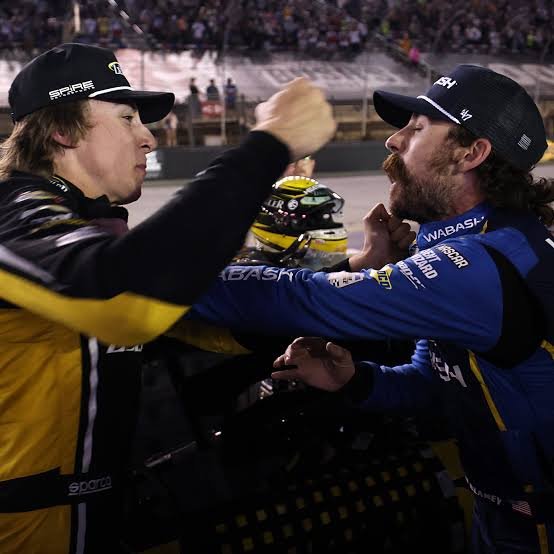
This final example is perhaps the strangest of all because, unlike the previous three, it is not an official technical or sporting regulation.
Instead, it is an unwritten tradition associated with NASCAR’s distinctive racing culture.
Anyone who follows stock-car racing will know that tensions can run high. Close racing, aggressive defensive moves and contact between cars can leave drivers furious with one another, especially when an incident destroys a driver’s chances of winning.
Occasionally, those arguments continue after the cars return to the pits.
NASCAR has a long history of heated confrontations between drivers, including arguments, shoving matches and, in some cases, physical fights. One of the best-known examples of this culture is the expectation that drivers should remove their helmets before exchanging punches.
According to this unwritten tradition, if two drivers decide to settle their disagreement physically, both should take off their helmets rather than allow one driver to retain the protective equipment while the other is left exposed.
In other words, the idea is that both participants should face one another on roughly equal terms.
NASCAR itself has acknowledged the tradition in its own published coverage. A NASCAR article examining the sport’s unwritten rules highlighted the expectation that drivers should fight with their helmets off.
The tradition is also illustrated by a 2019 incident involving Clint Bowyer and Ryan Newman. After the two drivers became involved in a confrontation following the NASCAR All-Star Race, Bowyer was seen throwing punches while still wearing his helmet.
Bowyer’s team co-owner at the time, Tony Stewart, subsequently joked that drivers should remove their helmets before getting into a fight. Stewart’s remarks reflected a familiar sentiment within NASCAR’s racing culture: keeping the helmet on while throwing punches is often viewed as an unfair advantage rather than a display of courage.
But there is an important distinction here.
Taking off a helmet before a fight is an unwritten cultural expectation, not an official NASCAR rule requiring drivers to fight. Nor does it mean physical altercations are automatically acceptable under the regulations. NASCAR can still discipline drivers for conduct that violates its rules.
The tradition is better understood as a form of paddock etiquette that has developed around the sport’s combative reputation.
It also has an obvious contradiction. A racing helmet is designed to protect its wearer from impact, so removing it exposes the driver’s head to injury. At the same time, leaving it on can provide an advantage during a physical confrontation and potentially turn the helmet into an object used to strike someone.
Neither situation makes fighting a sensible way to resolve a disagreement.
Nevertheless, the helmet-off tradition has become a memorable part of NASCAR folklore. It reflects the wider culture of a racing series in which rivalries can become intensely personal, and drivers are often expected to stand by their actions when the race is over.
That is why the helmet-off tradition continues to attract attention. It is not a matter of engineering or race strategy, but a cultural expectation that has become closely associated with NASCAR’s image.
It also demonstrates how motorsport can develop traditions that exist outside the formal rulebook, yet remain widely recognised by drivers, teams and fans.
WHY NASCAR’S STRANGE RULES ARE PART OF ITS APPEAL
NASCAR’s unusual rules reveal a great deal about what makes the series different from other forms of motorsport.
The absence of an automatic pit-speed limiter places greater responsibility on the driver during pit stops. The Lucky Dog procedure offers a way to recover a lap without encouraging dangerous racing back to the caution flag. Overtime creates an opportunity for a competitive finish while maintaining a clear limit on restarts. Meanwhile, the helmet-off tradition demonstrates how the sport’s culture extends beyond the official regulations.
Not all these examples serve the same purpose, and not all of them are written into the rulebook. Some are formal procedures developed to improve safety and competition, while others are traditions that have grown organically within the sport.
Together, however, they help explain why NASCAR has developed such a distinctive identity.
In an era when many racing categories continue to explore new technologies and increasingly sophisticated systems, the NASCAR Cup Series retains a strong connection to its traditional stock-car roots. Its powerful V8 engines, close racing, aggressive rivalries and distinctive procedures remain central to the experience.
Personally, I think this combination is precisely what makes NASCAR so interesting. Some of its rules might appear strange when compared with Formula 1 or endurance racing, but understanding the reasons behind them makes the sport even more fascinating. Not every unusual rule is perfect, and safety must always come first, but NASCAR’s willingness to preserve its own identity is part of what makes it stand out.
What do you think? Which of these four rules surprised you the most, and would you like to see any of NASCAR’s procedures adopted by other racing series?
Let us know in the comments below!

Adhe is part of the 88 Eight Box Editorial Team, covering JDM culture, motorsport, automotive technology, and industry news. The team focuses on delivering original automotive stories, reviews, and insights for enthusiasts worldwide.