In a gasoline engine, combustion must occur at precisely the right time and under controlled conditions. However, under certain circumstances, the air-fuel mixture can ignite abnormally, potentially causing serious engine damage.
Two of the most commonly misunderstood combustion problems are detonation, commonly known as engine knock, and pre-ignition.
Both involve abnormal combustion inside the cylinder. They can produce excessive pressure and heat, potentially damaging pistons, spark plugs, valves, and other internal engine components.
Despite their similarities, detonation and pre-ignition are fundamentally different phenomena. The key differences lie in when the abnormal combustion begins, how it develops, and what causes it.
Understanding these differences is particularly important for owners of turbocharged vehicles, high-compression engines, and cars frequently driven under heavy acceleration or high engine loads.
HOW DOES NORMAL COMBUSTION WORK?
Before examining detonation and pre-ignition, it is important to understand how a conventional gasoline engine operates.
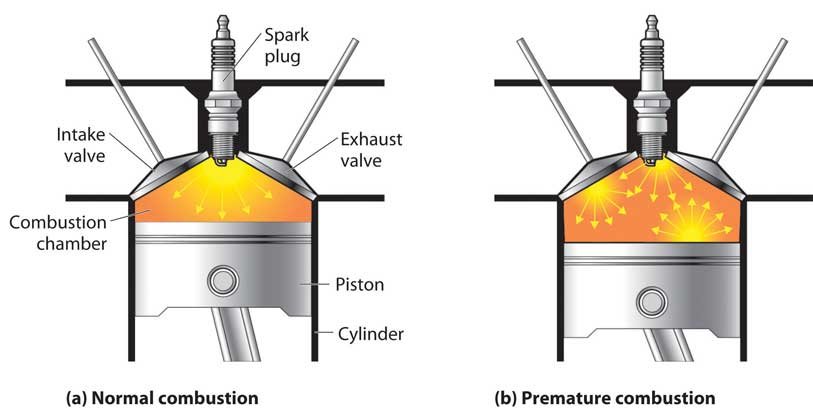
During the intake stroke, air and fuel enter the cylinder. The piston then compresses the mixture before the spark plug produces a spark at a precisely controlled point in the engine cycle.
The spark initiates combustion, creating a flame front that travels through the air-fuel mixture. As the flame spreads, the burning gases expand and increase the pressure inside the cylinder, pushing the piston downward during the power stroke.
Ignition timing is carefully calibrated to ensure that peak cylinder pressure occurs at an appropriate point after the piston reaches top dead center (TDC).
Contrary to what some people might assume, normal combustion is not an instantaneous explosion. Instead, the flame propagates through the mixture in a controlled manner, allowing the engine to convert the released energy into useful mechanical work.
Problems arise when part of the remaining unburned mixture ignites spontaneously under excessive pressure and temperature, or when a hot spot inside the combustion chamber ignites the mixture before the spark plug fires.
The first phenomenon is associated with detonation, while the second is known as pre-ignition. Both can interfere with normal engine operation and potentially cause severe damage.
1. WHAT IS ENGINE DETONATION?
Detonation, commonly referred to as engine knock, spark knock, or pinging, is a form of abnormal combustion in which part of the unburned air-fuel mixture ignites spontaneously after normal combustion has already begun.
To understand how this happens, imagine that the spark plug fires at the correct time. A flame front then begins spreading through the air-fuel mixture inside the cylinder.
As combustion progresses, the pressure and temperature of the remaining unburned mixture increase. This portion of the mixture is known as the end gas.
If the end gas becomes sufficiently hot and compressed, it can ignite spontaneously before the normal flame front reaches it.
This sudden release of energy generates pressure waves inside the cylinder, disturbing the normal combustion process and producing high-frequency vibrations that are often heard as a metallic knocking or pinging sound.
This phenomenon is known as detonation.
According to the U.S. Energy Information Administration (EIA), engine knock occurs when the temperature and pressure generated during combustion cause the remaining unburned fuel-air mixture to ignite spontaneously.
What Causes Engine Detonation?
Several factors can increase the likelihood of detonation in a gasoline engine.
1. Using gasoline with an insufficient octane rating
Octane rating measures a fuel’s resistance to knock under specified test conditions. Higher-octane gasoline generally offers greater resistance to spontaneous ignition under the conditions that cause detonation.
If an engine is designed to operate on fuel with a particular octane rating, using gasoline below the manufacturer’s recommended specification can increase the risk of knock, particularly under heavy acceleration or high engine loads.
However, using higher-octane fuel does not automatically produce more power in every engine. Any performance benefit depends on the engine’s design, calibration, and fuel requirements.
2. Excessive cylinder pressure and temperature
High compression ratios and substantial turbocharger boost can create conditions that make an engine more susceptible to detonation.
High intake-air temperatures, cooling-system problems, and operating conditions that increase cylinder pressure can further increase the risk.
This is one reason high-performance engines require careful control of combustion temperatures, ignition timing, and fuel quality.
3. Incorrect ignition timing
Ignition timing that is excessively advanced can increase cylinder pressure and temperature during combustion, potentially increasing the likelihood of detonation.
Modern engine management systems continuously adjust ignition timing according to operating conditions. When knock is detected, the engine control unit (ECU) can retard ignition timing to reduce the risk.
4. An excessively lean air-fuel mixture
Under certain operating conditions, an excessively lean mixture can increase combustion temperatures and contribute to abnormal combustion.
Potential causes include fuel-delivery problems, intake-air leaks, and incorrect engine calibration.
Carbon deposits inside the combustion chamber can also contribute to abnormal combustion under certain conditions, particularly when they create localized hot spots or alter the chamber’s effective volume.
These factors can interact with one another, which is why replacing the fuel alone may not solve the problem if an underlying mechanical or calibration issue remains.
What Damage Can Detonation Cause?
Mild knock may be detected and controlled by a modern engine management system. However, severe or persistent detonation can expose engine components to damaging pressure waves, heat, and mechanical stress.
Potential consequences include:
- Piston crown erosion or cracking.
- Damage to piston ring lands.
- Spark plug electrode damage.
- Head gasket failure.
- Damage to other internal engine components under extreme conditions.
In severe cases, prolonged detonation can result in catastrophic engine failure.
A metallic rattling or pinging sound that repeatedly occurs during acceleration or under heavy engine loads should therefore never be ignored, particularly if it becomes louder or more frequent.
2. WHAT IS PRE-IGNITION?
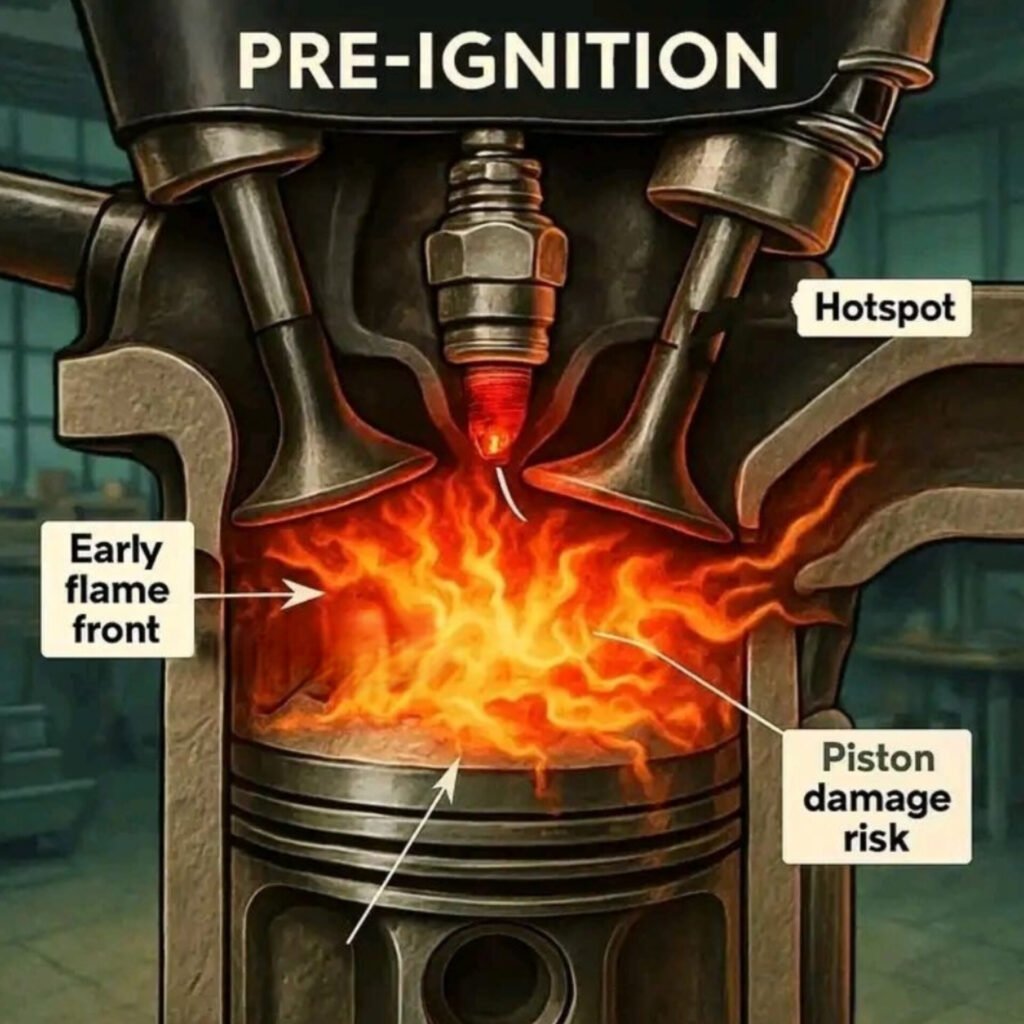
Pre-ignition occurs when the air-fuel mixture ignites before the spark plug produces its scheduled spark.
This is the fundamental difference between pre-ignition and detonation.
Unlike normal combustion, pre-ignition does not wait for the spark plug to initiate the flame. Instead, the mixture is ignited prematurely by an excessively hot surface or another ignition source inside the combustion chamber.
Potential sources include an overheated spark plug tip, glowing carbon deposits, an excessively hot exhaust valve, or another localized hot spot.
When combustion begins too early, cylinder pressure rises at an inappropriate point in the engine cycle. If this happens while the piston is still moving toward top dead center, the rising pressure can oppose the piston’s upward movement and place extreme stress on engine components.
The result can be a rapid increase in cylinder temperature and pressure, potentially causing severe damage.
NGK Spark Plugs identifies pre-ignition as a condition that can produce extremely high combustion temperatures and pressures, potentially resulting in melted or holed pistons and burned valves.
What Causes Pre-Ignition?
Pre-ignition is commonly associated with hot spots inside the combustion chamber, but several conditions can contribute to their formation.
1. Incorrect spark plugs
Spark plugs are designed with a specific heat range, which determines how efficiently heat is transferred from the firing end of the plug to the cylinder head.
A spark plug with an unsuitable heat range may retain excessive heat under certain operating conditions. In extreme cases, the overheated firing end can become a source of premature ignition.
Incorrect installation or an unsuitable spark plug design can also interfere with proper heat transfer.
For this reason, spark plugs should always match the engine manufacturer’s specifications. Choosing a hotter or colder plug without understanding the engine’s requirements can introduce additional problems.
2. Carbon deposits inside the combustion chamber
Carbon deposits can accumulate as a result of combustion and engine operating conditions.
Under certain circumstances, these deposits can become sufficiently hot to act as ignition sources, triggering combustion before the scheduled spark.
The actual risk depends on the deposits’ characteristics, combustion-chamber temperatures, and the engine’s design.
3. Excessive engine temperatures
Cooling-system malfunctions, overheated exhaust valves, and other conditions that create excessively hot areas inside the combustion chamber can increase the risk of pre-ignition.
A malfunctioning cooling system is therefore an important consideration when diagnosing abnormal combustion.
4. Oil droplets or other particles inside the combustion chamber
Under certain conditions, oil droplets and particles entering or forming inside the combustion chamber can contribute to premature ignition.
This is particularly relevant when discussing low-speed pre-ignition, a phenomenon associated with certain modern turbocharged gasoline direct-injection engines.
However, the presence of oil consumption alone does not prove that pre-ignition is occurring. Proper diagnosis is necessary to identify the actual cause.
Why Can Pre-Ignition Be More Dangerous Than Detonation?
One of the main reasons pre-ignition is particularly dangerous is that combustion begins before the intended ignition timing.
Under normal conditions, the engine’s ignition system controls when the spark occurs, allowing cylinder pressure to develop at the appropriate stage of the combustion cycle.
During pre-ignition, combustion begins independently of that scheduled spark.
As a result, cylinder pressure and temperature can rise dramatically while the piston is still moving upward toward top dead center.
This can place enormous loads on the piston, piston rings, connecting rod, and other engine components.
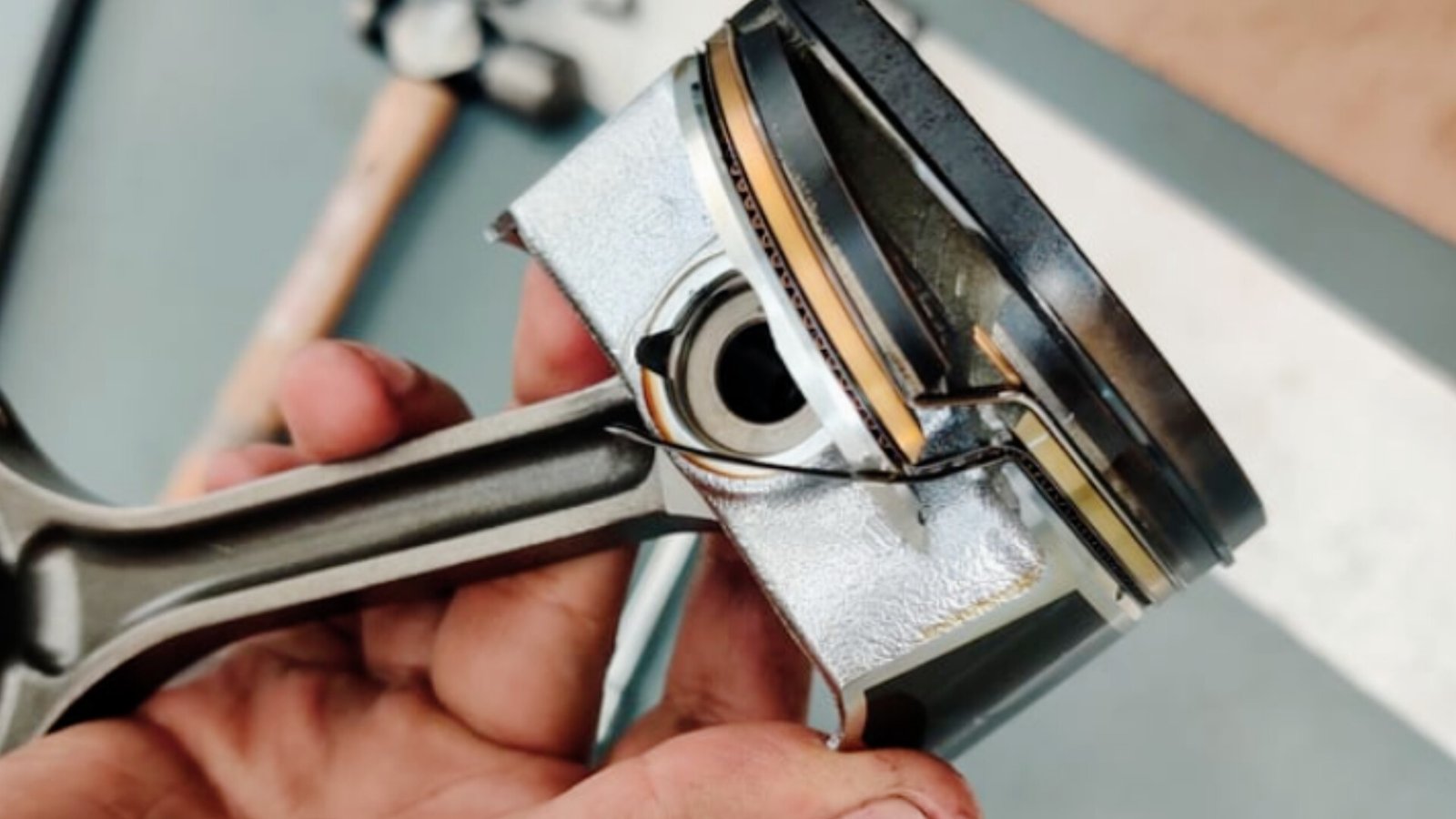
Possible damage includes melted or holed pistons, damaged piston rings, burned valves, and severe mechanical failure requiring extensive engine repairs.
Another concern is that pre-ignition does not always produce an obvious warning sound before damage occurs.
The absence of metallic knocking does not necessarily mean an engine is safe from pre-ignition.
3. WHAT ARE THE MAIN DIFFERENCES BETWEEN DETONATION AND PRE-IGNITION?
Although both are forms of abnormal combustion, their mechanisms and timing are different.
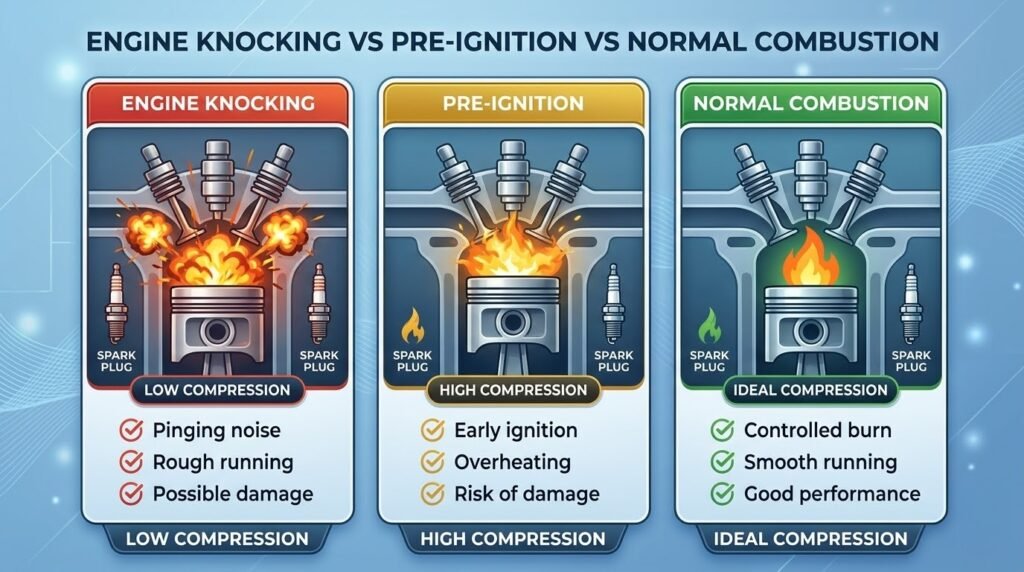
Detonation
- Occurs after the spark plug has initiated normal combustion.
- Develops when the remaining unburned mixture, or end gas, ignites spontaneously because of excessive pressure and temperature.
- Often produces a metallic knocking or pinging sound, particularly under heavy engine loads.
- Can be aggravated by insufficient fuel octane, excessive intake temperatures, high cylinder pressure, or excessively advanced ignition timing.
Pre-Ignition
- Occurs before the scheduled spark plug ignition.
- Begins when a hot spot or another ignition source ignites the air-fuel mixture prematurely.
- Can cause extreme cylinder pressure and temperature without producing an obvious knocking sound.
- May be associated with overheated spark plugs, carbon deposits, cooling-system problems, or other sources of abnormal heat.
It is important to understand that the two phenomena are not always mutually exclusive.
Severe detonation can increase thermal stress on combustion-chamber components, potentially contributing to conditions that promote pre-ignition. Conversely, pre-ignition can produce extreme cylinder pressures and may be followed by severe knock.
In other words, detonation involves the spontaneous ignition of the remaining unburned mixture after normal combustion has begun, whereas pre-ignition occurs when combustion starts before the scheduled spark.
4. WHAT IS LOW-SPEED PRE-IGNITION (LSPI)?

Modern gasoline engines face another combustion-related challenge known as low-speed pre-ignition, or LSPI.
LSPI is a form of pre-ignition that has attracted particular attention in certain turbocharged gasoline direct-injection (TGDI or GDI) engines.
These engines often combine relatively small displacement with turbocharging to deliver improved fuel efficiency while maintaining strong power output.
However, this combination can create operating conditions that increase the risk of premature ignition.
LSPI is particularly associated with low engine speeds and high loads. For example, it can occur when a driver demands substantial acceleration while the engine is operating at relatively low RPM.
Under these conditions, an uncontrolled early ignition event can generate an exceptionally large increase in cylinder pressure.
In severe cases, LSPI can develop into super-knock, potentially causing catastrophic damage to pistons, piston rings, and connecting rods.
Research published through SAE International has examined LSPI in turbocharged gasoline direct-injection engines and the potential for severe engine damage caused by the resulting pressure spikes.
How Is LSPI Related to Engine Oil?
Engine oil does more than lubricate moving components and reduce friction. Its formulation can also influence the tendency of certain engines to experience LSPI.
Oil droplets and particles entering the combustion chamber may contribute to premature ignition under specific conditions.
Consequently, lubricant development and testing increasingly consider the relationship between oil formulation and LSPI protection.
ASTM D8291, for example, is a standardized test method used to evaluate an engine oil’s ability to mitigate LSPI under specified operating conditions in turbocharged gasoline direct-injection engines.
This does not mean that a particular oil viscosity automatically causes or prevents LSPI. The risk depends on several factors, including the lubricant’s formulation, engine design, and operating conditions.
For vehicle owners, the most appropriate approach is to use engine oil that meets the manufacturer’s recommended viscosity and performance specifications, including any specific LSPI-related requirements.
5. CAN A KNOCK SENSOR PREVENT DETONATION AND PRE-IGNITION?
Many modern vehicles are equipped with a knock sensor, which detects vibrations associated with engine detonation.
The sensor sends information to the engine control unit, allowing the ECU to identify knock and adjust ignition timing when necessary.
For example, the ECU may retard ignition timing to reduce the likelihood of further detonation. Depending on the engine’s control strategy, it may also adjust other operating parameters to help protect the engine.
These systems allow modern engines to adapt to changing operating conditions and reduce the risk of damage caused by abnormal combustion. However, retarding ignition timing can also reduce performance and efficiency under certain circumstances.
Bosch identifies knock sensors as an important component of modern engine management systems, helping the ECU detect knock and optimize ignition timing.
However, a knock sensor is not a universal solution for every form of abnormal combustion.
Detonation and pre-ignition have different mechanisms. Although modern engine management systems can reduce the risk through ignition control, fuel injection, and other strategies, a hot spot that initiates pre-ignition may not be prevented simply by adjusting ignition timing.
The presence of a knock sensor should therefore never be treated as a substitute for using the correct fuel, maintaining the engine properly, and investigating abnormal symptoms.
6. HOW CAN YOU PREVENT DETONATION AND PRE-IGNITION?
There is no single measure that eliminates every form of abnormal combustion in every engine. Prevention depends on the engine’s design, the underlying cause, and the manufacturer’s recommendations.
Use the Correct Octane Fuel
Always use gasoline with the octane rating recommended by the vehicle manufacturer.
Engines differ in their compression ratios, combustion-chamber designs, and operating requirements. Using fuel with the appropriate octane rating helps reduce the risk of detonation.
However, higher-octane fuel does not automatically produce more power in an engine that does not require it, nor does it eliminate every possible cause of pre-ignition.
Avoid Heavy Acceleration at Very Low RPM
In vehicles with manual transmissions, avoid demanding strong acceleration while the engine is operating at very low RPM in a high gear.
If the engine struggles under load, downshift to bring the engine into a more suitable operating range.
Drivers of automatic vehicles should likewise avoid repeatedly demanding substantial power when the engine is clearly struggling to respond normally.
This is particularly relevant to certain turbocharged engines susceptible to LSPI under low-speed, high-load conditions.
Maintain the Cooling System
Ensure that the cooling system operates correctly.
Check the coolant level, radiator, cooling fans, thermostat, and other relevant components according to the vehicle manufacturer’s maintenance recommendations.
Excessive engine temperatures can increase the likelihood of abnormal combustion and contribute to the formation of hot spots.
Use the Correct Spark Plugs
Install spark plugs that match the manufacturer’s specifications, including the correct heat range and design.
Avoid switching to a different spark plug type without understanding its suitability for the engine.
Incorrect plugs may interfere with combustion performance and, under certain conditions, contribute to overheating or premature ignition.
Use Engine Oil That Meets the Required Specifications
For turbocharged gasoline direct-injection engines that require LSPI protection, ensure that the selected oil meets the manufacturer’s specifications.
Do not choose engine oil based solely on its brand or viscosity grade. The required performance standard and the engine manufacturer’s approval are also important.
Investigate Abnormal Engine Noises
If a metallic knocking sound repeatedly occurs during acceleration, reduce engine load and avoid continuing to drive aggressively until the problem has been investigated.
If the noise persists, the engine loses power, or unusual vibration develops, have the vehicle inspected by a qualified technician.
If the engine produces severe knocking or shows signs of serious mechanical distress, stop the engine in a safe location and consider arranging a tow rather than continuing to drive.
The underlying cause should be identified before the vehicle is subjected to heavy loads again. Simply changing the fuel or replacing the spark plugs may not resolve the problem if the actual cause lies elsewhere.
BOTH CAN DESTROY AN ENGINE, BUT THEY ARE NOT THE SAME
Detonation and pre-ignition are both forms of abnormal combustion in gasoline engines, but they occur through different mechanisms.
Detonation occurs when the remaining unburned air-fuel mixture ignites spontaneously after normal combustion has begun. Pre-ignition occurs when the mixture ignites before the spark plug produces its scheduled spark.
Detonation often produces a recognizable metallic knocking or pinging sound under heavy engine loads. Pre-ignition, meanwhile, can generate extreme cylinder temperatures and pressures without providing an obvious audible warning.
Both phenomena can damage pistons, piston rings, spark plugs, valves, and other engine components. Under certain circumstances, they can also occur in combination, increasing the risk of catastrophic engine failure.
For this reason, proper maintenance, the correct fuel octane rating, suitable spark plugs, appropriate engine oil, and prompt attention to abnormal engine behavior are essential for protecting a gasoline engine.
Ultimately, understanding the difference between detonation and pre-ignition is more than a matter of automotive terminology. It helps drivers recognize distinct combustion problems, understand their potential consequences, and take the appropriate steps to prevent expensive engine damage.

Adhe is part of the 88 Eight Box Editorial Team, covering JDM culture, motorsport, automotive technology, and industry news. The team focuses on delivering original automotive stories, reviews, and insights for enthusiasts worldwide.