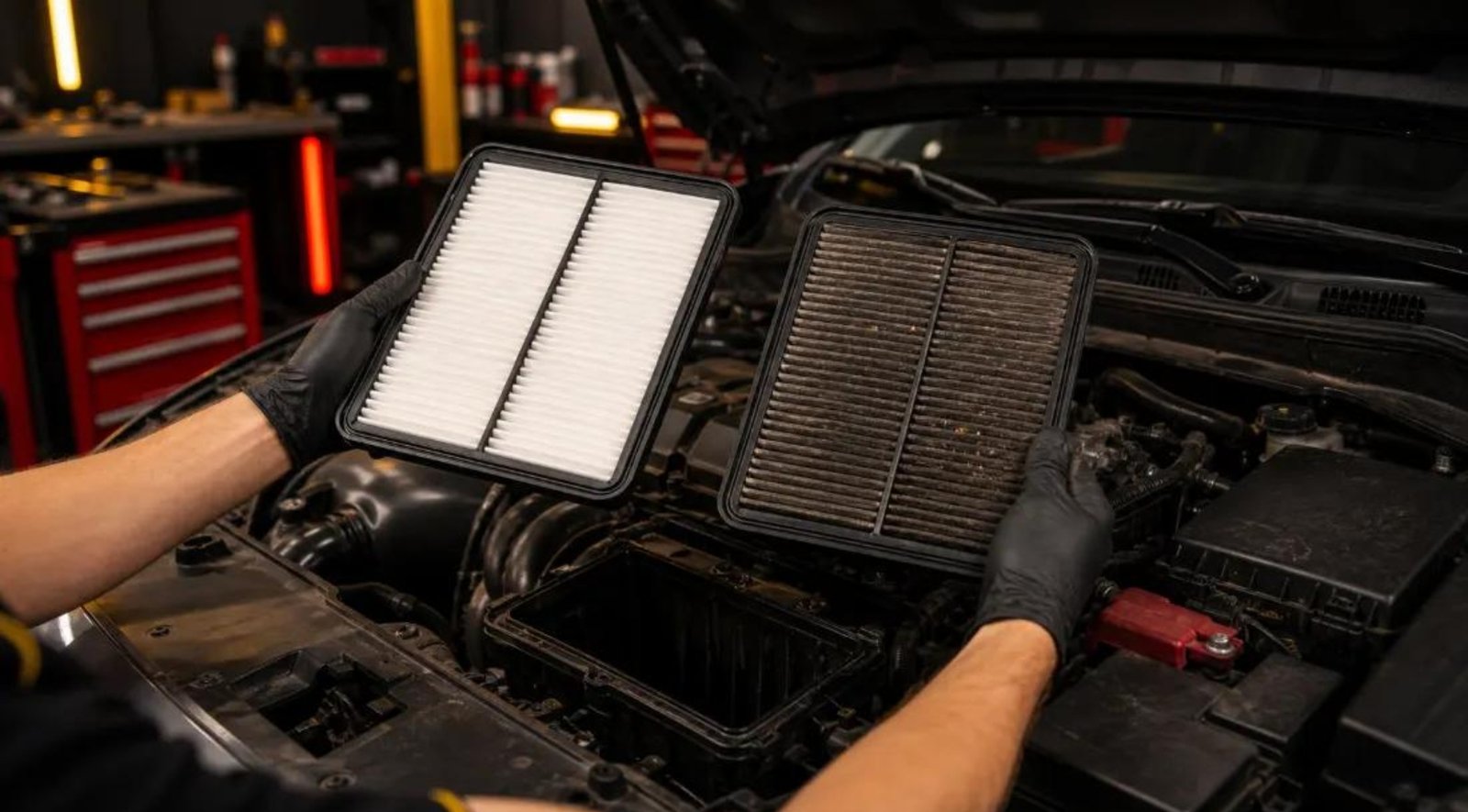
A dirty air filter is one of the most common maintenance issues car owners encounter. When it becomes clogged with dust, dirt, and debris, the obvious solution seems simple: remove it, clean it, and put it back. After all, why spend money on a replacement when the old filter might still have some life left in it?
However, the answer is not quite that straightforward. While certain automotive air filters are designed to be cleaned and reused, many standard filters are intended to be replaced once they become dirty enough to require servicing. Cleaning the wrong type can compromise its ability to protect the engine, potentially creating problems far more expensive than the cost of a new filter.
So, can you really clean a car’s air filter, or is replacement always the better option? The answer depends primarily on the filter’s design, the materials used in its construction, and the manufacturer’s maintenance recommendations.
WHY YOUR CAR NEEDS AN AIR FILTER
Before deciding whether an air filter should be cleaned or replaced, it helps to understand what it actually does.
Most internal-combustion engines need a continuous supply of air to burn fuel efficiently. However, the air entering the engine also contains unwanted particles, including dust, sand, pollen, and other debris. Without proper filtration, these contaminants can enter the engine and contribute to wear on internal components.
The engine air filter prevents most of these particles from passing through the intake system. It is typically housed inside a plastic airbox located in the engine compartment, although its exact position varies between vehicles.
Modern cars commonly use pleated filter elements made from cellulose-based paper or synthetic nonwoven materials. Their folded construction provides a large filtration surface within a relatively compact space, allowing the filter to capture contaminants while maintaining adequate airflow.
Over time, however, particles accumulate within the filter media. As contamination increases, airflow resistance can also increase, particularly when the filter becomes heavily clogged.
This is why air filters are an important part of routine vehicle maintenance. A filter that is too restrictive can limit the amount of air entering the engine, potentially reducing its available power under demanding conditions. A damaged filter, meanwhile, may allow contaminants to bypass the filtration media entirely.
According to automotive maintenance guidance from the American Automobile Association (AAA), replacing a conventional engine air filter is generally the appropriate approach because attempts to clean standard disposable filters can damage their structure and compromise their ability to protect the engine.
CAN YOU CLEAN A STANDARD PAPER AIR FILTER?
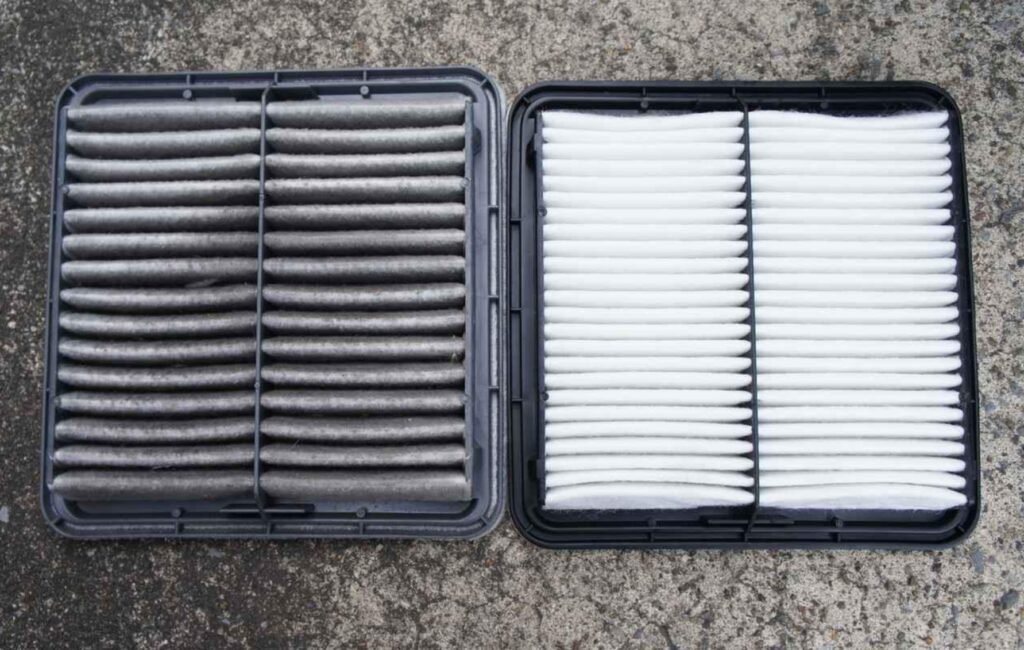
For most factory-installed, disposable engine air filters, replacement is preferable to cleaning.
These filters are designed to be used for a specified service interval before being discarded and replaced with a new element. Although removing visible dirt might make an old filter look cleaner, that does not necessarily mean it has returned to its original condition.
The problem lies in the filtration media itself.
Dust and other particles become trapped throughout the filter’s structure, not just on the surface. Attempting to remove them using unsuitable cleaning methods can disturb or damage the material responsible for capturing contaminants.
Compressed air, for example, is sometimes used to blow dust out of an air filter. However, directing a powerful stream of air at a disposable paper filter can damage its delicate media or compromise its filtration performance.
Likewise, washing a conventional paper filter with water is generally inappropriate unless the manufacturer specifically permits that procedure. Water can damage the media, adhesives, or other components, depending on the filter’s construction.
Hitting the filter against a hard surface to dislodge dirt is also not a reliable solution. It may remove loose debris, but it cannot guarantee that the filter remains capable of providing its intended level of filtration.
In other words, a filter that looks clean is not necessarily a filter that works properly.
Technical research published through SAE International has examined cleaning procedures for original-equipment engine air filters and explains why conventional disposable filter elements are generally not intended to be cleaned and reused.
For that reason, if your vehicle uses a conventional disposable air filter that has reached its replacement interval or become excessively dirty, installing a new element is generally the safer choice.
SOME AIR FILTERS ARE DESIGNED TO BE CLEANED
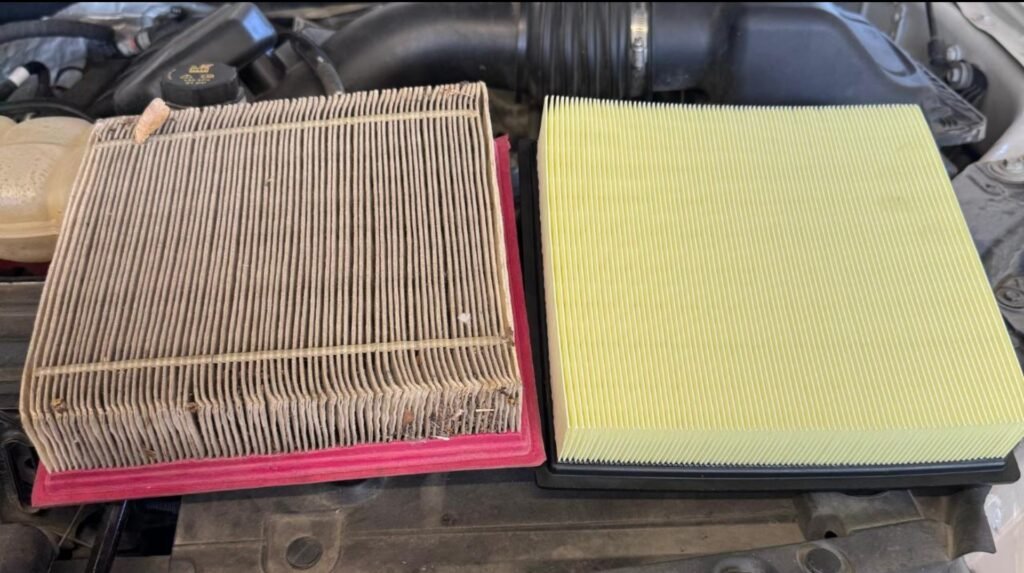
There is an important exception: reusable performance air filters.
These are commonly found in aftermarket cold-air intake systems and other modified intake setups. Unlike conventional disposable filters, some reusable designs are manufactured using materials that allow them to be cleaned and returned to service.
Oiled cotton-gauze filters are one example. Certain synthetic filters are also designed to be washable and reusable.
Manufacturers such as K&N provide dedicated cleaning products and maintenance procedures for these filters. Depending on the model, servicing may involve removing loose debris, applying an approved cleaning solution, rinsing the filter, allowing it to dry, and applying the specified filter oil where required.
However, the process varies depending on the filter’s construction. Some reusable filters require oil after cleaning, while others are designed to operate without it.
Using the wrong cleaning product, applying excessive force, or reinstalling a filter before it has dried sufficiently can undermine the maintenance process.
It is also important to understand that not every aftermarket filter is washable. Some are designed to be replaced just like factory-installed filters.
The distinction is straightforward: a reusable filter should be cleaned according to its manufacturer’s instructions, while a disposable filter should generally be replaced rather than washed or repeatedly blown clean.
Before attempting to service an aftermarket filter, check its model number and consult the manufacturer’s official maintenance guide.
DOES A DIRTY AIR FILTER AFFECT FUEL ECONOMY?
One of the most persistent beliefs surrounding air filter maintenance is that a dirty filter automatically causes a significant increase in fuel consumption.
The reality is more complicated.
A severely restricted filter can reduce the maximum airflow available to an engine, potentially limiting power during acceleration or other demanding driving conditions. Replacing it can therefore help restore performance when airflow restriction is the problem.
However, the relationship between air filter condition and fuel economy is different in modern vehicles.
Research summarized by the U.S. Department of Energy found that clogged engine air filters did not measurably reduce fuel economy in the modern gasoline and diesel vehicles examined. The tests did, however, identify reduced full-power acceleration when the filters were restricted.
This helps explain why replacing a dirty air filter does not always produce an obvious improvement in fuel consumption.
Modern engine management systems can adjust fuel delivery according to operating conditions, so a restricted filter does not necessarily cause the same fuel-economy problems associated with older carbureted engines.
That does not make air filter maintenance unimportant. A heavily clogged or damaged filter still requires attention, and maintaining proper filtration helps protect the engine from contamination.
However, replacing a filter solely because you expect an immediate improvement in fuel economy may lead to disappointment if the existing filter is not significantly restricting airflow.
The objective should be to maintain the manufacturer’s recommended filtration performance, rather than treating every filter replacement as a guaranteed fuel-saving measure.
HOW OFTEN SHOULD YOU REPLACE YOUR CAR’S AIR FILTER?
There is no single replacement interval that applies to every car.
The recommended service schedule depends on the vehicle, its engine, the type of filter installed, and the conditions in which it is driven.
Some manufacturers specify replacement by mileage, while others incorporate the filter into a broader maintenance schedule. Certain vehicles also require more frequent attention when operated in particularly dusty environments.
For example, Honda’s maintenance information for the 2027 HR-V identifies the engine air cleaner element as part of its scheduled maintenance system. It also highlights dusty driving conditions as a reason to replace the element more frequently, illustrating why environmental conditions matter when determining service intervals.
Cars regularly driven on unpaved roads, around construction sites, through dusty rural areas, or in environments with substantial airborne debris may accumulate contaminants more quickly than vehicles primarily used on clean, paved roads.
In these situations, inspecting the filter more frequently is sensible, even if the normal replacement interval has not yet been reached.
A practical approach is to inspect the filter at the intervals recommended in the owner’s manual and ask a mechanic to check its condition during routine servicing.
During inspection, look for excessive debris, damaged pleats, tears, deformation, or problems with the rubber sealing surface. Any damage that could allow unfiltered air to enter the engine is a reason to replace the filter.
Do not rely exclusively on colour, however. A filter can darken during normal use, and appearance alone does not always establish whether it has reached the end of its useful life.
The correct maintenance interval and any applicable inspection procedure should take priority over a universal mileage recommendation.
WHAT ABOUT THE CABIN AIR FILTER?
There is another important distinction worth understanding: the engine air filter and the cabin air filter perform completely different jobs.
The engine air filter cleans the air entering the engine. The cabin air filter, meanwhile, cleans incoming air for the vehicle’s ventilation and air-conditioning system.
Depending on its design, the cabin filter can capture particles such as dust, pollen, and soot. Some versions also incorporate activated carbon to help reduce certain unwanted odours.
When a cabin filter becomes clogged, airflow from the air-conditioning vents may decrease. A neglected filter can also contribute to unpleasant smells or reduced cabin filtration performance.
Like engine filters, most conventional cabin filters are designed to be replaced rather than washed and reused. Specially designed washable cabin filters are available, but they must be maintained according to their manufacturers’ instructions.
The replacement interval depends on the vehicle manufacturer’s recommendations and the environment in which the car operates. Dusty roads and poor air quality can shorten the time between replacements.
It is important not to confuse the two systems. Cleaning or replacing a cabin air filter will not resolve an engine air filter problem, and replacing the engine air filter will not restore the cabin filter’s ability to clean the air entering the passenger compartment.
Both deserve attention during routine maintenance.
IS REPLACING AN AIR FILTER BETTER VALUE THAN CLEANING IT?
For a conventional disposable filter, replacing the element is usually the most sensible option once servicing is required.
A new filter restores the vehicle’s filtration system with an element intended for that application, provided the replacement is the correct specification and is installed properly.
By comparison, attempting to extend the life of a disposable filter through repeated cleaning can create uncertainty about its remaining filtration ability.
The calculation is different for a reusable performance filter. Its initial purchase price may be higher, but proper cleaning and reuse can make it a practical long-term option for some drivers.
Even then, reusable filters are not automatically the best choice for every vehicle. Owners should consider the filter’s compatibility, maintenance requirements, filtration characteristics, and the vehicle manufacturer’s recommendations.
For most everyday drivers, there is little reason to complicate the process. A conventional filter should be inspected and replaced when required, while a reusable filter should be cleaned only when its manufacturer says it is ready for servicing.
Most importantly, the filter must be installed correctly, with its sealing surface properly seated. A poorly fitted filter can allow unfiltered air to bypass the element, undermining the protection it is supposed to provide.
CLEAN IT OR REPLACE IT?
The answer depends on what is fitted to your car.
If your car uses a standard disposable paper or synthetic engine air filter, replacement is generally the right answer. Cleaning it with water, aggressively tapping it, or blasting it with compressed air can damage the filtration media and compromise its ability to protect the engine.
If your car uses a reusable filter specifically designed for cleaning, reuse is possible. Follow the filter manufacturer’s instructions and use the correct cleaning products and servicing procedure.
The same principle applies to the cabin air filter: replace conventional disposable elements according to the maintenance schedule, and clean only those specifically designed to be reused.
Ultimately, an air filter should not be judged simply by how clean it looks. Its real purpose is to capture contaminants while allowing the appropriate airflow, and that performance cannot always be restored by removing visible dust.
From an enthusiast’s perspective, spending money on a new filter might seem unnecessary when the old one appears salvageable. But routine maintenance is about more than appearances. A relatively inexpensive replacement is often a better investment than taking an unnecessary risk with a component responsible for keeping contaminants out of the engine.
What do you think? Do you replace your air filter as recommended, or have you successfully cleaned and reused one? Share your experience in the comments.

Adhe is part of the 88 Eight Box Editorial Team, covering JDM culture, motorsport, automotive technology, and industry news. The team focuses on delivering original automotive stories, reviews, and insights for enthusiasts worldwide.