
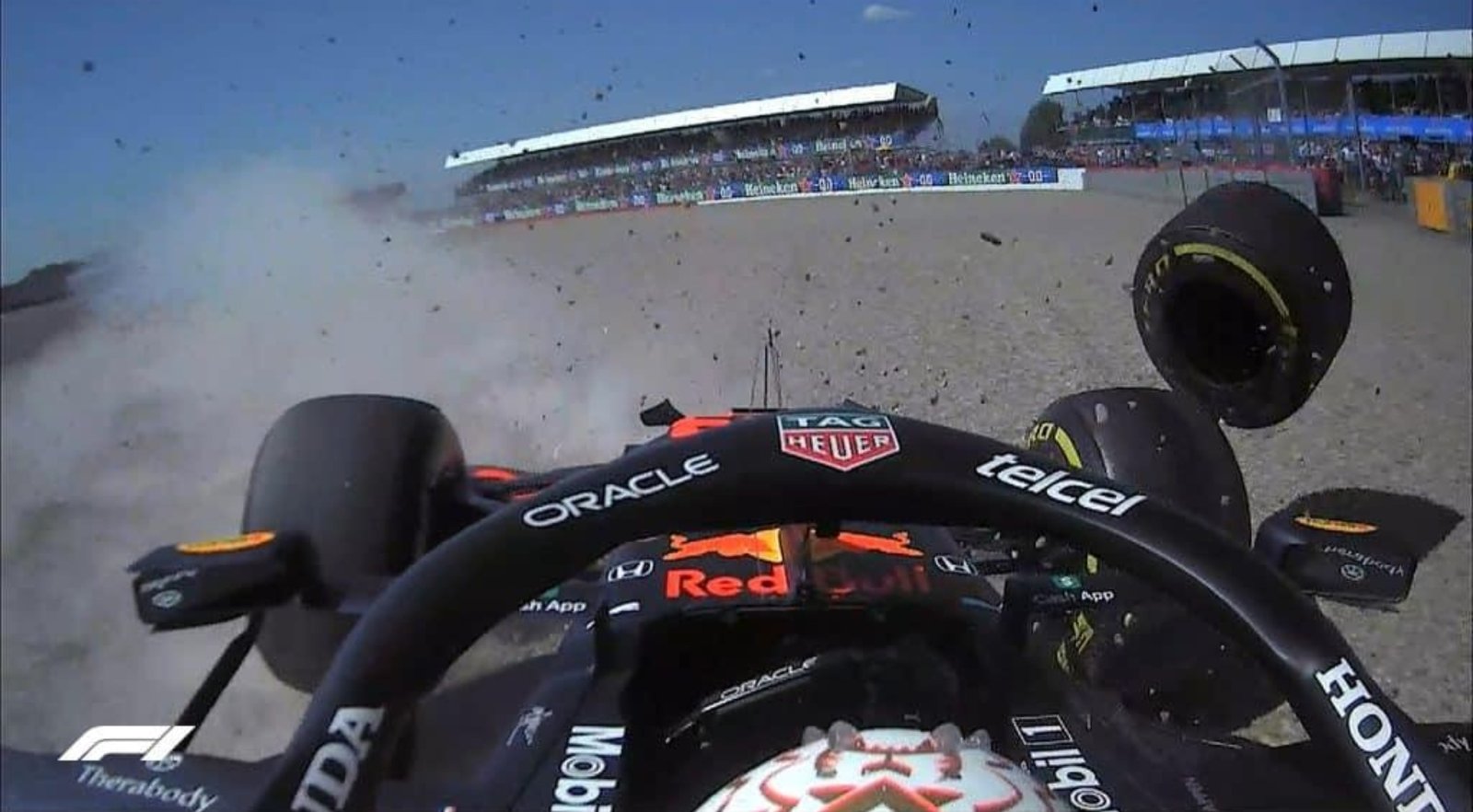
Max Verstappen once experienced a crash of around 51 G at Silverstone during the 2021 British Grand Prix. It was an extremely violent impact. Imagine the human body receiving a force roughly 51 times stronger than Earth’s gravity in just a fraction of a second. The crash sent his Red Bull heavily into the barriers and became one of the most talked-about high G-force accidents in modern Formula 1 history.
However, 51 G is not actually the highest force ever recorded in Formula 1. Some drivers have experienced much more extreme impacts, reaching around 75 G and even more than 250 G. But before discussing those incidents, we need to understand one important thing first: what exactly is G-force in Formula 1?
Simply put, G-force is a measurement of acceleration experienced by the human body compared to the normal gravitational force of Earth. When a person stands still, their body experiences 1 G, which is the standard gravitational force we feel every day.
In a normal road car, sudden braking or aggressive cornering usually produces around 0.8 to 1 G. Even extreme roller coasters generally reach only around 3 to 4 G for short periods.
Formula 1, however, operates on a completely different level.
Under certain conditions, F1 drivers can experience around 5 to 6 G while braking heavily or attacking high-speed corners. This means every part of their body feels five to six times heavier than normal.
So the question is: How can a Formula 1 car generate such extreme forces?
The answer lies in a combination of advanced technologies that almost no ordinary vehicle possesses.
1. Slick Tires
Unlike road car tires that have grooves to disperse water, Formula 1 slick tires have a completely smooth surface. This allows the rubber to create a much larger contact patch with the asphalt.
On a dry track, slick tires provide an extraordinary amount of grip, allowing the car to accelerate, brake, and corner at speeds impossible for normal vehicles.
2. Advanced Aerodynamics
The front wing, rear wing, diffuser, and especially the floor of an F1 car are designed to generate downforce.
Downforce is a force that pushes the car toward the track surface, making it feel as if it is attached to the asphalt. The faster the car travels, the more downforce it produces.
At high speeds, the amount of downforce generated can even exceed the weight of the car itself. This is why Formula 1 cars can take corners at speeds that would be impossible for regular road cars.
3. Carbon Brakes
Formula 1 braking systems are among the most advanced in motorsport.
When a driver presses the brake pedal, an F1 car can slow down from over 300 km/h to around 80 km/h in just a few seconds.
This extreme deceleration creates enormous braking forces, producing some of the highest G-forces experienced during a race.
The combination of slick tires, aerodynamic downforce, carbon brakes, and an extremely lightweight carbon-fiber chassis makes Formula 1 one of the most extreme racing machines on Earth when it comes to braking and cornering ability.
Types of G-Force Experienced in Formula 1
Not all G-forces act in the same direction. In Formula 1, drivers experience three main types of forces:
Longitudinal G-Force
This occurs during acceleration and braking.
When a driver exits a corner and accelerates aggressively, their body is pushed backward into the seat. However, the biggest force usually comes during braking.
At circuits like Monza, drivers brake from speeds above 330 km/h before entering the first chicane. During this moment, their bodies can experience around 5 G of deceleration.
Lateral G-Force
This is the type of G-force most associated with Formula 1.
Lateral G occurs when the car takes high-speed corners. The force pushes the driver’s body sideways, forcing their neck and shoulders to work extremely hard to keep their head facing forward.
At corners such as Copse at Silverstone, 130R at Suzuka, or the Maggotts-Becketts sequence, drivers can experience around 5 to 6 G of lateral force.
This is why Formula 1 drivers have noticeably stronger neck muscles compared to ordinary athletes. They must control the weight of their head and helmet while experiencing forces several times greater than normal throughout a race.
Vertical G-Force
Vertical G occurs when the car hits kerbs, climbs steep sections, drops downhill, or passes through elevation changes on a circuit.
Although it is usually not as intense as lateral or longitudinal forces, it still creates additional stress on the spine and entire body.
Tracks such as Spa-Francorchamps and Circuit of the Americas contain significant elevation changes, meaning drivers constantly experience vertical loads throughout a race.
The Physical Challenge of Being a Formula 1 Driver
Many people think Formula 1 is only about driving skill. In reality, it is one of the most physically demanding sports in the world.
The part of the body that suffers the most is the neck.
A modern Formula 1 helmet weighs around 1.5 kg. Combined with the weight of the driver’s head, the total load is around 7 kg.
When the car experiences 5 G, the neck must effectively support more than 30 kg of force while the driver is cornering at high speed.
That is why F1 drivers spend countless hours training their neck muscles using weights, resistance bands, and specialized equipment designed to simulate racing conditions.
The right leg also works incredibly hard.
An F1 brake pedal is completely different from a normal road car. To achieve maximum braking performance, drivers must apply around 150 to 180 kg of pressure on the pedal.
Every time they enter a corner, their legs are essentially performing a heavy strength workout.
The heart is also pushed to its limit.
During a race, a driver’s heart rate usually stays between 170 and 190 beats per minute.
At the same time, they must remain mentally focused, communicate with engineers, manage tire strategy, monitor the car’s condition, and search for overtaking opportunities.
On top of that, cockpit temperatures can exceed 50°C. During a single race, drivers can lose around 2 to 4 kg of body weight through sweat.
All of these physical challenges happen while controlling a machine at extreme speeds with precision measured in centimeters.
The Highest G-Forces Ever Recorded in Formula 1
During normal racing conditions, drivers usually experience around 5 to 6 G. But during a crash, those numbers can increase dramatically.
One of the most famous examples happened to Robert Kubica at the 2007 Canadian Grand Prix.
After losing control, Kubica’s BMW Sauber slammed into the barriers with enormous force. Sensors recorded an impact of approximately 75 G, an incredible figure.
Many people feared his career was over, but thanks to the strength of the carbon-fiber monocoque chassis, modern safety systems, and the quick response of the medical team, Kubica survived.
Remarkably, he returned to Formula 1 and even achieved his first Grand Prix victory the following season.
Another famous example was Max Verstappen’s crash at the 2021 British Grand Prix in Silverstone.
After contact with Lewis Hamilton, Verstappen’s Red Bull hit the barriers with an impact of around 51 G.
There was also the dramatic crash involving Romain Grosjean at the 2020 Bahrain Grand Prix.
His Haas struck the barrier, split apart, and immediately caught fire. The impact was measured at approximately 53 G.
However, the highest recorded G-force in Formula 1 history came from the tragic accident involving Jules Bianchi at the 2014 Japanese Grand Prix at Suzuka.
The impact was estimated at around 254 G, making it the largest recorded G-force figure in Formula 1 history.
These numbers may only last for a fraction of a second, but they show how dangerous racing can be without modern safety technology protecting the drivers.
Why Don’t Formula 1 Drivers Pass Out Under Extreme G-Forces?
The answer is extraordinary physical preparation.
F1 drivers perform intense cardiovascular training almost every day to maintain endurance. Their neck muscles are specifically trained to handle massive lateral forces, while their core, shoulders, back, and legs are strengthened because every part of their body works during a race.
They also spend countless hours in simulators and train in hot environments to prepare their bodies for the extreme temperatures inside the cockpit.
Formula 1 is not just about driving the fastest cars in the world.
It is a perfect combination of cutting-edge technology, engineering excellence, and human physical ability pushed to the absolute limit.
And after understanding the incredible forces these drivers experience, one question remains:
How can anyone still say that Formula 1 is not a sport?

Adhe is part of the 88 Eight Box Editorial Team, covering JDM culture, motorsport, automotive technology, and industry news. The team focuses on delivering original automotive stories, reviews, and insights for enthusiasts worldwide.