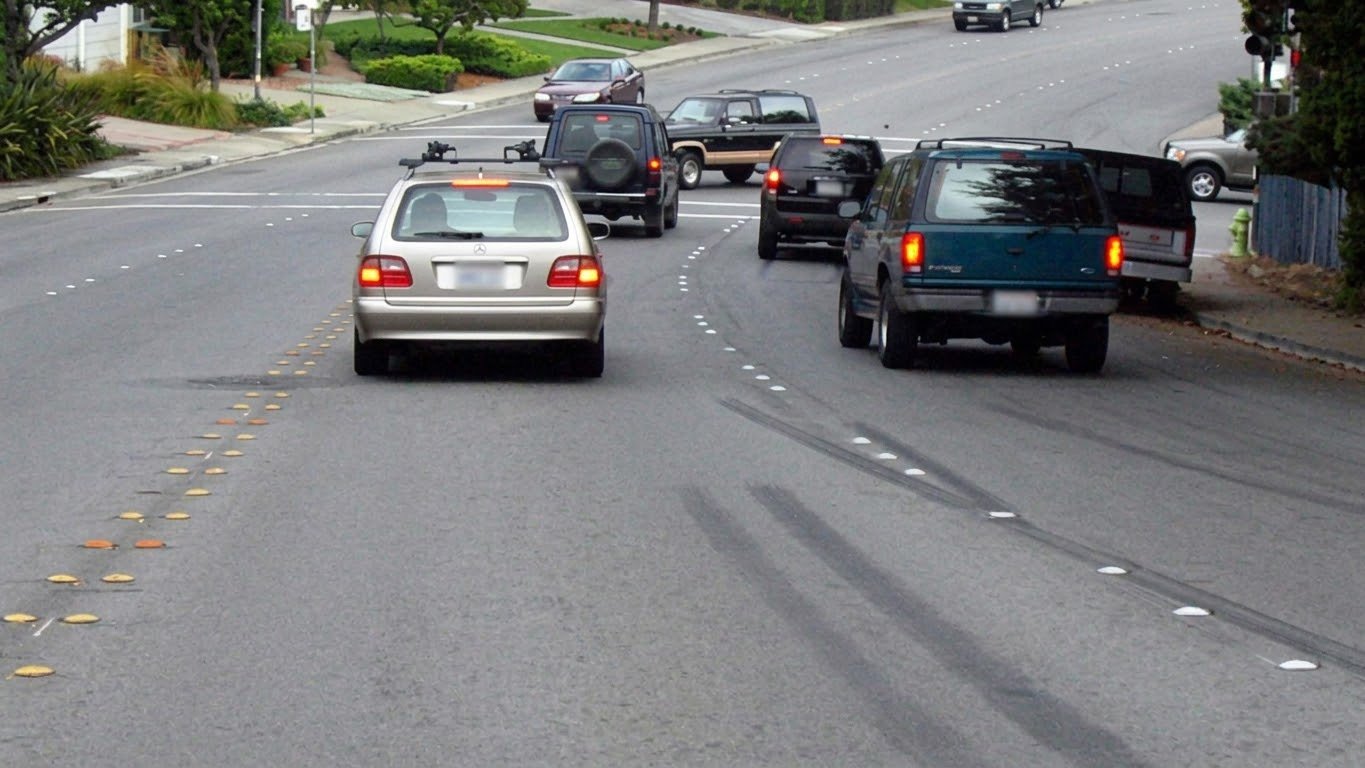
If you’ve ever driven through Las Vegas, you may have noticed something unusual about the road markings. On some roads, lane boundaries aren’t defined solely by the familiar painted lines. Instead, drivers encounter rows of small raised dots running along the pavement.
At first glance, it can look like Las Vegas has simply decided to replace traditional lane stripes with a series of bumps.
The reality is much more interesting.
Those small raised markers are commonly known as Botts’ Dots, or more formally, raised pavement markers. They are designed to improve lane visibility while also giving drivers a physical and audible warning when their vehicle begins to cross a lane boundary.
And there is a good reason they make particular sense in the Nevada desert.
IT STARTED WITH A PROBLEM IN CALIFORNIA

Despite their strong association with the American Southwest, Botts’ Dots were not invented in Las Vegas.
The technology dates back to California in the 1950s, when highway engineers were looking for a better way to make lane markings more visible and durable as freeway traffic increased.
California engineer and chemist Elbert D. Botts became closely associated with the development and testing of raised pavement markers. The idea was relatively simple: instead of relying entirely on paint, engineers could place physical markers directly onto the road surface.
The markers could then remain visible even when conventional paint began to wear.
Over time, the technology became widely used on highways in California and eventually spread to other parts of the United States.
THE DOTS DO MORE THAN MARK THE LANE
One of the cleverest features of raised pavement markers is that they don’t just provide a visual reference.
They can also be felt and heard.
If a vehicle begins drifting over a row of raised markers, the tires produce a noticeable vibration and rumbling sound. That can alert the driver that the vehicle is moving outside its intended lane.
In effect, the road provides its own warning system.
This can be particularly useful when a driver is distracted, tired or simply fails to notice the visual lane marking.
The tactile feedback is similar in principle to the warning produced by rumble strips, although raised pavement markers are primarily intended to delineate the roadway rather than serve as full-size rumble strips.
WHY DO THEY WORK SO WELL IN LAS VEGAS?
Climate is one of the biggest reasons.
Raised pavement markers have a major weakness: snowplows don’t like them.
A plow blade passing over a road can strike raised markers and potentially tear them out of the pavement. For that reason, their use is far more practical in areas that don’t regularly require snow removal.
Las Vegas has an obvious advantage here.
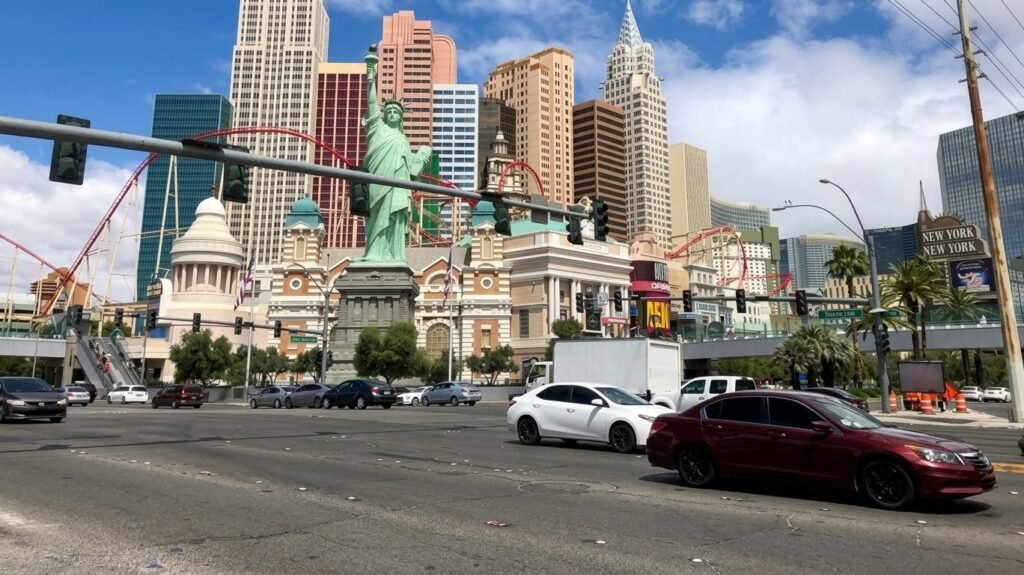
The city sits in the Mojave Desert and normally experiences little to no snow compared with northern U.S. cities. That means road agencies can use raised pavement markers without having to worry about routine snowplow operations destroying them.
Nevada’s roadway standards recognize raised pavement markings as part of the state’s broader pavement-marking system, while roadway markings are governed by standards established through the Manual on Uniform Traffic Control Devices (MUTCD).
So while Las Vegas didn’t invent the technology, its climate makes it a particularly suitable environment for it.
THEY DON’T ACTUALLY REPLACE EVERY PAINTED LINE
There is an important misconception surrounding the dots.
Las Vegas isn’t simply replacing every painted lane line with rows of bumps.
Different pavement markings have different meanings under the MUTCD, including solid lines, broken lines and dotted lines. A painted dotted lane line can indicate a specific traffic condition or transition, while raised pavement markers are physical devices used to supplement or provide lane delineation.
In many locations, raised markers can work alongside conventional pavement markings rather than completely replacing them.
The exact combination depends on the roadway, traffic conditions and applicable engineering standards.
That’s why you shouldn’t assume that every row of dots has exactly the same meaning as a painted dashed line.
WHY NOT JUST USE MODERN ROAD PAINT?
Modern pavement-marking materials have improved considerably since the early days of Botts’ Dots.
High-quality paints, thermoplastic markings and other advanced systems can provide excellent visibility and durability. They can also be easier to maintain on roads where raised markers would be impractical.
There is another consideration today: vehicle technology.
Modern cars increasingly rely on cameras and other sensors to detect lane markings. Advanced driver-assistance systems such as lane-keeping assistance depend heavily on clearly detectable road markings.
As these technologies become more common, road agencies are increasingly considering how pavement markings interact with automated and semi-automated driving systems.
That doesn’t make raised markers obsolete, but it means the future of road markings is likely to involve a combination of technologies rather than one universal solution.
THE LITTLE BUMPS ALSO NEED MAINTENANCE
Botts’ Dots aren’t maintenance-free.
Heavy traffic, road repairs, impacts and general wear can damage or dislodge individual markers. They must therefore be inspected and replaced when necessary.
The markers also don’t eliminate the need for proper painted markings in every situation.
Their biggest advantage is that they add another layer of information to the road surface.
A driver can see the boundary.
If the vehicle crosses it, the driver can feel it.
And in many cases, the driver can hear it.
That’s a surprisingly effective combination.
LAS VEGAS DIDN’T INVENT THEM BUT THE DESERT MADE THEM PRACTICAL
The next time you’re driving through Las Vegas and notice those strange rows of bumps between lanes, remember that you’re looking at the result of decades of highway engineering.
The concept was developed in California, but the dry, snow-free environment of Nevada makes raised pavement markers particularly practical.
What looks like a simple series of plastic or ceramic bumps is actually part of a larger traffic-safety system designed to improve lane visibility and provide drivers with immediate feedback when they begin drifting across a lane boundary.
And that distinctive vibration under your tires isn’t just road noise.
It’s the highway effectively telling you:
Stay in your lane.

Adhe is part of the 88 Eight Box Editorial Team, covering JDM culture, motorsport, automotive technology, and industry news. The team focuses on delivering original automotive stories, reviews, and insights for enthusiasts worldwide.