Behind the three-pointed star of Mercedes-Benz, a symbol now associated with luxury, innovation, and automotive excellence, lies a story filled with struggle, sacrifice, and extraordinary determination. Many people recognize Mercedes-Benz as one of the most prestigious car brands in the world, but few know that its origins began with a poor child who lost his father at a young age and a courageous woman who risked everything to support a dream that seemed impossible.
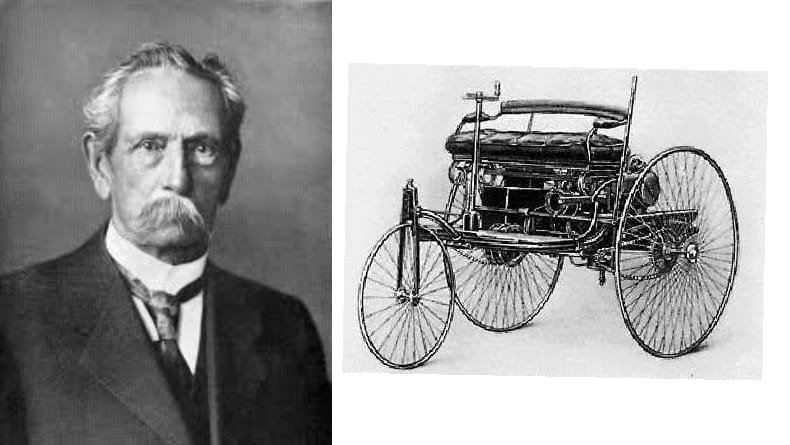
The story began on November 25, 1844, near Karlsruhe, Germany, when a boy named Karl Benz was born into a modest family. His father worked as a railway engine driver but passed away when Karl was only around two years old, leaving his family facing severe financial difficulties.
Raised by his mother alone, Karl grew up without the presence of a father figure. However, his mother was determined to give him the best education possible. She worked tirelessly, sacrificed her own needs, and invested everything she could into Karl’s future. That support became the foundation that eventually allowed him to pursue engineering and create one of the most important inventions in human history.
From an early age, Karl Benz showed an extraordinary curiosity about machines and technology. He spent hours observing trains, repairing tools, and building small mechanical devices with his own hands. His fascination with engineering eventually led him to study at the Polytechnic School in Karlsruhe, where he developed his knowledge of science and mechanics.
At a time when horses dominated transportation, Karl had a dream that many considered unrealistic: creating a vehicle that could move by itself without the need for animals. While others laughed at the idea, Karl believed that machines would define the future of transportation.
After completing his studies, Karl worked as an engineer in several companies before establishing his own mechanical workshop in Mannheim in 1871. That small workshop would later become the birthplace of the modern automobile industry.
However, success did not come easily. Karl Benz faced years of financial struggles, limited resources, and constant doubt from people around him. His business repeatedly came close to bankruptcy, and many would have abandoned such an uncertain dream.
But during the most difficult period of his life, Karl had someone who stood firmly beside him: Bertha Benz.
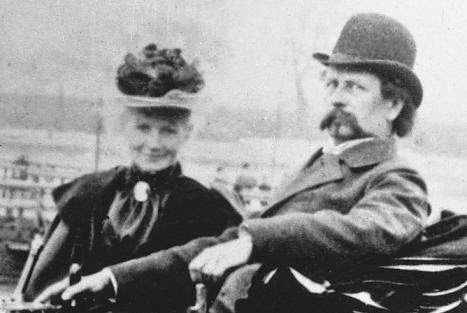
Karl and Bertha married in 1872, and she became far more than just his wife. She was his business partner, financial supporter, and one of the most important figures behind his success. Bertha invested her own dowry into Karl’s work, providing the financial support needed to continue his experiments.
Beyond financial assistance, Bertha understood Karl’s engineering ambitions. She supported his ideas, discussed technical improvements, and encouraged him whenever failure made him lose confidence. At a time when women were rarely recognized in engineering and business, Bertha played a crucial role in one of the greatest technological breakthroughs in history.
After years of research and countless failures, Karl Benz finally achieved his dream. He developed a reliable internal combustion engine and installed it into a lightweight three-wheeled vehicle. The machine featured a gasoline engine, ignition system, cooling system, and power transmission mechanism — technologies that created the foundation of the modern automobile.
On January 29, 1886, Karl Benz received a patent for his invention, officially known as the Benz Patent-Motorwagen. This moment is widely considered the birth of the automobile.
However, the world was not immediately ready to accept his invention. Many people viewed the strange, noisy machine as dangerous and unnecessary. Most believed that horses were still the best form of transportation. Sales were slow, and Karl began to doubt whether his invention would ever succeed.
Then came the moment that changed automotive history.
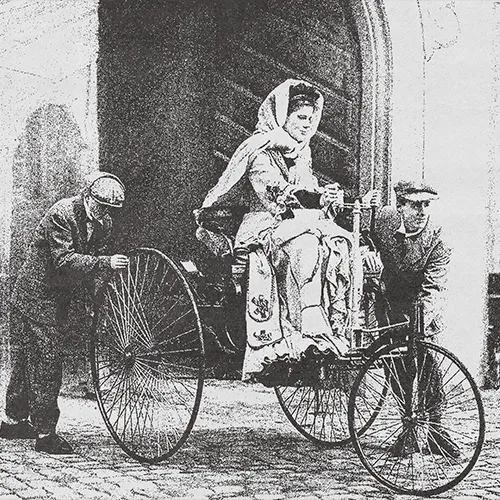
In August 1888, Bertha Benz made a bold decision without telling her husband. She took the Benz vehicle, brought along her two sons, and began a journey of more than 100 kilometers to visit her mother. This became the first long-distance automobile journey in history.
The journey was filled with challenges. When the fuel line became blocked, Bertha used a hat pin to clear it. When an ignition wire became damaged, she repaired it using part of her clothing. When the wooden brakes wore out during the trip, she visited a shoemaker and asked him to add leather coverings to improve the braking system — an action often regarded as an early inspiration for modern brake pads.
Because fuel stations did not exist at the time, Bertha purchased fuel from a pharmacy that sold ligroin, a petroleum-based solvent suitable for the vehicle. That location later became recognized as one of the world’s first fuel stations.
After completing the journey successfully, Bertha sent a message to Karl proving that his invention was not just a laboratory experiment but a practical machine capable of real transportation.
Her courageous journey attracted public attention and changed how people viewed automobiles. Newspapers reported the achievement, interest in Benz vehicles increased, and customers slowly began placing orders.
The story of Karl Benz and Bertha Benz proves that great inventions are rarely created in perfect circumstances. Behind the luxury image of Mercedes-Benz today is a story of hardship, perseverance, teamwork, and courage.
88eightbox Opinion:
The story of Karl and Bertha Benz is one of the most inspiring chapters in automotive history. Karl Benz may have created the technology, but Bertha Benz proved its value to the world. Her courage, intelligence, and willingness to take risks transformed an invention into a revolution.
Modern automotive history should not only remember the inventor behind the machine but also the people who supported, challenged, and helped bring that vision to life. Without Bertha’s determination, the automobile might have taken much longer to gain public acceptance.
The Mercedes-Benz three-pointed star is not just a symbol of luxury and engineering excellence. It represents a journey built from struggle, belief, and the courage to challenge what others thought was impossible.
What do you think about the incredible journey of Karl and Bertha Benz? Do you believe Bertha Benz deserves more recognition in automotive history?
Share your comments.

Adhe is part of the 88 Eight Box Editorial Team, covering JDM culture, motorsport, automotive technology, and industry news. The team focuses on delivering original automotive stories, reviews, and insights for enthusiasts worldwide.