Formula 1 has always been a place where the most extreme automotive technologies are developed. Many innovations created for F1 have eventually influenced road cars. One of the biggest evolutions in recent decades has happened to a component that looks simple but plays a crucial role: the Formula 1 steering wheel.
If a steering wheel in the past was only used to control the direction of the car, the modern F1 steering wheel has transformed into a small computer system that acts as the main communication center between the driver and the car.
Today, an F1 driver is not simply using the steering wheel to turn the car. They are controlling almost every aspect of the car’s behavior through a device that fits directly in their hands.
The Evolution of the F1 Steering Wheel: From Simple Control to a Command Center
During the 1960s through the 1980s, Formula 1 steering wheels were extremely simple. Their main purpose was only to steer the car. Drivers focused mainly on:
- Steering input
- Manual gear changes
- Braking
- Throttle control
The major transformation began in the late 1980s and early 1990s when electronic technology started entering Formula 1. Teams began introducing: - Paddle shifters behind the wheel
- Digital displays
- Engine adjustment buttons
- Electronic control systems
One of the biggest milestones came when teams such as Ferrari, Williams, and McLaren began developing more advanced electronic steering wheels in the early 1990s. At that point, the steering wheel started evolving from a mechanical component into an electronic interface capable of providing information and controlling vehicle systems.
Entering the 2000s, the technology became even more advanced. Systems such as engine mapping, brake bias adjustment, differential settings, telemetry information, and vehicle performance controls turned the steering wheel into a much more sophisticated device.
The biggest transformation arrived with the introduction of hybrid power units in Formula 1 in 2014. With the arrival of hybrid technology, drivers needed additional controls to manage systems such as ERS (Energy Recovery System) and electrical energy deployment.
The Modern F1 Steering Wheel: A Small Computer Packed With Technology
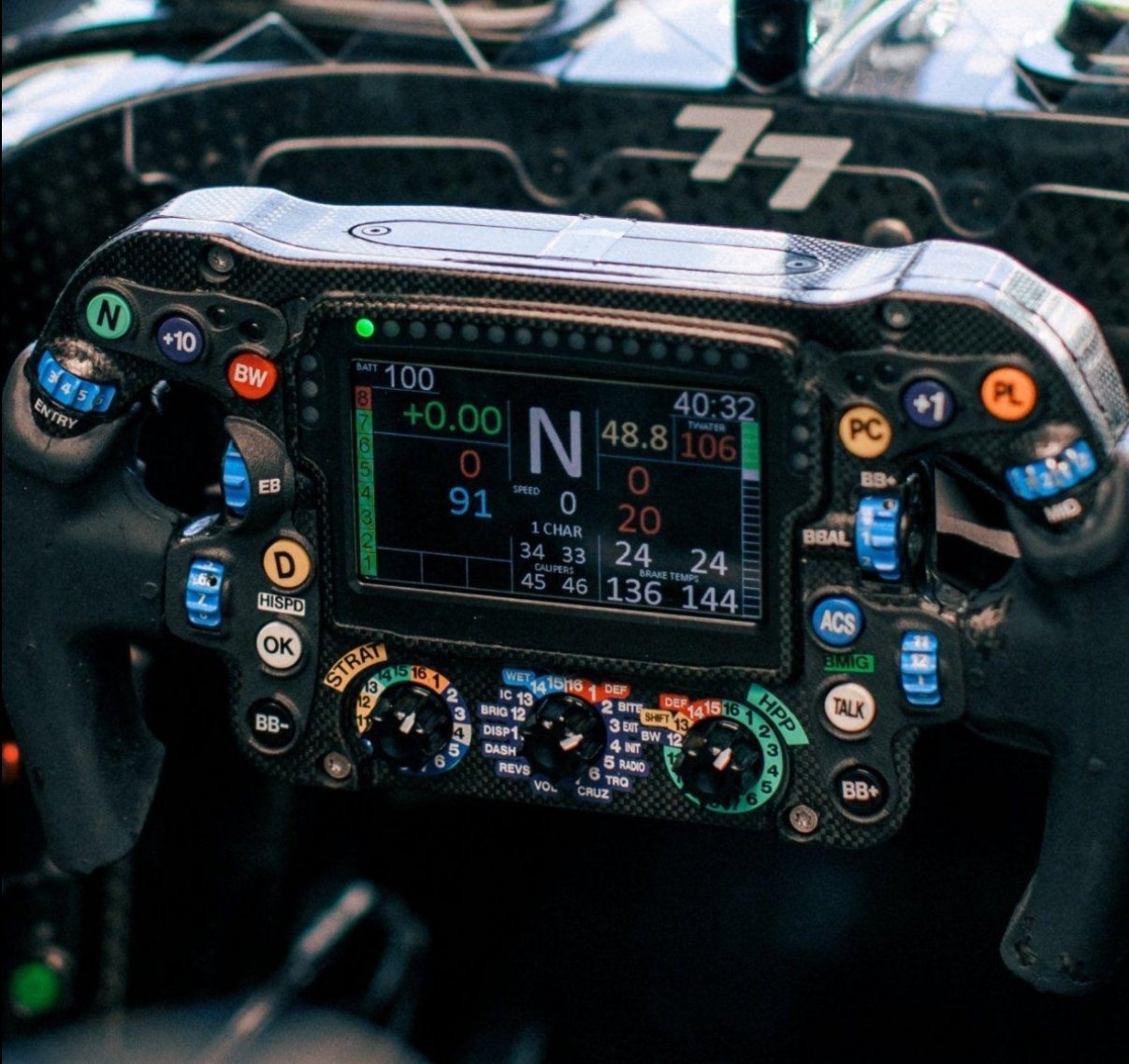
A modern Formula 1 steering wheel weighs around 1–1.5 kilograms and is built using lightweight materials such as carbon fiber. Despite its compact size, it contains technology that would normally require a much larger control panel.
A modern F1 steering wheel can include:
- More than 20 buttons and rotary switches
- A high-resolution digital display
- Paddle shifters and clutch paddles
- Engine controls and hybrid system controls
- Team radio communication
- Differential adjustment and brake bias control
- Race strategy settings
Note: All of these functions must be operated by the driver without losing focus on the track.
Key Functions Inside a Modern F1 Steering Wheel
1. Digital Display
The center screen of the steering wheel works as a miniature dashboard. Drivers can see:
- Vehicle speed and engine RPM
- Current gear
- Car temperature data
- Battery status and hybrid energy usage
- Messages from the team
This information changes constantly and helps drivers make decisions during the race.2. Brake Bias: Controlling Stability Under Braking
One of the most important controls is the brake bias adjustment. Drivers can shift the braking balance between the front and rear wheels depending on changing conditions.
- For example: When the front tires begin losing grip, the driver can adjust the brake balance to keep the car stable.
Even a small change in brake bias can determine whether a driver completes a corner perfectly or locks up the tires.3. Differential Adjustment
The modern F1 steering wheel allows drivers to change the behavior of the differential. These adjustments help:
- Improve corner entry rotation
- Maximize traction when exiting corners
- Adapt to changing tire conditions
Drivers can make these changes while racing at extreme speeds.4. ERS and Hybrid Energy Management
Since the introduction of hybrid technology in 2014, F1 drivers must manage electrical energy in addition to the combustion engine. Through the steering wheel, they can control:
- When electrical energy is deployed
- How much power is released
- Attack or defensive race strategies
Poor energy management can cost a driver valuable lap time or an opportunity to overtake.5. Paddle Shifting and Clutch Control
Modern F1 cars use paddle shifters located behind the steering wheel. This system allows drivers to change gears extremely quickly.
The clutch paddles are also critical during race starts, where drivers must perfectly control clutch release, engine speed, and traction to achieve maximum acceleration.Why Can a Modern F1 Steering Wheel Be Considered More Difficult Than an Airplane Cockpit?
In terms of overall complexity, an aircraft cockpit is still far more advanced. Airplane contain thousands of systems controlling navigation, communication, engines, safety systems, and flight operations.
However, the comparison becomes interesting when looking at human interaction and decision-making speed.
- Decision-Making Time: A pilot usually has more time to read instruments, follow procedures, and make calculated decisions. In contrast, an F1 driver must make every decision within seconds or milliseconds.
- Physical Conditions: While a pilot typically operates in a stable flight environment (except during severe turbulence), an F1 driver must operate the steering wheel while traveling above 300 km/h, experiencing 5–6G forces, and braking at extreme speeds.
- Space Constraint: An aircraft cockpit spreads its controls across a relatively spacious panel, whereas an F1 steering wheel packs many critical functions into a very small, dense space.
The complexity of an F1 steering wheel does not come from having more systems than an aircraft. It comes from the fact that many critical functions must be controlled in a very small space under the most extreme conditions.The F1 Steering Wheel: The Connection Between Human and Machine
The modern Formula 1 steering wheel represents how technology can expand human performance. Today’s F1 car is not simply a machine with enormous power. It is a highly advanced electronic system that requires perfect communication between the driver and the vehicle.
In the hands of a professional driver, every button has a purpose. Every switch adjustment can change the behavior of the car. Every decision can determine victory or defeat.
The modern F1 steering wheel is not just a steering device. It is a high-tech command center that connects the driver’s mind with the machine at the highest level of motorsport. If an aircraft cockpit is the control center of a flying machine, then an F1 steering wheel is a compact racing computer that becomes the driver’s second brain while operating at the absolute limit of human performance.

Adhe is part of the 88 Eight Box Editorial Team, covering JDM culture, motorsport, automotive technology, and industry news. The team focuses on delivering original automotive stories, reviews, and insights for enthusiasts worldwide.