Before Formula 1 entered the era of advanced technology with steering wheels packed with buttons and digital displays, F1 cars of the 1980s featured much simpler cockpit designs. One of the most recognizable elements was the round steering wheel, which became an essential part of the character of racing cars from that era.
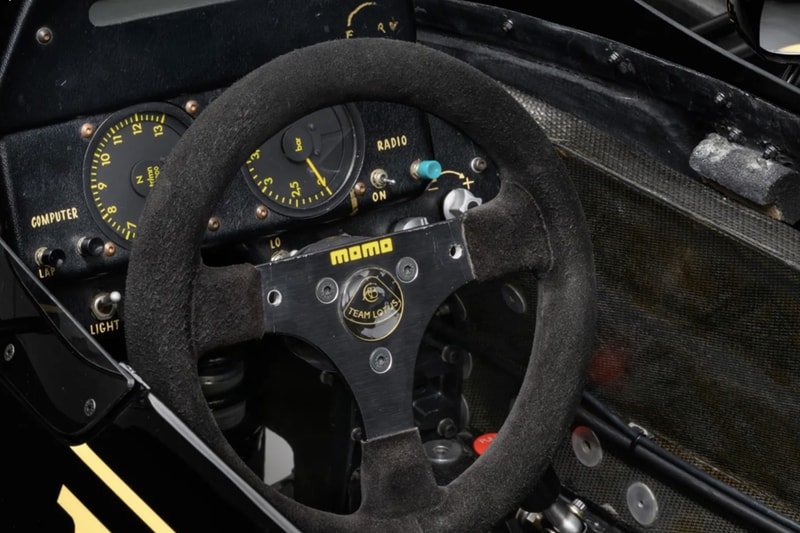
At first glance, a 1980s F1 steering wheel looks extremely basic compared to today’s versions. There were no digital screens, no dozens of adjustment buttons, and no rotary switches to change the car’s settings. However, behind its simple appearance was a crucial piece of equipment designed to control some of the fastest, most aggressive, and most challenging racing machines ever built.
A Round Design Focused on Maximum Control
The steering wheels used in Formula 1 during the 1980s still featured a full circular design because drivers needed a wider range of movement to control the car.
During this era, F1 cars did not have power steering systems like modern machines. Steering required significant physical effort, especially through high-speed corners or when the tires started losing grip.
The round shape gave drivers more freedom to make large and rapid corrections. When the car experienced oversteer or the rear end began sliding, drivers could quickly move their hands around the wheel to regain control and stabilize the car.
For legendary drivers such as Ayrton Senna, Alain Prost, Nigel Mansell, and Nelson Piquet, the steering wheel was not just a tool to turn the car. It was a direct connection between driver and machine, providing valuable feedback about grip, balance, and the overall condition of the car.
A Simple Design Without Complex Electronics
Unlike modern F1 steering wheels that contain dozens of functions, 1980s steering wheels only featured a few basic controls.
They usually included:
- a radio communication button to talk with the team,
- a neutral button on some cars,
- several simple functions related to the car’s systems.
Most adjustments were still handled by mechanics and engineers before the race. Drivers could not instantly change the car’s characteristics by turning switches on the steering wheel like they can today.
There were no:
- in-race brake bias adjustments,
- engine mode selections,
- direct differential controls,
- energy management systems,
- digital lap and strategy displays.
Drivers had to rely on communication with the team and their own understanding of how the car reacted to every change on track.
Steering Wheel Materials and Construction
A 1980s F1 steering wheel was designed with one main goal: to be lightweight and strong.
The typical construction included:
- an aluminum or lightweight metal frame,
- a leather or synthetic grip surface,
- a simple three-spoke design.
Its weight was far lighter compared to modern F1 steering wheels, which contain complex electronic components.
The steering wheel diameter was also larger than today’s designs. This helped drivers generate more force when turning the front wheels, especially because the cars used manual steering systems without electronic assistance.
A Tight Cockpit and Different Driving Position
The steering wheel of the 1980s also had to match the extremely tight cockpit design of that era. Drivers sat in a very low position, with their legs positioned higher than their hips, almost like being placed inside a narrow racing shell.
Because space was limited, drivers needed excellent physical ability to get in and out of the car quickly. Unlike modern F1 cars, the steering wheels of that period did not yet use advanced quick-release systems.
In emergency situations, drivers had to remove the steering wheel manually before exiting the car.
The Steering Wheel During the Ground Effect and Turbo Era
The 1980s was one of the most extreme periods in Formula 1 history. Cars used ground-effect technology and later entered the turbo era, producing enormous levels of power.
Cars such as the McLaren MP4/4 used Honda turbo engines that delivered incredible performance, yet they were still controlled through systems that were far simpler than today’s F1 cars.
This meant every small movement of the steering wheel had a major impact on the car’s behavior. Drivers needed exceptional sensitivity because there were very few electronic systems available to correct mistakes.
A Symbol of the Era When Drivers and Cars Communicated Directly
The 1980s F1 steering wheel may look outdated compared to today’s technology, but its simplicity is exactly what makes it special.
Drivers had very few assists. They had to understand the car through steering weight, vibrations, engine sounds, and changes in tire grip.
The round steering wheel of 1980s Formula 1 represents an era when driver skill was the most important factor. The cars were incredibly fast, but drivers had to truly become one with the machine to reach its absolute limit.

Adhe is part of the 88 Eight Box Editorial Team, covering JDM culture, motorsport, automotive technology, and industry news. The team focuses on delivering original automotive stories, reviews, and insights for enthusiasts worldwide.