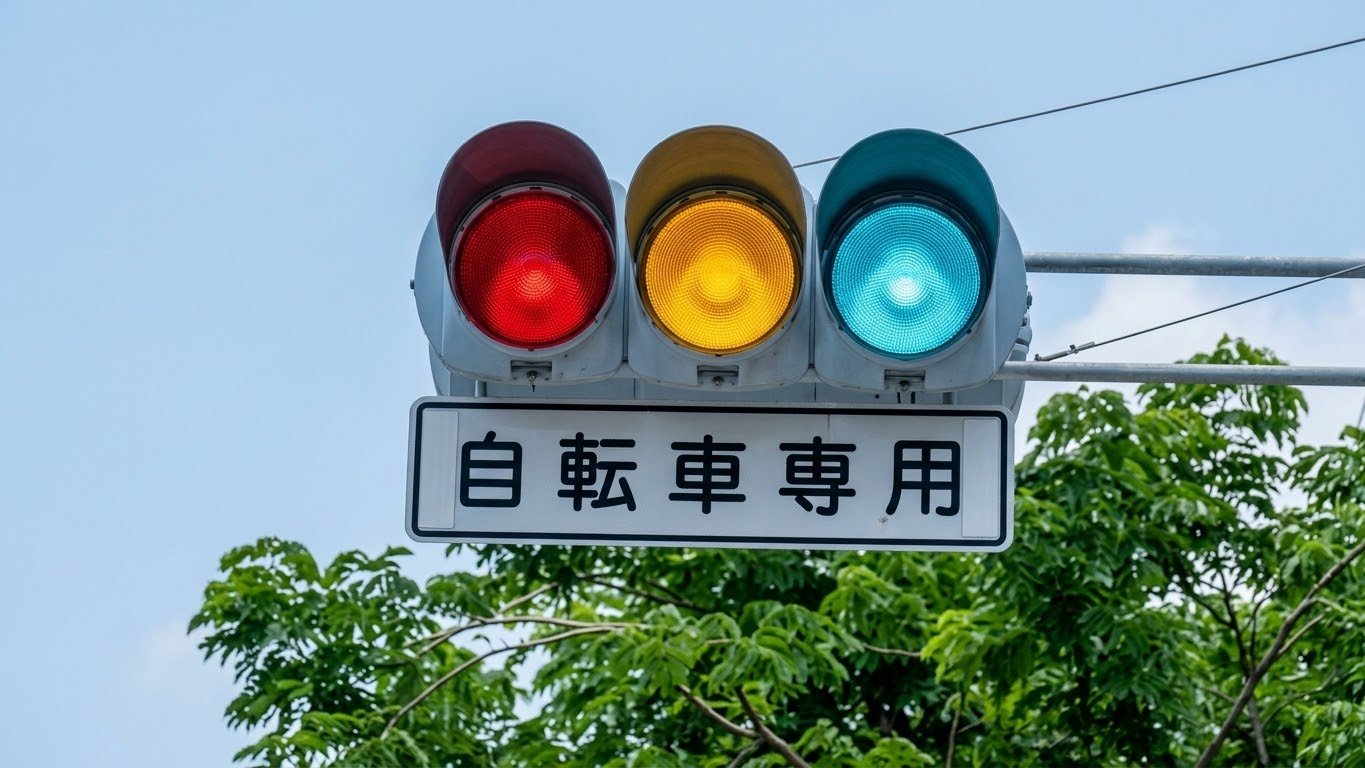
Japan’s traffic lights look green to most people. Yet officially, the light that tells drivers to go is called a “blue signal.” The reason is not that Japan uses a completely different traffic-light system, but rather a fascinating combination of language, history, and regulation.
When you look at a traffic light in Japan, the three familiar colors are still there: red means stop, yellow means caution, and green means go.
But there is one detail that often confuses visitors: the green light is commonly called “blue” in Japan.
In Japanese, a green light is known as 青信号 (aoshingō), which literally means “blue signal.” In reality, the light generally falls within the green portion of the visible spectrum, although some Japanese traffic lights can have a noticeably blue-green appearance.
It All Comes Down to the Word “Ao”
The answer begins with the history of the Japanese language.
Today, midori (緑) is normally used to describe the color green, while ao (青) generally means blue. Historically, however, ao had a much broader meaning and could describe colors ranging from blue to green.
That older usage has survived in modern Japanese.
For example, aoba refers to fresh green leaves. There are also traditional expressions such as aona for green vegetables and aomame for green beans, despite the fact that these objects are clearly green rather than blue.
So, calling something green ao is not necessarily strange within the Japanese language.
Japan Actually Started With Green
Interestingly, Japan did not originally set out to create a “blue” traffic light.
Japan’s first electric traffic signal was installed at the Hibiya intersection in Tokyo in 1930. The system was imported from the United States and used the familiar three-color arrangement of red, yellow, and green.
According to Japan’s National Police Agency, this marked an important early step in the development of Japan’s modern traffic-signal system.
Early Japanese regulations referred to the go signal as a green signal, or midori shingō. However, the public increasingly began referring to it as ao shingō, or “blue signal.”
By 1947, the term aoshingō had entered official Japanese legal terminology.
In other words, Japan did not suddenly decide to replace its green traffic lights with blue ones. The word “blue” became established through everyday language, and the government eventually adopted that terminology officially.
So Why Do Some Japanese Traffic Lights Look Bluish?
This is where the story gets even more interesting.
After the term aoshingō became established, efforts were made to make the actual light appear closer to what people understood as “blue.”
Japan’s Oita Prefectural Police explains that from 1973, newly installed traffic signals were produced with a color closer to blue. As a result, older signals can appear noticeably greener than newer ones.
However, calling the light simply “blue” can also be misleading.
A 1982 study published in the Journal of the Illuminating Engineering Institute of Japan examined the color of Japanese “blue signals.” Researchers found that the signals generally occupied a range from greenish-blue to bluish-green, rather than being pure blue.
So, scientifically speaking, the Japanese “blue” traffic light is better described as a blue-green or greenish-blue light.
It Is Not Because Japanese People Cannot Tell Blue From Green
One popular explanation claims that Japan deliberately uses a bluish-green traffic light because it is easier for people with color-vision deficiencies to distinguish.
While this explanation appears frequently online, it is not the primary explanation supported by Japanese official sources.
The stronger explanation is the historical use of ao in the Japanese language, combined with the development of official traffic-signal standards.
Japan’s current traffic regulations still officially use the term “blue light” (aoiro no tomoshibi) when referring to the signal that permits vehicles and pedestrians to proceed.
So, Does Japan Really Have Blue Traffic Lights?
Not in the simple sense that the term suggests.
Japan has not replaced the traditional green traffic light with a deep-blue light. The signal serves exactly the same function as a green light elsewhere in the world, and its actual color generally falls somewhere between green and blue-green.
What makes Japan unusual is the way language, culture, technology, and government regulation came together to turn a green traffic light into a “blue” one—at least officially.
And perhaps the most fascinating part is that the terminology did not simply follow the technology. In a way, the language helped shape the color that people eventually saw on the road.
This is a perfect example of how something as ordinary as a traffic light can reveal an unexpected piece of cultural history. The light is not really “wrong” or blue in the conventional sense. Japan simply has a linguistic history in which ao once covered a much broader range of colors.
So the next time someone in Japan says “the light is blue,” don’t immediately look for a blue light.
They probably mean green.
Have you ever noticed Japan’s unusual blue-green traffic lights? Do you think they look more blue, green, or somewhere in between? Let us know what you think in the comments.

Adhe is part of the 88 Eight Box Editorial Team, covering JDM culture, motorsport, automotive technology, and industry news. The team focuses on delivering original automotive stories, reviews, and insights for enthusiasts worldwide.