Tire speed ratings are about more than just maximum speed. They can also help drivers understand a tire’s performance characteristics, handling capabilities, and suitability for different vehicles. However, choosing the highest-rated tires does not automatically mean making the best choice for your car.
When shopping for new tires, most drivers focus on the brand, size, price, and tread pattern. However, another important detail is often overlooked: the tire speed rating.
Usually displayed as a letter on the tire’s sidewall, the speed rating indicates the maximum speed at which a tire can carry its designated load under specified test conditions. It is typically found alongside the load index, another important specification that indicates the tire’s load-carrying capacity.
According to tire manufacturers such as Michelin, Continental, and Goodyear, these specifications should be considered when replacing tires because vehicles are engineered to work with particular tire specifications.
WHAT DO THE LETTERS ON TIRE SPEED RATINGS MEAN?
A tire speed rating is not simply an indication of how fast a car can travel. Instead, it represents the tire’s tested capability to operate at a specified speed under defined conditions.
For example, an S-rated tire is designed for speeds of up to 112 mph (180 km/h), while a V-rated tire is rated for up to 149 mph (240 km/h). Higher-performance tires carry ratings such as W and Y, corresponding to 168 mph (270 km/h) and 186 mph (300 km/h), respectively.
However, these figures should not be interpreted as guarantees that a tire will remain safe at those speeds under every circumstance. Incorrect inflation pressure, excessive loads, tire damage, wear, and road conditions can all affect tire performance.
Here are some common tire speed ratings and their corresponding maximum speeds.
| Speed Rating | Maximum Speed |
|---|---|
| L | 75 mph (120 km/h) |
| M | 81 mph (130 km/h) |
| N | 87 mph (140 km/h) |
| P | 93 mph (150 km/h) |
| Q | 99 mph (160 km/h) |
| R | 106 mph (170 km/h) |
| S | 112 mph (180 km/h) |
| T | 118 mph (190 km/h) |
| U | 124 mph (200 km/h) |
| H | 130 mph (210 km/h) |
| V | 149 mph (240 km/h) |
| W | 168 mph (270 km/h) |
| Y | 186 mph (300 km/h) |
These figures represent standardized speed categories, not recommended driving speeds. Z and ZR markings may also appear on high-performance tires, but their precise speed capability must be determined from the complete tire specification.
WHY DO SPORTS CARS USE HIGHER SPEED-RATED TIRES?
Tires experience significant forces whenever a vehicle accelerates, brakes, or corners. At higher speeds, the tire also generates heat as its structure repeatedly deforms and returns to its original shape.
High-performance tires are engineered to withstand these demands through specialized rubber compounds, internal construction, and tread designs. Their construction helps maintain stability and manage the forces generated during high-speed driving.
That is why V-, W-, and Y-rated tires are commonly found on sports cars, performance sedans, and supercars.
However, a higher speed rating does not automatically mean a tire will provide better grip or shorter stopping distances than every tire with a lower rating.
Actual performance depends on several factors, including rubber compounds, tread design, road temperature, inflation pressure, vehicle setup, and road conditions. Two tires carrying the same speed rating can also deliver very different levels of grip, comfort, and braking performance.
In other words, speed rating is an important specification, but it is not a universal measurement of tire quality.
ARE HIGHER SPEED-RATED TIRES LESS COMFORTABLE?
Not necessarily, although there can be trade-offs.
Some high-performance tires use construction designed to improve steering response, cornering stability, and control at high speeds. Depending on the design, these characteristics can result in a firmer ride compared with touring tires developed primarily for everyday comfort.
Touring tires generally prioritize a balance of comfort, low road noise, durability, and everyday usability. Performance tires, meanwhile, may emphasize sharper steering response and greater control under demanding driving conditions.
Tread compounds also influence tire longevity. Some performance-oriented compounds prioritize grip over tread life, which can lead to faster wear in certain applications. However, not every high-speed-rated tire wears quickly or rides harshly.
Cold-weather performance is another consideration. A tire’s behavior in low temperatures depends largely on its rubber compound and intended application, not simply its speed rating. Summer performance tires, for example, may lose grip significantly in cold conditions.
For drivers who spend most of their time commuting or traveling long distances, a properly specified touring tire may offer a better overall experience than a performance tire designed for more demanding driving.
HOW DO YOU CHOOSE THE RIGHT SPEED RATING?
The best starting point is your vehicle manufacturer’s recommendation. Depending on the vehicle, the required tire specifications can be found in the owner’s manual or on the tire information label, often located near the driver’s door.
The correct rating varies according to the vehicle’s design, engine performance, weight, wheel configuration, and intended use. There is no single speed rating that automatically suits every compact car, sedan, SUV, or pickup truck.
For family cars and everyday SUVs, the appropriate rating may be S, T, H, or another specification selected by the manufacturer. Performance-oriented vehicles may require V-, W-, or Y-rated tires.
Pickup trucks require additional attention to load index and tire construction. A tire must be capable of carrying the vehicle’s intended load, and choosing a suitable speed rating alone is not enough.
Installing a replacement tire with a higher speed rating is generally possible when its size, load capacity, construction, and other specifications remain appropriate for the vehicle.
However, fitting tires with a lower speed rating than the manufacturer’s recommendation should generally be avoided unless the vehicle manufacturer or a qualified tire professional confirms that the application is acceptable. Certain winter-tire regulations and manufacturer recommendations may allow exceptions in specific markets.
CAN YOU MIX TIRES WITH DIFFERENT SPEED RATINGS?
Technically, some vehicles can operate with tires carrying different speed ratings in specific configurations. Nevertheless, mixing tire specifications is generally not the preferred approach.
Differences in tire construction and performance characteristics can affect steering response and vehicle balance, particularly during emergency maneuvers or on wet roads.
If tires with different speed ratings are fitted, the vehicle’s overall speed capability is limited by the tire with the lowest rating. Michelin also advises against fitting tires with different speed ratings on the same axle.
Some tire manufacturers provide guidance for particular configurations involving different ratings on the front and rear axles. However, these recommendations should not be treated as universal rules because vehicle design, drivetrain configuration, suspension geometry, and manufacturer requirements can vary.
The safest general approach is to use four tires with compatible specifications, including size, load index, and speed rating, while following the vehicle manufacturer’s recommendations.
If a different combination is necessary, consult the vehicle manufacturer or a qualified tire specialist before making the change.
DON’T FORGET THE LOAD INDEX
Speed rating is only one part of the information printed on a tire’s sidewall.
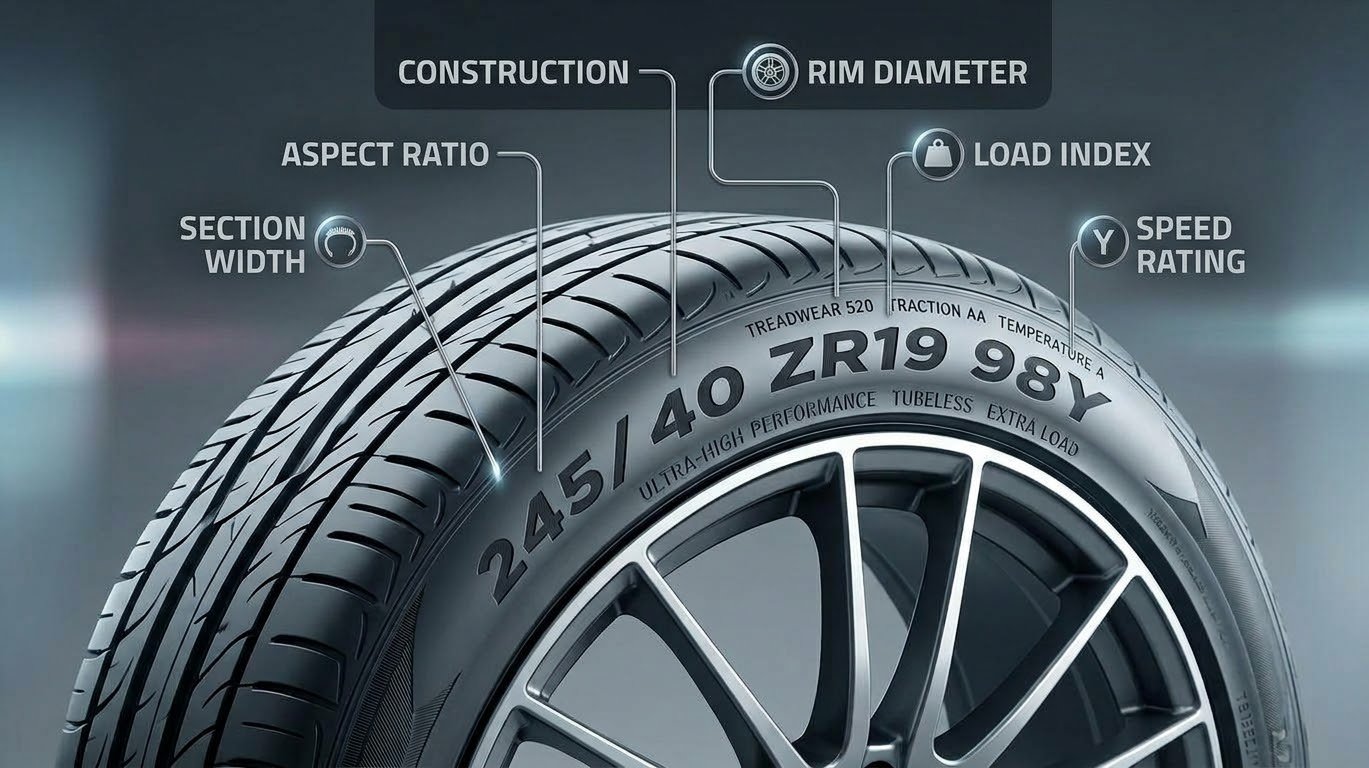
The load index indicates the maximum load a tire is designed to carry under specified conditions. Consider the tire designation 205/55 R17 91V.
In this example:
- 205 indicates the nominal tire width in millimeters.
- 55 is the aspect ratio, expressed as a percentage of the tire’s width.
- R indicates radial construction.
- 17 indicates the wheel diameter in inches.
- 91 is the load index.
- V is the speed rating.
A load index of 91 corresponds to a maximum load capacity of 615 kg per tire under the specified conditions.
However, this does not mean a vehicle can automatically carry 2,460 kg simply because it has four tires with that load index. The vehicle’s maximum permitted weight, axle-load limits, load distribution, inflation pressure, and other requirements must also be considered.
Correct inflation pressure is equally important. Even a tire with an appropriate speed rating and load index can become unsafe if it is underinflated, overloaded, or damaged.
The U.S. National Highway Traffic Safety Administration (NHTSA) recommends checking tire pressure regularly, including when the tires appear to be in good condition.
DOES A HIGHER SPEED RATING MEAN YOU CAN DRIVE FASTER?
Absolutely not.
A tire’s speed rating describes its tested capability under specified conditions. It does not grant permission to exceed posted speed limits or drive beyond what road and traffic conditions allow.
For example, fitting Y-rated tires capable of speeds up to 186 mph (300 km/h) does not make it safe or legal to drive at those speeds on public roads.
Actual safety depends on much more than the tires themselves. Braking systems, suspension condition, vehicle stability, road surface, visibility, weather, and driver judgment all play important roles.
Drivers should always obey local speed limits and adjust their speed to the prevailing conditions.
THE HIGHEST RATING ISN’T ALWAYS THE BEST
Tire speed ratings provide valuable information about a tire’s ability to operate at specified speeds, but they should never be the only factor when choosing replacement tires.
High-speed-rated tires are important for vehicles engineered to require them. However, everyday drivers should also consider comfort, tread life, road noise, load capacity, weather conditions, and the manufacturer’s specifications.
Before purchasing new tires, check the markings on your existing tires and compare them with the specifications recommended for your vehicle. Make sure the tire size, load index, and speed rating are appropriate, and remember that a higher rating does not justify driving faster.
Ultimately, the best tire is not necessarily the one with the highest speed rating. It is the one that best matches your vehicle, driving conditions, and everyday needs.
What matters more to you when choosing tires for a daily driver: comfort and durability, or sharper handling and sports-car-like performance? Let us know in the comments.

Adhe is part of the 88 Eight Box Editorial Team, covering JDM culture, motorsport, automotive technology, and industry news. The team focuses on delivering original automotive stories, reviews, and insights for enthusiasts worldwide.