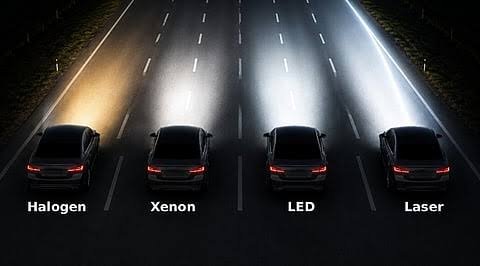
Car headlights have evolved from simple incandescent-style bulbs into sophisticated lighting systems capable of illuminating the road over long distances while adapting to changing driving conditions. Today, four major technologies stand out: halogen, high-intensity discharge (HID) or xenon, light-emitting diode (LED), and laser headlights.
Although all four serve the same basic purpose, they differ significantly in how they produce light, their power consumption, brightness, lifespan, cost, and engineering complexity. However, the most expensive or technologically advanced headlight is not automatically the best performer. Beam design, optical components, correct alignment, and glare control are equally important. The Insurance Institute for Highway Safety (IIHS) evaluates headlights based on their real-world illumination and glare performance rather than simply rewarding a particular technology.
Here is how each technology works, including its technical specifications, advantages, disadvantages, and practical differences.
1. HALOGEN HEADLIGHTS: SIMPLE, AFFORDABLE, AND EASY TO REPLACE

Halogen headlights are among the most familiar lighting systems in the automotive industry. They were widely used in passenger cars for decades and remain common in affordable vehicles because their components are relatively inexpensive and their bulbs are generally straightforward to replace.
How do halogen headlights work?
A halogen bulb produces light by passing electrical current through a thin tungsten filament. As electricity flows through the filament, its resistance causes it to heat up until it glows.
The bulb contains a small quantity of halogen gas, typically iodine or bromine compounds, which participates in a chemical cycle that helps return evaporated tungsten to the filament. This process helps the bulb maintain its performance over its operating life.
The technology is relatively simple, but much of the electrical energy is converted into heat rather than visible light. Consequently, halogen lamps are less energy-efficient than modern LED or xenon systems.
Technical specifications
A standard OSRAM H7 halogen bulb provides a useful example of the technology’s specifications:
- Nominal voltage: 12 volts
- Nominal power: 55 watts
- Power input listed by the manufacturer: 58 watts
- Nominal luminous flux: 1,500 lumens, with a ±10% tolerance
- Typical light appearance: Warm white or yellowish
- Typical service-life figures: B3 life of 330 hours and Tc life of 550 hours for this particular bulb
- Common bulb types: H1, H4, H7, H11, and other vehicle-specific fitments
These figures are for a particular H7 bulb, not universal specifications for every halogen lamp. OSRAM’s published H7 data lists its nominal power, luminous flux, and two different lifespan ratings.
The B3 lifespan represents a statistical reliability measure associated with the point at which a defined proportion of lamps have failed. Tc is a different rated lifetime measure; neither should be interpreted as a guaranteed replacement interval for every vehicle.
Halogen light generally appears warmer than the whiter output associated with xenon and many LED systems. Nevertheless, the color depends on the bulb design, and specially coated halogen bulbs can produce a noticeably whiter appearance. For example, OSRAM markets certain halogen bulbs with a color temperature of up to 5,000 K.
Advantages of halogen headlights
The biggest advantage is affordability. Replacement bulbs are widely available, and many can be installed without replacing the complete headlight assembly.
Halogen systems are also relatively uncomplicated, making them attractive for older vehicles and budget-conscious owners. Their warm-colored light is familiar to many drivers, and replacement parts are often less expensive than those for more advanced systems.
Disadvantages of halogen headlights
The main drawbacks are comparatively high power consumption, significant heat generation, and shorter bulb life. Their illumination performance can also be limited compared with a well-designed modern LED or xenon headlight.
However, a good halogen headlight with an accurate beam pattern can still be more useful than a poorly designed or incorrectly aimed modern lighting system.
Best suited for: Drivers looking for an affordable, conventional lighting system that is relatively simple to maintain.
2. HID/XENON HEADLIGHTS: BRIGHTER LIGHT WITH LOWER POWER CONSUMPTION THAN HALOGEN

High-intensity discharge headlights, commonly called HID or xenon headlights, became more widely available in production cars during the 1990s. They became particularly popular in premium vehicles because they could produce more light than conventional halogen bulbs while using less electrical power.
Unlike a halogen bulb, an HID lamp does not rely on a glowing tungsten filament.
How do HID/xenon headlights work?
An HID bulb contains electrodes and a gas-discharge chamber filled with xenon and other materials, depending on the bulb design. When activated, a high-voltage electrical pulse creates an arc between the electrodes.
The arc generates intense light, while an electronic unit called a ballast supplies the ignition voltage and regulates the lamp’s operating power.
HELLA explains that certain xenon systems use an ignition pulse of up to 30,000 volts before regulating the lamp at approximately 35 watts. The actual ignition and operating characteristics depend on the HID system.
HID headlights also commonly use projector optics or carefully designed reflectors to direct light toward the road. Some vehicles feature bi-xenon systems, which use a movable mechanism within the projector to switch between low-beam and high-beam patterns.
Technical specifications
An OSRAM XENARC ORIGINAL D4S bulb provides a representative example:
- Nominal voltage: 42 volts at the lamp
- Nominal power: 35 watts
- Nominal luminous flux: 3,200 lumens, with a ±15% tolerance
- Color temperature: 4,300 K
- B3 lifespan: 2,000 hours
- Tc lifespan: 4,000 hours
- Technology: High-intensity discharge
These are manufacturer specifications for the D4S bulb specifically. Other HID types, including D1S, D2S, D3S, and D4R, have different electrical interfaces, designs, and compatibility requirements.
The 4,300 K color temperature produces a relatively neutral white light, sometimes with a slight warm tint. Higher color temperatures can appear cooler or bluer, but a bluer appearance does not automatically mean better visibility.
Compared with the 55-watt nominal rating of the example H7 halogen bulb, the D4S HID lamp uses 35 watts while producing a higher nominal luminous flux. This is a comparison of two specific bulb examples, not a guarantee that every xenon system will outperform every halogen headlight.
Advantages of HID/xenon headlights
HID headlights can deliver strong illumination and good visibility while consuming less electrical power than many conventional halogen systems. Their light output can also help illuminate roadside areas and improve the driver’s ability to see hazards at night.
Another advantage is that xenon bulbs can operate for substantially longer than many standard halogen bulbs, although their lifespan depends on the lamp type, operating conditions, and electrical system.
Disadvantages of HID/xenon headlights
HID systems are more complicated than halogen setups because they require a ballast and high-voltage ignition circuitry. If the bulb, ballast, wiring, or control electronics fail, repairs can be more expensive.
HID lamps also take a short time to reach their full operating output after being switched on. Their high voltage means that replacement work should be performed according to the manufacturer’s safety instructions.
Incorrect installation is another concern. Fitting xenon bulbs into a headlight designed for a different light source can result in a poor beam pattern or excessive glare. Compatibility is not determined by whether the bulb physically fits into the socket alone.
Best suited for: Drivers who want strong nighttime illumination from a factory-designed system and are prepared for potentially higher repair costs.
3. LED HEADLIGHTS: HIGH EFFICIENCY, LONG LIFE, AND FLEXIBLE DESIGN

Light-emitting diode technology has become increasingly common in modern vehicles, ranging from affordable passenger cars to premium electric vehicles and high-performance models.
LED headlights offer a combination of energy efficiency, compact size, fast response, and design flexibility. They can also be arranged into sophisticated lighting systems that change the beam pattern according to driving conditions.
How do LED headlights work?
LEDs produce light when electrical current passes through semiconductor materials. Unlike halogen bulbs, they do not require a tungsten filament, and unlike HID lamps, they do not generate light through an electrical arc inside a gas-filled chamber.
The light-emitting chips are combined with optical components such as reflectors, lenses, and projection elements to create the required beam pattern.
Because LEDs generate heat at their semiconductor junctions, the headlight also needs an appropriate thermal-management system. Depending on the design, this can include heat sinks, cooling fans, and electronic control units.
Factory-installed LED headlights may contain multiple LED modules, each assigned to a particular part of the beam. Some advanced systems can independently control different sections of the light distribution.
Technical specifications
Unlike the conventional H7 halogen bulb or D4S xenon bulb, there is no single universal specification for an automotive LED headlight. Power, luminous flux, color temperature, and lifespan depend on the individual LED, optics, electronics, and overall headlamp assembly.
For a concrete example, one OSRAM LED H7 replacement product lists the following specifications:
- Nominal voltage: 12 volts
- Nominal power: 19 watts
- Nominal luminous flux: 1,700 lumens, with a ±20% tolerance
- Color temperature: 6,000 K
- Rated Tc lifespan: 5,000 hours
These figures describe that particular LED replacement product, not all factory-installed LED headlights. Its published product information also classified it for off-road use, so the specifications must not be taken as approval for public-road use.
A factory-integrated LED headlamp can have considerably different specifications because it may use a completely different optical and electronic architecture.
What are Matrix LED and adaptive LED headlights?
One of the biggest advantages of LED technology is the ability to control separate light sources electronically.
Matrix LED headlights use multiple individually controlled light segments. Depending on the vehicle’s system, they can maintain illumination across much of the road while reducing light directed toward detected vehicles ahead or approaching from the opposite direction.
Other adaptive systems can adjust the light distribution as the car turns or as driving conditions change. These functions depend on the particular vehicle’s sensors, cameras, software, and headlight hardware; they are not automatically available on every LED-equipped car.
Advantages of LED headlights
Energy efficiency and long service life are two of their most important benefits. LEDs also provide greater design flexibility because their light sources can be compact and arranged in different shapes.
Their ability to support electronically controlled beam patterns is another major advantage. Modern adaptive systems can improve illumination around curves and selectively reduce glare for other road users.
Disadvantages of LED headlights
LED technology can be expensive to repair, particularly when the light source is integrated into a sealed headlight assembly. A failed electronic control unit, damaged lens, or defective LED module may require specialist diagnosis or replacement of expensive components.
Thermal management also matters: poor heat dissipation can affect LED performance and longevity.
Another common misconception is that converting a halogen headlight to LED automatically improves visibility. Even if an LED replacement appears brighter, the light source must be correctly positioned relative to the reflector or projector to produce a safe beam pattern. Some retrofit products are not approved for public roads in particular markets.
Best suited for: Drivers who want an efficient, long-lasting lighting system, particularly when it is engineered and approved for the vehicle from the factory.
4. LASER HEADLIGHTS: ADVANCED TECHNOLOGY FOR EXTENDED HIGH-BEAM RANGE

Laser headlights represent another development in automotive lighting, especially for premium cars where engineers want a long high-beam range within a relatively compact package.
BMW introduced production laser-light technology on the i8 in 2014. The system supplemented the car’s LED headlamps with a laser-based high-beam function capable of extending the claimed illumination range to as much as 600 metres under suitable conditions.
How do laser headlights work?
Despite the name, a production laser headlight does not simply project an exposed blue laser beam directly onto the road.
In BMW’s system, laser diodes produce concentrated blue laser light, which is directed toward a fluorescent phosphor material inside the headlamp. The material converts that energy into intense white light, which is then optically directed onto the road.
This conversion is crucial: the light illuminating the road is white light generated by the phosphor, rather than the original blue laser beam striking the road surface.
The laser-based module can be extremely compact because laser diodes have a very small light-emitting area. That allows engineers to produce a highly concentrated beam using relatively small optical components.
Technical specifications
Laser headlights do not have one standardized bulb rating comparable to a typical H7 halogen or D4S xenon replacement. Their specifications depend on the manufacturer’s integrated lighting system.
BMW’s original i8 laser-light system provides a useful reference:
- Application: Supplementary high-beam lighting
- Claimed maximum high-beam range: Up to 600 metres
- Light generation: Blue laser diodes exciting a fluorescent phosphor material
- Road illumination: Intense white light
- Packaging: Compact laser-based optical module
- Control strategy: Used with a camera-assisted high-beam system to help manage glare
BMW also stated that its i8 laser-light system could be around 30% more energy-efficient than the car’s already efficient LED lighting. That figure is a manufacturer claim for the particular i8 system, not a universal efficiency rating for every laser headlight.
The 600-metre figure should likewise be understood as a manufacturer’s stated maximum range for that system, not a guarantee that every laser-equipped vehicle will illuminate every object clearly at that distance. Actual usable visibility depends on beam pattern, weather, road conditions, vehicle speed, and other factors.
Advantages of laser headlights
The principal advantage is the ability to produce a highly concentrated high beam with an extended reach while packaging the light source into a small space.
That can be particularly useful on dark roads where the driver needs to identify hazards farther ahead. Laser technology can also give designers more freedom to create compact headlamp assemblies.
Disadvantages of laser headlights
The main limitations are cost, complexity, and availability. Laser systems are more specialized than conventional halogen, HID, and LED headlights, and they have historically been concentrated in higher-end vehicles.
Their ability to deliver a long beam is also most relevant to high-beam driving. Laser technology does not automatically eliminate the need for conventional lighting, appropriate low-beam optics, or systems that control glare for other road users.
Best suited for: Premium vehicles that need an extended high-beam range and can accommodate the cost and complexity of advanced lighting hardware.
HALOGEN VS HID/XENON VS LED VS LASER: TECHNICAL COMPARISON
The following table combines representative manufacturer specifications and key characteristics. The numbers are examples of specific products or systems, not universal standards for each technology.
| Specification | Halogen | HID/Xenon | LED | Laser |
|---|---|---|---|---|
| How it produces light | Heated tungsten filament | Electrical arc in a gas-discharge lamp | Semiconductor light-emitting chips | Laser diodes excite a phosphor material |
| Example power rating | 55 W nominal | 35 W nominal | 19 W nominal for one H7 retrofit | No universal standard |
| Example luminous flux | 1,500 lm | 3,200 lm | 1,700 lm for one H7 retrofit | No directly comparable universal bulb rating |
| Example color temperature | Usually warm white | 4,300 K | 6,000 K | White light generated by phosphor |
| Example lifespan | 330-hour B3 / 550-hour Tc | 2,000-hour B3 / 4,000-hour Tc | 5,000-hour Tc | Depends on integrated system |
| Main strength | Low cost and easy replacement | Strong illumination with moderate power consumption | Efficiency and flexible beam control | Extended high-beam range |
| Main limitation | Shorter bulb life and lower efficiency | Ballast complexity and high-voltage ignition | Potentially expensive integrated repairs | Cost and specialist hardware |
Sources: OSRAM halogen specifications, OSRAM xenon specifications, OSRAM LED specifications, and BMW’s laser-light information.
The comparison also highlights why specifications must be interpreted carefully. The halogen, xenon, and LED figures come from particular bulbs, whereas the laser figure refers to a complete vehicle lighting system. These figures therefore cannot be treated as a perfectly controlled, like-for-like laboratory comparison.
LUMENS, KELVIN, AND BEAM RANGE: WHAT DO THEY ACTUALLY MEAN?
Understanding headlight specifications is easier when three commonly advertised measurements are separated.
Lumens (lm) measure the total visible light output from a source. More lumens can indicate greater light output, but they do not tell you exactly how much light reaches the road or whether the beam is correctly distributed.
Kelvin (K) describes the color temperature of the light. Lower values tend to look warmer or more yellow, while higher values tend to appear cooler or bluer. A headlight with a higher Kelvin rating is not automatically brighter or better at revealing hazards.
Beam range describes how far a lighting system illuminates an area to a specified or claimed level. A long-range high beam may help on a dark, straight road, but performance varies with beam intensity, optical design, vehicle loading, weather, and the target being illuminated.
For safety, beam distribution is just as important as total output. A headlight that sends too much light upward can dazzle oncoming drivers, while one that fails to illuminate the road edges or curves adequately can leave hazards difficult to detect.
The IIHS therefore assesses how far headlights provide adequate illumination on straight roads and curves, as well as the glare their low beams produce for other drivers. Its research makes one point particularly clear: a headlight’s technology alone does not guarantee good performance.
WHICH CAR HEADLIGHT TECHNOLOGY IS THE BEST?
There is no universal winner because each system has different priorities.
Halogen remains a sensible choice for drivers who value affordability and straightforward maintenance. HID/xenon offers strong illumination and can provide a worthwhile improvement over older lighting systems when properly engineered. LED is particularly attractive for its efficiency, long service life, and ability to support adaptive beam technology. Laser headlights offer impressive high-beam potential, but their benefits are more specialized and come with higher system complexity.
For most modern drivers, a well-designed factory LED headlight is a compelling all-round solution. Nevertheless, a properly engineered xenon system can be excellent, and a well-rated halogen headlight can outperform a poorly designed LED setup in real-world conditions.
Most importantly, avoid choosing headlights on color or claimed brightness alone. Check vehicle compatibility, legal approval, beam alignment, and the condition of the headlight assembly. Replacing a bulb with a different technology without confirming optical compatibility and road legality can create glare and reduce visibility rather than improve it.
What do you prefer: the simplicity of halogen, the strong output of HID/xenon, the efficiency of LED, or the long-range capability of laser headlights? Share your thoughts in the comments.

Adhe is part of the 88 Eight Box Editorial Team, covering JDM culture, motorsport, automotive technology, and industry news. The team focuses on delivering original automotive stories, reviews, and insights for enthusiasts worldwide.