Four wheels are enough. At least, that’s what the automotive industry decided a very long time ago.
Two at the front, two at the back, and everybody goes home happy.
But every now and then, someone looks at a perfectly normal car and thinks: “You know what this needs? Another axle.”
And so began one of the strangest chapters in automotive history.
From outrageous luxury cars and bizarre hunting machines to Formula 1 racers and experimental hybrids, six-wheeled cars have appeared in almost every corner of the automotive world. Some were built for speed, some for extra traction, some for pure extravagance, and some simply because their creators wanted to see what would happen.
Most disappeared almost as quickly as they arrived.
But they existed. They moved. Some even raced.
So, here are 10 forgotten six-wheelers that deserve to be remembered.
1. 1923 HISPANO-SUIZA H6A
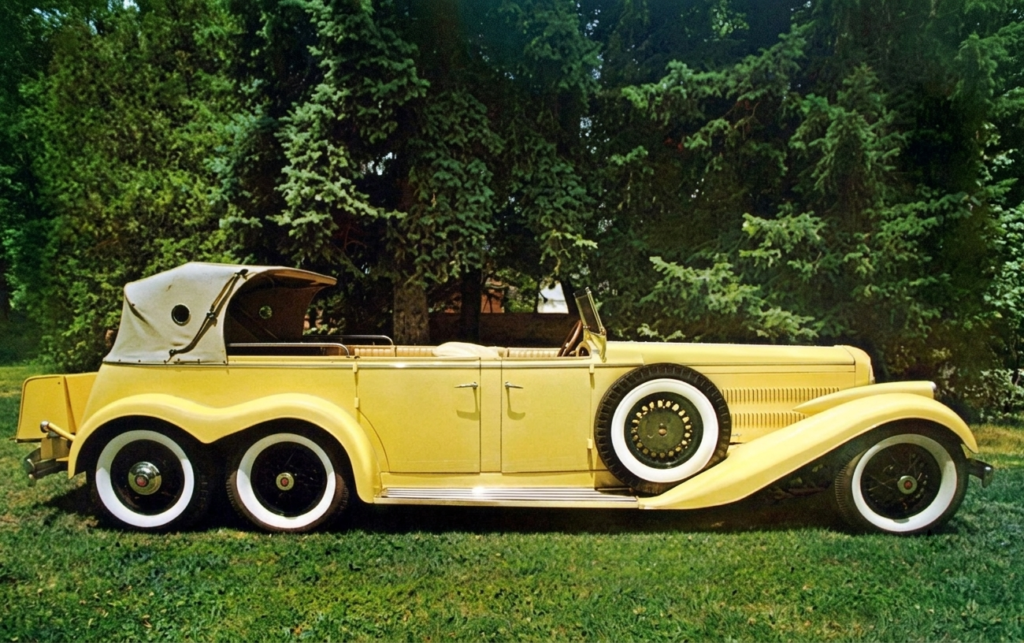
Long before the Tyrrell P34 put six wheels on the Formula 1 grid, there was already a spectacular road-going six-wheeler wearing one of the most prestigious badges in the world.
The Hispano-Suiza H6A was given a unique six-wheel body by French coachbuilder Leon Rubay. The car was reportedly intended for the King of Greece, but after he was forced to abdicate, the unusual machine eventually found its way into the hands of Hollywood director D.W. Griffith.
And Griffith didn’t exactly buy it on a whim.
The car reportedly cost an extraordinary US$35,000 at the time — a staggering amount of money in the early 1920s. It subsequently appeared in several films, including My Lips Betray, turning the already bizarre Hispano-Suiza into something of a Hollywood celebrity.
Underneath the enormous body was the sophisticated H6A chassis, powered by Hispano-Suiza’s famous 6.6-litre straight-six.
Specifications
| Specification | Hispano-Suiza H6A Six-Wheeler |
|---|---|
| Year | 1923 |
| Base model | Hispano-Suiza H6A |
| Engine | 6-cylinder inline |
| Capacity | 6,597cc |
| Transmission | 3-speed manual |
| Wheel configuration | Six wheels |
| Coachbuilder | Leon Rubay |
| Famous owner | D.W. Griffith |
| Original price | US$35,000 |
| Production | One-off |
It sounds like something from a Hollywood prop department.
Except it was real, enormously expensive, and actually drove on public roads.
2. 1976 TYRRELL P34
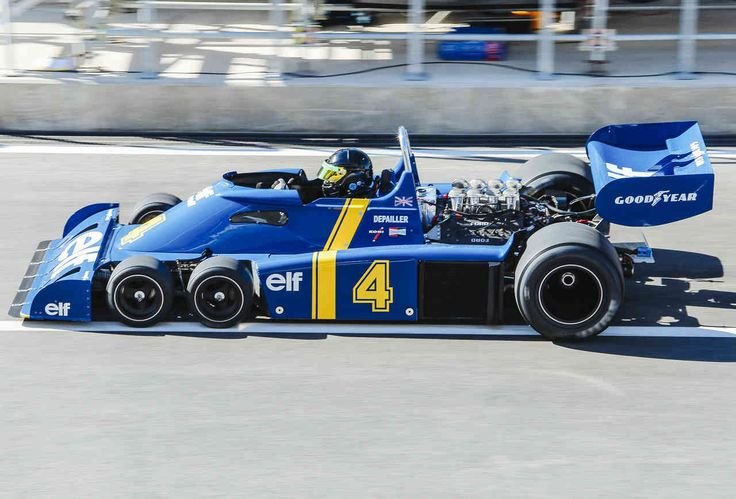
Now we arrive at the six-wheeler that everyone remembers.
The Tyrrell P34 remains the most famous six-wheeled racing car ever built — and for good reason.
Designed by Derek Gardner, the P34 used four tiny 10-inch wheels at the front and two conventional wheels at the rear.
Why?
Because Gardner wanted to reduce the aerodynamic disturbance created by the front wheels. By making the front wheels smaller, they could be tucked behind the front wing while still providing four contact patches.
It was wonderfully bonkers.
The P34 was powered by the legendary Ford-Cosworth DFV 3.0-litre V8, producing roughly 485bhp and driving the rear wheels through a Hewland gearbox.
And unlike many experimental racing cars, it actually won.
At the 1976 Swedish Grand Prix, Jody Scheckter took the P34 to victory, with Patrick Depailler finishing second.
That makes the Tyrrell P34 the only six-wheeled car ever to win a Formula 1 Grand Prix.
Specifications
| Specification | Tyrrell P34 |
|---|---|
| Year | 1976 |
| Engine | Ford-Cosworth DFV V8 |
| Capacity | 2,993cc |
| Power | Approx. 485bhp |
| Transmission | Hewland 5-speed |
| Drive | Rear-wheel drive |
| Wheels | Four front, two rear |
| Front wheel diameter | 10 inches |
| Weight | Approx. 595kg |
| Designer | Derek Gardner |
| Major achievement | Winner, 1976 Swedish GP |
The concept eventually ran into problems, particularly with tyre development and the complex behaviour of the four front tyres.
But one thing can’t be taken away from it:
It won a Formula 1 Grand Prix.
3. 1977 PANTHER 6
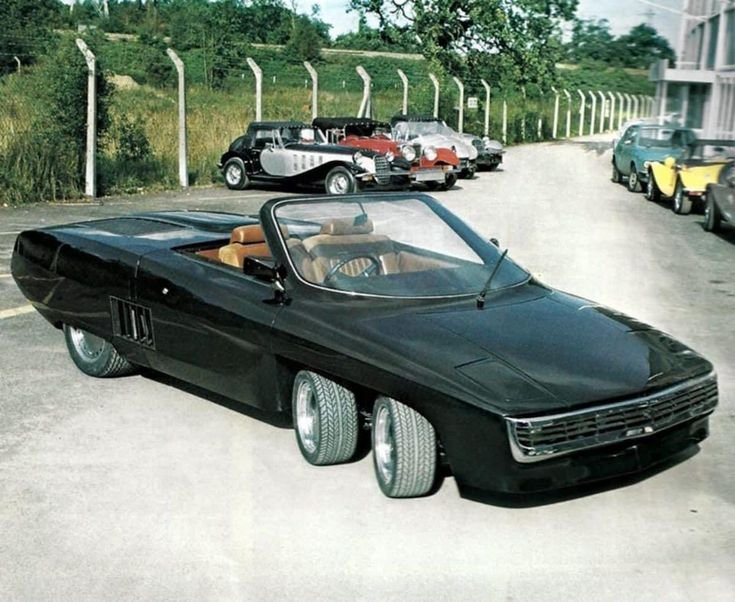
If the Tyrrell P34 was too sensible for you, meet the Panther 6.
The Panther 6 took the six-wheel idea and turned it into a road-going supercar that looked as though it had escaped from a particularly extravagant 1970s science-fiction film.
Designed by Robert Jankel of Panther Westwinds, the Panther 6 featured four steering wheels at the front and two driven wheels at the rear.
Underneath the enormous engine cover was an absolutely ridiculous 8.2-litre Cadillac V8, fitted with twin turbochargers.
Panther claimed around 600bhp and a potential top speed of more than 200mph — approximately 322km/h.
There was just one problem: that spectacular top-speed claim was never independently proven.
Still, the equipment list was ridiculous enough without it.
The Panther 6 featured air conditioning, electric seats, television and even a telephone.
Only two examples are known to have been built.
Specifications
| Specification | Panther 6 |
|---|---|
| Year | 1977 |
| Engine | Cadillac V8 twin-turbo |
| Capacity | 8.2 litres |
| Claimed power | Approx. 600bhp |
| Transmission | 3-speed automatic |
| Drive | Rear-wheel drive |
| Wheels | Four front, two rear |
| Claimed top speed | 200+ mph / 322+ km/h |
| Production | 2 cars |
| Designer | Robert Jankel |
It was less a car and more a rolling declaration that subtlety had been permanently cancelled.
4. 1978 SBARRO FUNCTION CAR
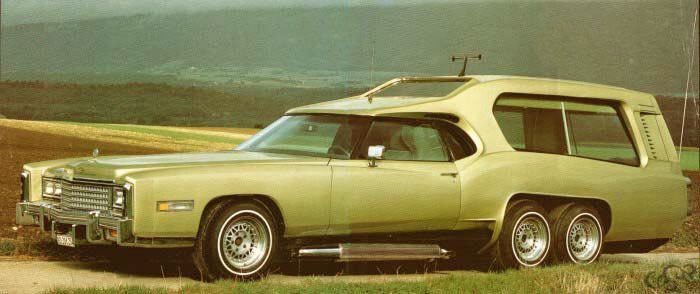
Franco Sbarro was not particularly interested in making normal cars.
The Sbarro Function Car is proof.
Based on a Cadillac Eldorado, this enormous six-wheeled machine was transformed into a kind of mobile executive lounge.
It stretched to around 7.2 metres, weighed approximately three tonnes and used a massive 8.2-litre Cadillac V8.
But the real party was inside.
The cabin included a television, telephone, refrigerator, freezer, coffee machine and work desks.
In other words, it was essentially an office on six wheels — decades before the phrase “mobile office” became fashionable.
Specifications
| Specification | Sbarro Function Car |
|---|---|
| Year | 1978 |
| Base model | Cadillac Eldorado |
| Engine | Cadillac V8 |
| Capacity | 8.2 litres |
| Power | Approx. 180bhp |
| Transmission | Automatic |
| Drive | Front-wheel drive |
| Wheels | Six |
| Length | Approx. 7.2m |
| Weight | Approx. 3,000kg |
| Equipment | TV, telephone, refrigerator, freezer, coffee machine |
| Status | One-off |
And unlike many crazy concept cars, the Function Car was actually used by its owner for journeys around Europe.
Imagine explaining that at a petrol station.
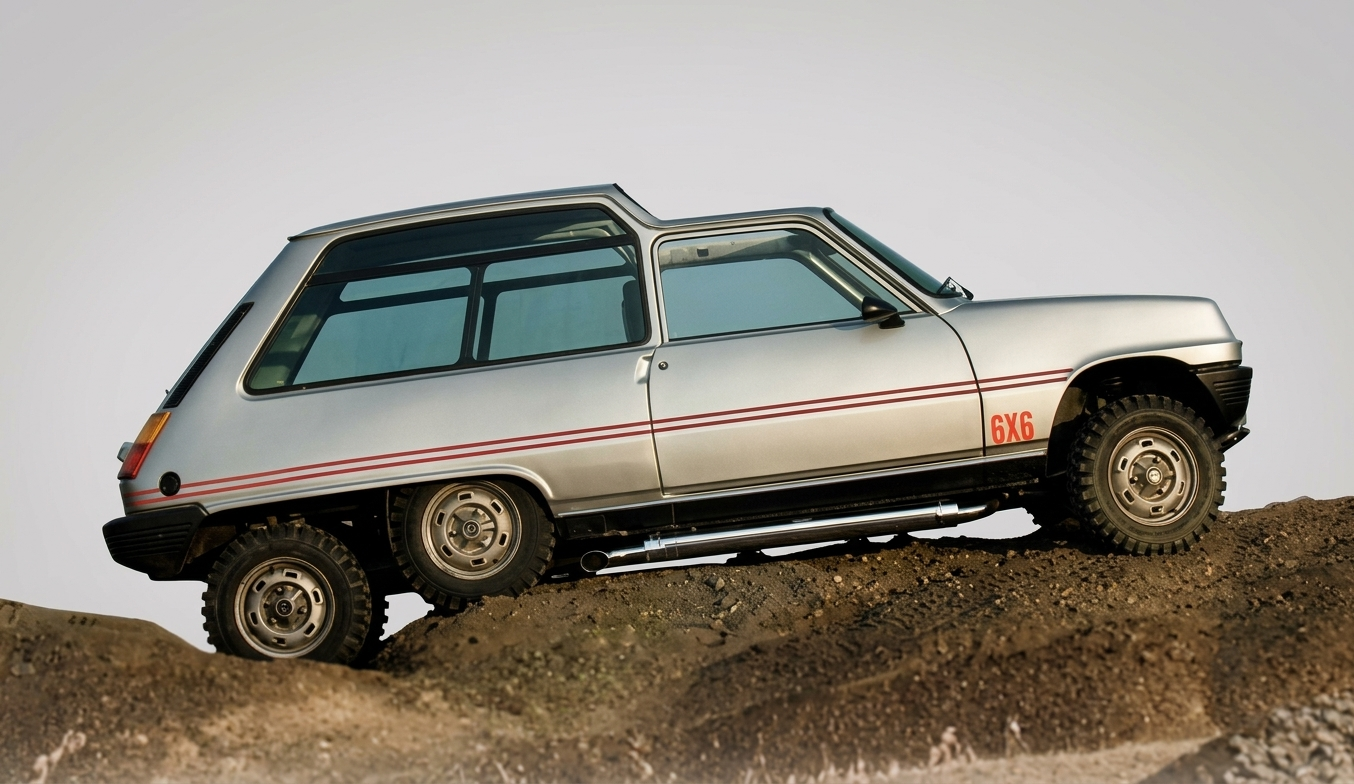
5. 1979 RENAULT 5 TURBO 6×6
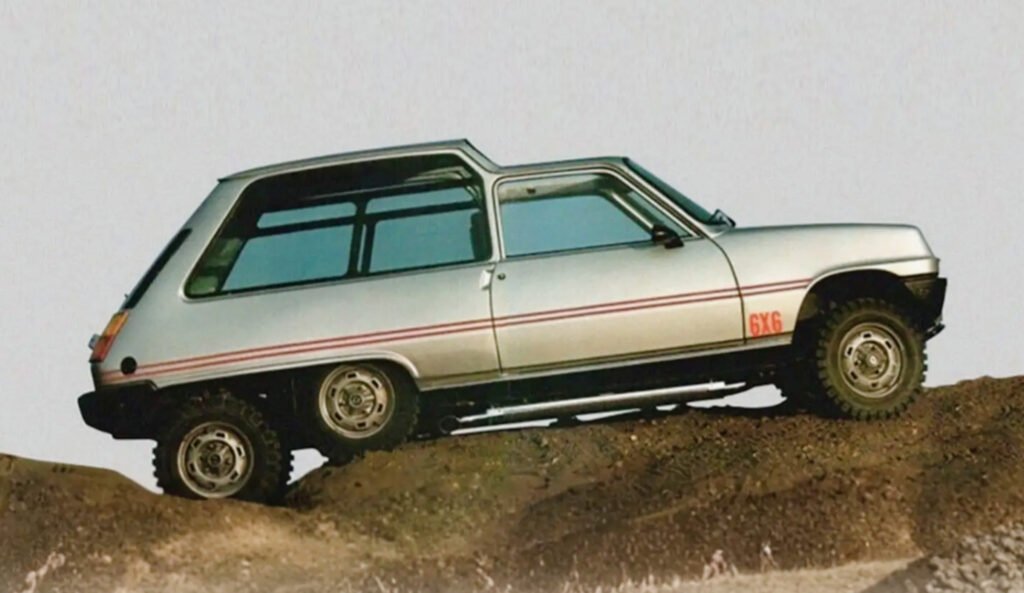
The Renault 5 was supposed to be a small, lightweight French hatchback.
Then Christian de Léotard got involved.
He transformed the humble Renault 5 into a six-wheeled machine measuring roughly 4.2 metres long, with the additional axle giving it a distinctly more serious stance.
But the most outrageous version was the Renault 5 Turbo 6×6.
This machine used two engines.
The rear engine was a turbocharged unit producing around 160bhp, while a Renault 5 Alpine engine producing approximately 93bhp powered the front wheels.
Yes, that means two engines and six driven wheels.
Specifications
| Specification | Renault 5 Turbo 6×6 |
|---|---|
| Year | 1979 |
| Base | Renault 5 / Renault 5 Turbo |
| Number of wheels | 6 |
| Drive | 6×6 |
| Rear engine | Turbo, 1.4-litre |
| Rear power | Approx. 160bhp |
| Front engine | R5 Alpine |
| Front power | Approx. 93bhp |
| Drive system | Hydrostatic all-wheel drive |
| Length | Approx. 4.2m |
| Weight | Approx. 980kg |
| Intended roles | Rally, police, ambulance, fire command |
The six-wheeled Renault was even adapted for roles including police, ambulance and fire-service command duties.
It wasn’t particularly successful in its Paris-Dakar adventure, but the idea itself was spectacular.
6. 1979 SBARRO WINDHAWK 6×6
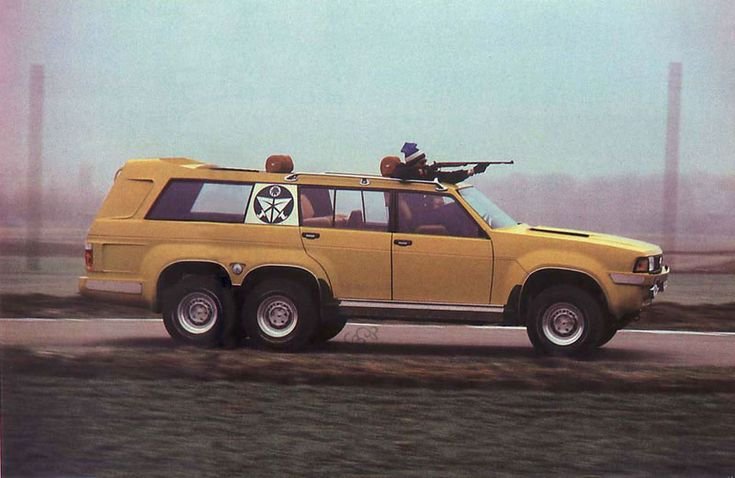
The Sbarro Windhawk might be the strangest hunting vehicle ever built.
It was commissioned for King Khaled of Saudi Arabia as a specialist vehicle for falcon hunting.
That meant it needed to cope with rough desert terrain while allowing its occupants to operate from the vehicle.
Sbarro’s answer was a huge six-wheeled machine powered by a 6.9-litre Mercedes-Benz V8 producing around 217bhp.
The really clever bit was the hydraulic system.
The driver’s or hunter’s seat could be raised by around 80 centimetres, giving the occupant a better view over the surrounding terrain.
Specifications
| Specification | Sbarro Windhawk 6×6 |
|---|---|
| Year | 1979 |
| Engine | Mercedes-Benz V8 |
| Capacity | 6.9 litres |
| Power | 217bhp |
| Transmission | 5-speed manual |
| Drive | 4WD + additional axle |
| Wheels | Six |
| Fuel capacity | Approx. 350 litres |
| Top speed | Approx. 180km/h |
| Special feature | Hydraulic seat lift |
| Purpose | Desert/falcon hunting |
A six-wheeler with a giant fuel tank and a hydraulic hunting seat.
Because apparently a Land Cruiser simply wasn’t dramatic enough.
7. 1980 BRIGGS & STRATTON HYBRID CONCEPT
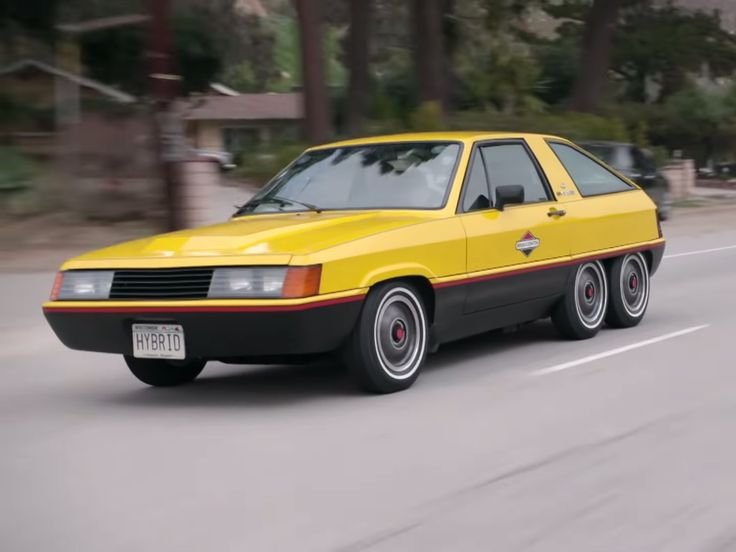
Here’s the one that deserves far more attention.
In 1980, Briggs & Stratton — a company better known for small engines and garden equipment — experimented with hybrid propulsion alongside industrial designer Brooks Stevens.
The result was a rather strange six-wheeled hybrid concept.
The car used a small two-cylinder petrol engine producing around 18bhp, combined with an electric motor producing roughly 8bhp.
The concept could operate using the petrol engine, electric motor or both.
And remember: this was 1980.
The Toyota Prius wouldn’t arrive until 1997.
The prototype was tested at around 68mph, or approximately 109km/h, with racing legend Richard Petty reportedly involved in testing.
Specifications
| Specification | Briggs & Stratton Hybrid |
|---|---|
| Year | 1980 |
| Petrol engine | 2-cylinder air-cooled |
| Petrol power | Approx. 18bhp |
| Electric motor | Approx. 8bhp |
| Hybrid system | Parallel hybrid |
| Transmission | 4-speed manual |
| Wheels | Six |
| Drive | Rear-wheel drive |
| Tested top speed | Approx. 109km/h |
| Status | Experimental prototype |
There are inconsistencies between historical sources regarding the exact battery configuration, but the basic idea remains remarkable.
A six-wheeled hybrid in 1980.
That’s the sort of thing that makes automotive history so much fun.
8. 1984 SAAB 906 TURBO
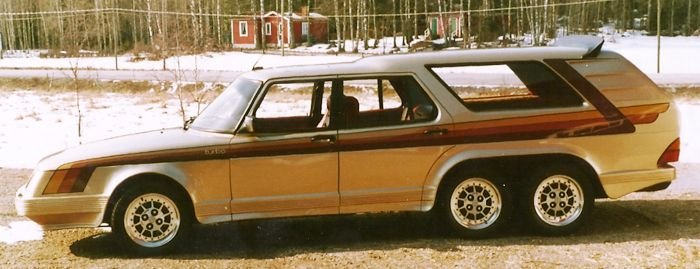
Saab has produced plenty of unusual cars over the decades.
But very few were as unusual as the Saab 906 Turbo.
Built by Swedish coachbuilder Leif Mellberg, the car was based on a Saab 900 GLS but stretched dramatically.
At approximately 5.3 metres long, it was essentially a Saab 900 that had discovered an unhealthy obsession with limousines.
An additional rear axle gave it six wheels, while the turbocharged engine produced around 145bhp.
And then there was the interior.
The 906 featured a video screen, a 16-speaker audio system, refrigerator, freezer, heater, police radio and radar detector.
Because apparently a normal Saab 900 wasn’t sufficiently equipped.
Specifications
| Specification | Saab 906 Turbo |
|---|---|
| Year | 1984 |
| Base model | Saab 900 GLS |
| Engine | Turbocharged 4-cylinder |
| Power | Approx. 145bhp |
| Drive | Front-wheel drive |
| Wheels | Six |
| Length | Approx. 5.3m |
| Interior | Video screen, 16-speaker audio |
| Other equipment | Refrigerator, freezer, heater |
| Additional equipment | Police radio, radar detector |
| Builder | Leif Mellberg |
| Status | One-off |
Sadly, the story eventually became rather less glamorous. The prototype was reportedly spotted in a scrapyard in Varberg, Sweden.
A six-wheeled Saab with a cinema-style interior deserved better.
9. 1997 DODGE RAM T-REX 6×6
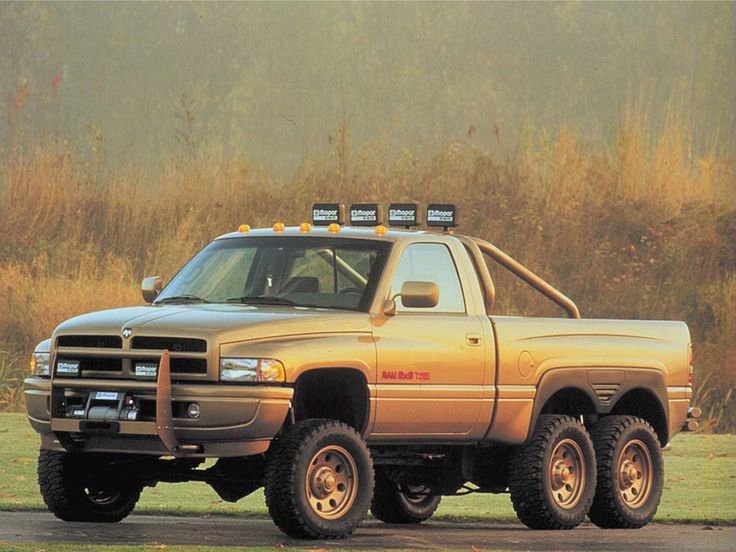
Long before six-wheeled Mercedes G-Class derivatives became internet royalty, Dodge had already built a six-wheeled monster.
The Dodge Ram T-Rex was unveiled as a concept for SEMA in 1997.
Based on the Ram 3500, it featured three axles, permanent six-wheel drive and a massive 8.0-litre Magnum V10.
Output was around 497bhp and 804Nm, while towing capacity was rated at approximately 26,000lb — around 11,800kg.
That’s enough to make most modern pickup trucks look slightly embarrassed.
Specifications
| Specification | Dodge Ram T-Rex |
|---|---|
| Year | 1997 |
| Base | Dodge Ram 3500 |
| Engine | Magnum V10 |
| Capacity | 8.0 litres |
| Power | Approx. 497bhp |
| Torque | Approx. 804Nm |
| Transmission | 4-speed automatic |
| Drive | 6×6 |
| Payload | Approx. 2,267kg |
| Towing capacity | Approx. 11,800kg |
| Suspension | Air suspension |
| Debut | SEMA |
| Status | Concept |
The T-Rex showed that the six-wheel pickup idea was alive in America long before the modern wave of extreme 6×6 trucks.
10. 2004 COVINI C6W
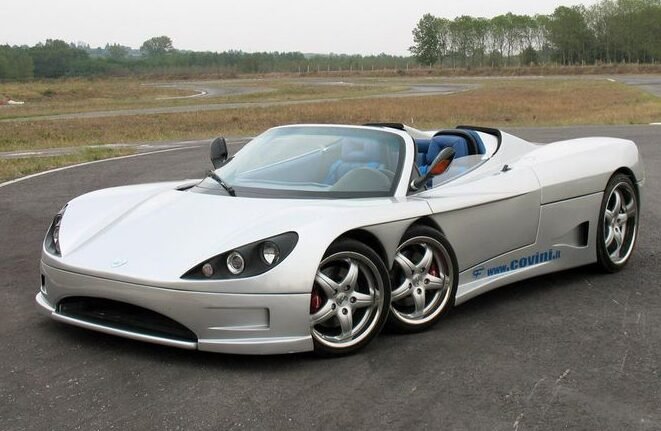
The final car on our list is also one of the most convincing.
The Covini C6W took the basic philosophy of the Tyrrell P34 and attempted to turn it into a proper road-going supercar.
Instead of two front wheels, it had four. Instead of a tiny Cosworth V8, it used an Audi 4.2-litre V8 mounted in the middle.
Power was approximately 440bhp, sent to the rear wheels through a six-speed manual gearbox.
The car weighed around 1,150kg, and Covini claimed a top speed of approximately 300km/h.
Unlike many obscure prototypes, the C6W wasn’t merely a drawing. It was demonstrated publicly, including an appearance at the Goodwood Festival of Speed.
Specifications
| Specification | Covini C6W |
|---|---|
| Year | 2004 |
| Engine | Audi V8 |
| Capacity | 4.2 litres |
| Power | Approx. 440bhp |
| Torque | Approx. 470Nm |
| Transmission | 6-speed manual |
| Drive | Rear-wheel drive |
| Wheels | Four front + two rear |
| Weight | Approx. 1,150kg |
| Length | Approx. 4.18m |
| Width | Approx. 1.99m |
| Claimed top speed | Approx. 300km/h |
| Status | Limited production |
It was effectively a road-going answer to the question:
What if Tyrrell had decided to build a supercar?
SO, WHY DID SIX-WHEELED CARS NEVER TAKE OVER?
That’s the interesting question.
Six wheels can offer genuine advantages.
More tyres mean potentially more grip. An additional axle can improve load distribution. On commercial vehicles, extra wheels can help with payload capacity. In the case of the Tyrrell P34, the extra front wheels were intended to provide aerodynamic and handling advantages.
But there is a price.
More wheels mean more tyres, more suspension components, more steering hardware, more weight and greater mechanical complexity.
And when you’re building millions of cars, simplicity wins.
That’s why the six-wheeler remained an oddball solution rather than becoming the next big thing.
There’s something wonderfully refreshing about these cars.
They weren’t necessarily sensible. They weren’t always successful. Some were spectacularly impractical.
But they were brave.
The engineers and designers behind them were willing to challenge one of the most basic assumptions in automotive design: that a car needs four wheels.
Some experiments failed. Others became automotive icons. And one of them — the Tyrrell P34 — actually won a Formula 1 Grand Prix.
Personally, that’s what makes the six-wheeler story so fascinating. It’s not really about whether six wheels are better than four.
It’s about what happens when automotive designers are given permission to ask a completely ridiculous question and then actually build the answer.
And let’s be honest: a 6.9-litre Mercedes V8 hunting machine with a hydraulic seat, a two-engine Renault 5, and a 497bhp Dodge Ram 6×6 are exactly the sort of machines that make the history of the automobile worth digging through.
The modern car industry is extraordinarily clever, but it can also be remarkably conservative.
Perhaps that’s why these forgotten six-wheelers still feel so special.
They remind us that, occasionally, the best automotive ideas begin with someone saying:
“Why not?”
WHAT DO YOU THINK?
Which of these six-wheelers would you most like to see brought back to life?
Would you choose the outrageous Panther 6, the race-winning Tyrrell P34, the bizarre Sbarro Windhawk, or the ridiculous Dodge Ram T-Rex 6×6?
And if you were given a blank sheet of paper to design your own six-wheeled car, where would you put the extra axle?
Tell us what you think in the comments.
Six-Wheel Cars, Tyrrell P34, Classic Cars, Automotive History, Weird Cars

Adhe is part of the 88 Eight Box Editorial Team, covering JDM culture, motorsport, automotive technology, and industry news. The team focuses on delivering original automotive stories, reviews, and insights for enthusiasts worldwide.