The FIA is tightening the technical requirements for Formula 1’s active aerodynamic systems ahead of the 2027 season, introducing a shorter transition-time limit that could present a new engineering challenge for teams using unconventional rear-wing designs.
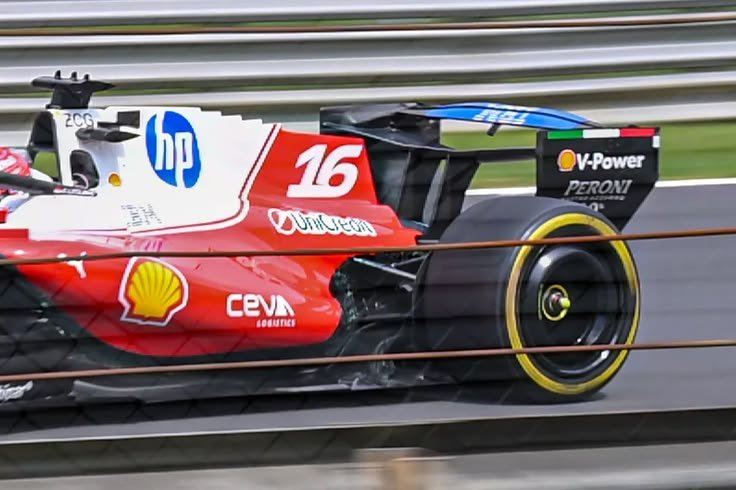
The change comes amid growing interest in the so-called “Macarena wing,” a rotating rear-wing concept that attracted considerable attention in 2026, particularly through the development programmes of Ferrari and Red Bull Racing.
Under the FIA’s 2027 Formula 1 Technical Regulations, Issue 3, dated October 1, 2026, the maximum permitted transition time for the front- and rear-wing adjustment systems is reduced from 400 milliseconds to 300 milliseconds. The revised regulations were approved by the FIA World Motor Sport Council on September 30, 2026.
The reduction amounts to 100 milliseconds, or 25%, placing a tighter limit on how quickly the active aerodynamic systems must move between their prescribed positions.
However, the change does not constitute a blanket ban on the Macarena wing. Instead, it establishes a stricter technical requirement that teams must meet when developing their active aerodynamic systems.
WHAT IS THE MACARENA WING?
The Macarena wing is an unconventional interpretation of Formula 1’s active aerodynamic technology. Rather than relying solely on a conventional adjustment of the rear-wing flap, the concept rotates the aerodynamic element through a much more dramatic movement, including an inverted position in straight-line mode.
Ferrari attracted widespread attention with its design during pre-season testing in Bahrain in 2026 before introducing it at a race weekend in China. Red Bull subsequently developed its own interpretation, bringing the concept into the spotlight again at the Miami Grand Prix.
The principle behind the design is to reduce aerodynamic drag on the straights while retaining the downforce needed for cornering.
In straight-line mode, the altered wing geometry changes the airflow between the aerodynamic elements, potentially reducing drag and improving top speed. When the car returns to cornering mode, the wing moves back into its conventional configuration to generate the downforce required for grip and stability.
The concept demonstrates how teams continue to explore innovative solutions within Formula 1’s active-aerodynamics framework.
FIA REDUCES THE TRANSITION-TIME LIMIT TO 300 MILLISECONDS
The revised 2027 regulations establish a maximum transition time of 300 milliseconds for the front- and rear-wing adjustment systems.
The transition is measured from the moment the FIA Standard ECU issues the command to change aerodynamic modes until the relevant position sensor confirms that the wing has reached its commanded position.
The new requirement represents a significant tightening of the permitted operating window.
Previous maximum transition time: 400 milliseconds.
New maximum transition time: 300 milliseconds.
Reduction: 100 milliseconds, equivalent to 25%.
Although the difference may appear small, it places additional demands on the mechanical and electronic systems responsible for controlling the wings.
Teams must ensure that their actuators, linkages, sensors and control systems can complete the required movement within the permitted time while maintaining reliability and operating within the regulations.
The requirement applies to the specified active aerodynamic systems, rather than exclusively targeting one manufacturer’s design.
WHY THE CHANGE MATTERS FOR FERRARI AND RED BULL
Ferrari and Red Bull have both explored rotating rear-wing concepts, but their designs do not necessarily use identical mechanical arrangements.
That distinction could prove important as teams work to comply with the revised requirements. The engineering challenge will depend on each system’s existing capabilities, mechanical complexity and ability to complete the transition reliably.
A shorter permitted transition time could prompt engineers to reassess actuator response, mechanical tolerances, structural loads and control-system calibration.
However, it would be premature to conclude that Ferrari or Red Bull must completely redesign their respective systems. The regulations establish the required performance threshold, while the extent of any necessary changes will depend on whether each design already complies.
Nor does the published technical requirement explicitly establish that Ferrari’s Macarena wing is the sole target of the change. The revised limit forms part of the wider regulatory framework governing active aerodynamics.
SAFETY AND RELIABILITY REMAIN KEY CONSIDERATIONS
Active aerodynamic systems introduce moving components that must operate consistently under the demanding conditions of a Formula 1 race.
A malfunction that leaves a wing in an unintended position could affect aerodynamic balance, drag and downforce. Depending on the circumstances, this could compromise vehicle stability and make the car more difficult to control.
The FIA’s technical regulations therefore address more than transition speed alone. They also prescribe requirements for system control, position sensing and mechanical limits, while requiring teams to consider potential failure modes.
These measures are particularly relevant to designs involving complex rotating mechanisms.
Nevertheless, the revised 300-millisecond limit should not be interpreted as evidence that the Macarena wing is inherently unsafe. It is a technical requirement intended to ensure that active aerodynamic systems operate within the prescribed conditions.
THE MACARENA WING HAS NOT BEEN BANNED
Despite the tighter requirements, the rotating rear-wing concept has not been prohibited simply by the introduction of the new transition-time limit.
The 2027 regulations continue to define the operation of active aerodynamic systems through prescribed Corner Mode and Straight Mode positions, alongside requirements governing their movement and control.
Teams can therefore continue exploring alternative aerodynamic solutions, provided their systems satisfy all applicable technical regulations.
The challenge is to retain the potential performance advantages of the rotating-wing concept while meeting the stricter transition-time requirement and maintaining dependable operation throughout a race weekend.
Whether the concept remains competitive in 2027 will depend on the effectiveness of each team’s engineering solution, its aerodynamic performance and its ability to comply with the revised rules.
A NEW ENGINEERING CHALLENGE FOR F1 2027
Formula 1’s active-aerodynamics regulations have opened the door to new engineering approaches, with the Macarena wing becoming one of the most distinctive examples of how teams interpret the available technical freedom.
The FIA’s revised transition-time limit highlights the continuing relationship between technical innovation and regulation. As teams search for performance advantages, the governing body establishes measurable requirements intended to ensure that their solutions remain compliant.
For Ferrari, Red Bull and other teams pursuing unconventional active aerodynamic designs, the priority will be to balance aerodynamic efficiency, mechanical reliability and regulatory compliance.
The Macarena wing may continue to feature in Formula 1’s aerodynamic development race in 2027, but its future will depend on whether teams can make the concept work within the tighter technical framework.

Adhe is part of the 88 Eight Box Editorial Team, covering JDM culture, motorsport, automotive technology, and industry news. The team focuses on delivering original automotive stories, reviews, and insights for enthusiasts worldwide.