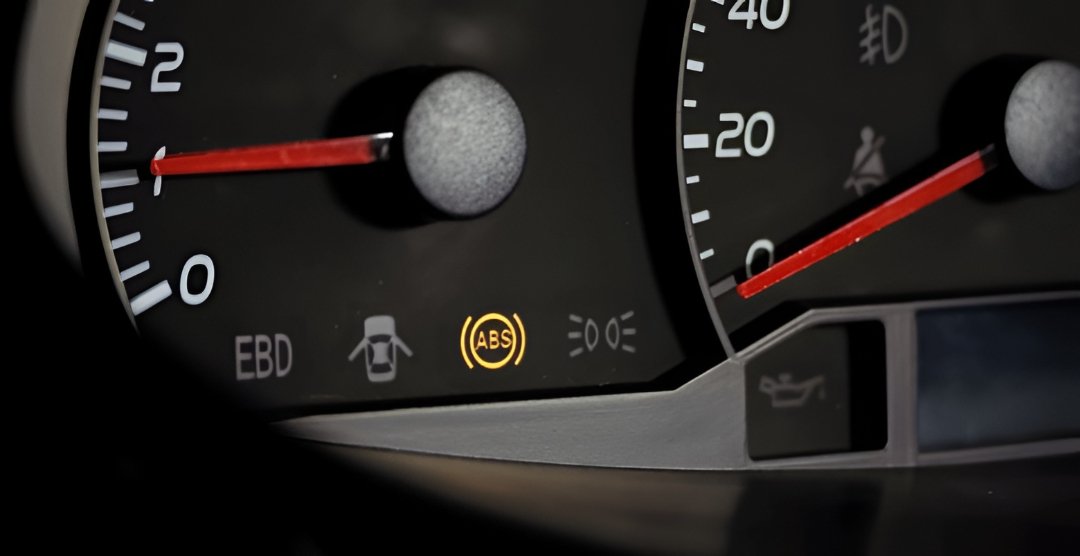
Seeing the ABS warning light illuminate on your dashboard can be alarming, but it does not automatically mean your car has lost all braking ability. In many vehicles, an illuminated ABS warning light means the anti-lock braking function has been disabled or detected a fault, while the conventional hydraulic braking system can continue to operate normally.
The important part is understanding the difference and knowing when you should stop driving altogether.
THERE IS NO “SAFE” NUMBER OF MILES
There is no universal distance or amount of time that a car can safely be driven with the ABS warning light on. The answer depends on what caused the warning and whether the normal braking system is still functioning correctly.
Several manufacturers state that when the ABS warning light remains illuminated, conventional braking can continue to work even though the anti-lock function is unavailable. Ford, for example, says a vehicle will continue to have normal braking without ABS and recommends having the system checked as soon as possible. A Jeep owner manual similarly explains that the conventional brake system continues to operate normally when the ABS warning light is illuminated.
That means a car with only an ABS warning light may be driven cautiously for the short distance necessary to reach a safe location or repair facility provided the brake pedal feels normal and there are no other serious symptoms.
It should not be interpreted as permission to continue driving normally for days or weeks.
WHAT DOES ABS ACTUALLY DO?
The Anti-lock Braking System is designed to prevent the wheels from locking during heavy braking.
Modern ABS systems use wheel-speed sensors to constantly monitor how quickly each wheel is rotating. The information is sent to an electronic control unit, which can command hydraulic valves and a pump to reduce and restore brake pressure at individual wheels when a lock-up is detected. This happens automatically and rapidly while the driver maintains pressure on the brake pedal.
The major advantage is that the driver can maintain more steering control during hard braking, particularly when the road surface has different levels of grip. Bosch notes that ABS helps maintain vehicle steerability and stability during emergency braking and varying road conditions.
Without functioning ABS, the basic brakes may still stop the car, but the wheels can potentially lock under heavy braking. That can make the vehicle harder to steer and can be particularly dangerous on wet, snowy, icy or otherwise slippery roads.
So if the ABS light comes on, reduce your speed, leave more space between your vehicle and the traffic ahead, and avoid situations that could require sudden emergency braking.
WHY DOES THE ABS LIGHT COME ON?
The warning light does not necessarily mean the ABS control module itself has failed.
One of the most common possibilities is a faulty wheel-speed sensor. These sensors are exposed to water, dirt, road debris, heat and physical damage, and a problem with a sensor or its wiring can prevent the ABS control unit from receiving reliable wheel-speed information.
HELLA’s technical diagnostic guidance lists broken wiring, short circuits, external damage, contamination, excessive wheel-bearing clearance and damage to the encoder or impulse ring among possible causes of wheel-speed sensor faults. Its recommended diagnostic process also includes checking battery voltage, fuses, wiring, wheel bearings, brake-fluid level and brake-pad condition.
A problem with a wheel bearing or hub can therefore trigger an ABS warning as well. Some modern wheel bearings incorporate the magnetic encoder or tone ring used by the wheel-speed sensor, making the condition of the hub assembly important when diagnosing an ABS fault.
Other possibilities include electrical problems, damaged connectors, a blown fuse, low brake fluid or faults elsewhere in the vehicle’s electronic brake-control system. On some vehicles, the ABS warning system is also connected to brake-assist or stability-control functions.
That is why replacing an ABS sensor without properly diagnosing the fault code can be a waste of money. The fault code is a starting point, not automatically proof that the sensor itself is defective.
THE BIG WARNING: ABS AND BRAKE LIGHTS TOGETHER
This is where the situation becomes much more serious.
Most vehicles have a separate brake-system warning indicator, often shown in red. Depending on the vehicle, this warning can be associated with conditions such as low brake-fluid level, a brake-system fault or other problems affecting conventional braking.
Toyota, for example, specifically warns that when the ABS and brake-system warning lights remain illuminated together, the vehicle can become extremely unstable during braking and the driver should stop in a safe location immediately.
In other words, an ABS light by itself can indicate a loss of anti-lock functionality. An ABS light combined with a red brake warning light can indicate that the problem extends beyond ABS and potentially affects the normal braking system.
Do not treat those two situations as equivalent.
STOP IMMEDIATELY IF THE BRAKES FEEL WRONG
Even if only the ABS light is illuminated, the warning should not be ignored if the vehicle begins behaving differently.
Stop driving and have the car inspected if you notice a soft or sinking brake pedal, significantly increased stopping distance, unusual brake noises, fluid leaking from the braking system, severe pulling under braking, grinding, or any other indication that the normal brakes are no longer working as they should.
A functioning ABS light does not guarantee that the underlying braking system is healthy. The warning is telling you that the vehicle has detected a problem that needs diagnosis.
WHAT SHOULD YOU DO WHEN THE LIGHT COMES ON?
If the ABS warning appears while driving and the brake pedal still feels normal, stay calm. Avoid hard braking, slow down and increase your following distance. Be particularly cautious in heavy rain or on slippery surfaces because you may no longer have the anti-lock function available.
Then arrange an inspection as soon as possible.
A technician will normally begin by scanning the ABS control module for stored fault codes and checking the wheel-speed sensors and their wiring. Depending on the diagnosis, the inspection may also include the wheel bearings, encoder rings, fuses, battery voltage, brake-fluid level and mechanical brake components.
And don’t assume that a specific mileage automatically means your brake pads need replacement. Brake-pad life varies considerably with vehicle type, driving style, traffic, terrain and load. Firestone, for example, gives a broad typical range of roughly 25,000 to 65,000 miles, illustrating why manufacturer maintenance schedules and actual pad condition are more useful than a single universal mileage figure.
An illuminated ABS warning light does not necessarily mean you have no brakes. In many vehicles, the conventional braking system remains operational while the anti-lock function is unavailable.
But there is no magic number of miles that is considered safe.
Treat the warning as a “get it checked now” situation, not a “keep driving until something breaks” situation.
If the ABS light is the only warning, the pedal feels normal and the car brakes normally, cautious short-distance driving to a safe location or qualified repair facility may be possible. If the ABS light appears together with the red brake warning light or the brakes feel abnormal the safest decision is to stop driving and seek assistance immediately.

Adhe is part of the 88 Eight Box Editorial Team, covering JDM culture, motorsport, automotive technology, and industry news. The team focuses on delivering original automotive stories, reviews, and insights for enthusiasts worldwide.