When a Formula 1 Safety Car enters the circuit today, nobody is surprised to see a Mercedes-AMG or Aston Martin.
But it wasn’t always this way.
Before Formula 1 had permanent official Safety Car suppliers, race organisers could use almost anything with four wheels that was considered suitable for controlling the field. The result was one of the strangest automotive timelines in F1 history.
From a humble Porsche 914 to Lamborghini V12s, family sedans, hot hatches and, eventually, 700-horsepower AMG monsters, here is how the F1 Safety Car evolved.
1973 — PORSCHE 914
Period: 1973
Race: Canadian Grand Prix
This is where the story begins.
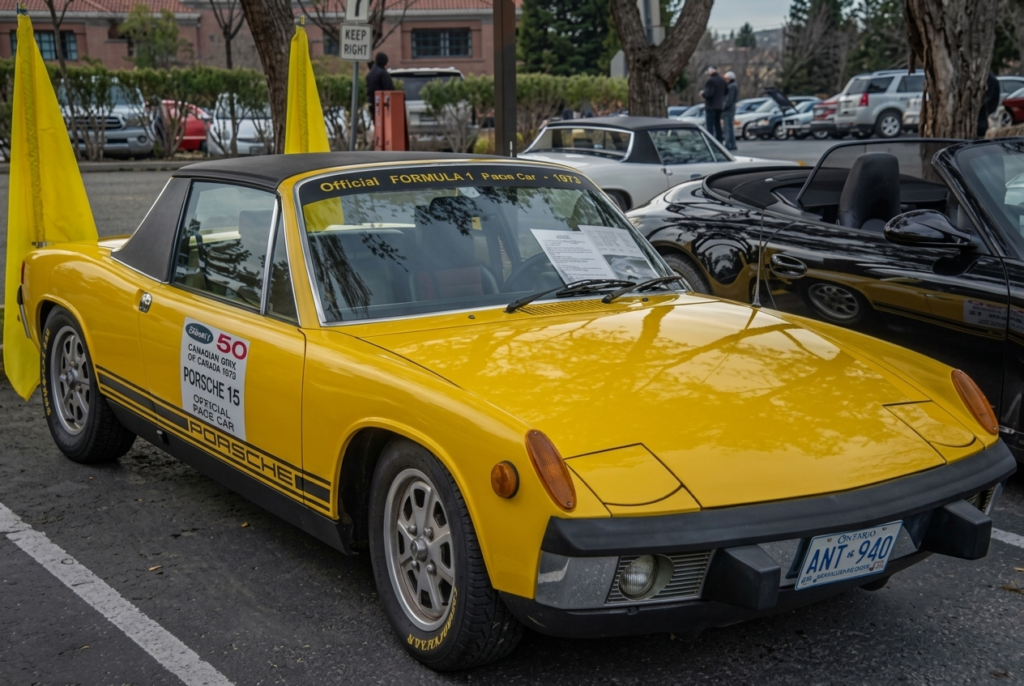
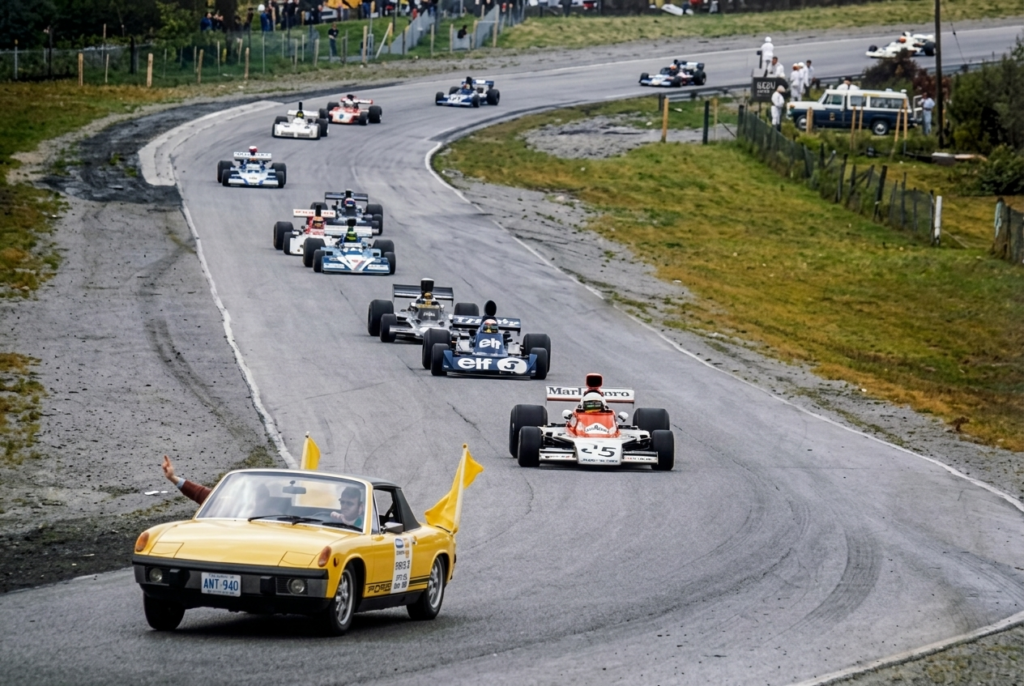
At the rain-soaked 1973 Canadian Grand Prix, officials deployed a yellow Porsche 914 at Mosport Park after a series of incidents created chaotic conditions.
Canadian racing driver Eppie Wietzes was behind the wheel.
The debut was hardly perfect. The Porsche picked up the wrong leading car, creating confusion over the running order and even contributing to several cars effectively being placed a lap down.
But despite the chaos, F1 had just created something that would become essential to modern Grand Prix racing.
The Safety Car was born.
1981–1983 — LAMBORGHINI COUNTACH
Period: 1981–1983
Races: Monaco Grand Prix
Now things started getting interesting.
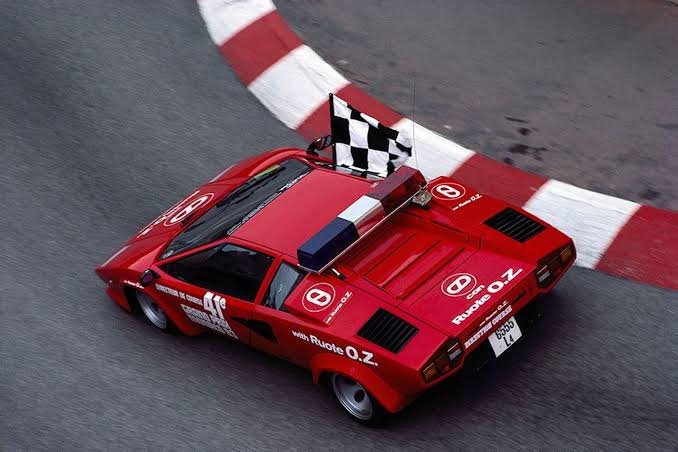
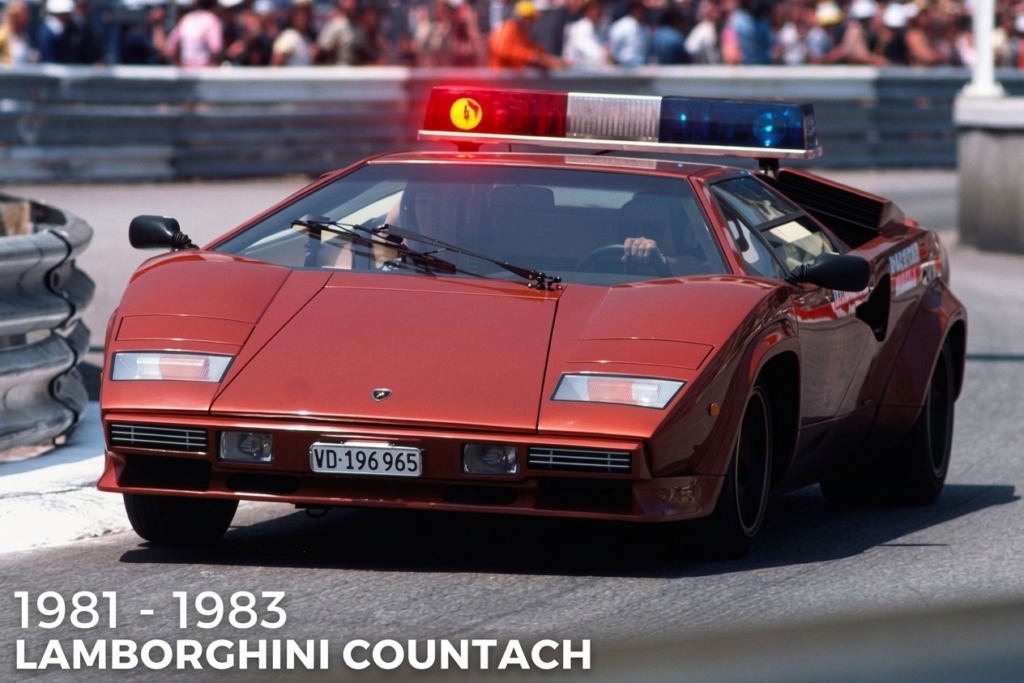
The Safety Car returned at Monaco in 1981 in the form of a Lamborghini Countach.
And unlike the Porsche 914, this thing looked like it belonged in a James Bond film.
The Countach also returned for the 1982 and 1983 Monaco Grands Prix, making it one of the most memorable early Safety Cars in F1 history.
A V12 Lamborghini leading Formula 1 cars around the streets of Monte Carlo?
That is difficult to make more 1980s than this.
1993 — FIAT TEMPRA 16V
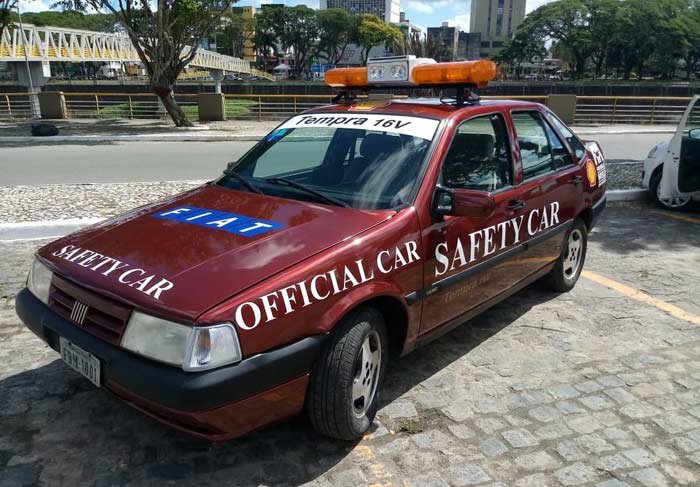
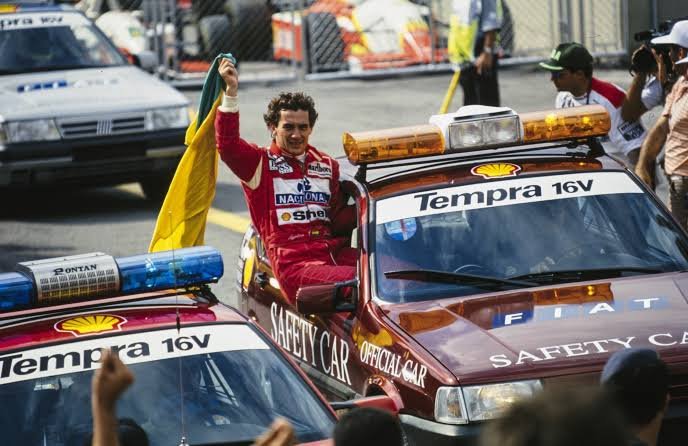
Period: 1993
Race: Brazilian Grand Prix
After another decade-long disappearance, the Safety Car became a regular feature of F1 from the 1993 season.
And the first wave of this new era was gloriously unpredictable.
At Brazil, officials used a Fiat Tempra 16V.
Yes, a Fiat sedan.
While F1 drivers were attacking Interlagos in purpose-built single-seaters, the field could suddenly find itself following a Tempra.
It perfectly illustrates how different the Safety Car concept was at the time: individual race organisers were responsible for supplying their own cars.
1993 — FORD ESCORT RS COSWORTH
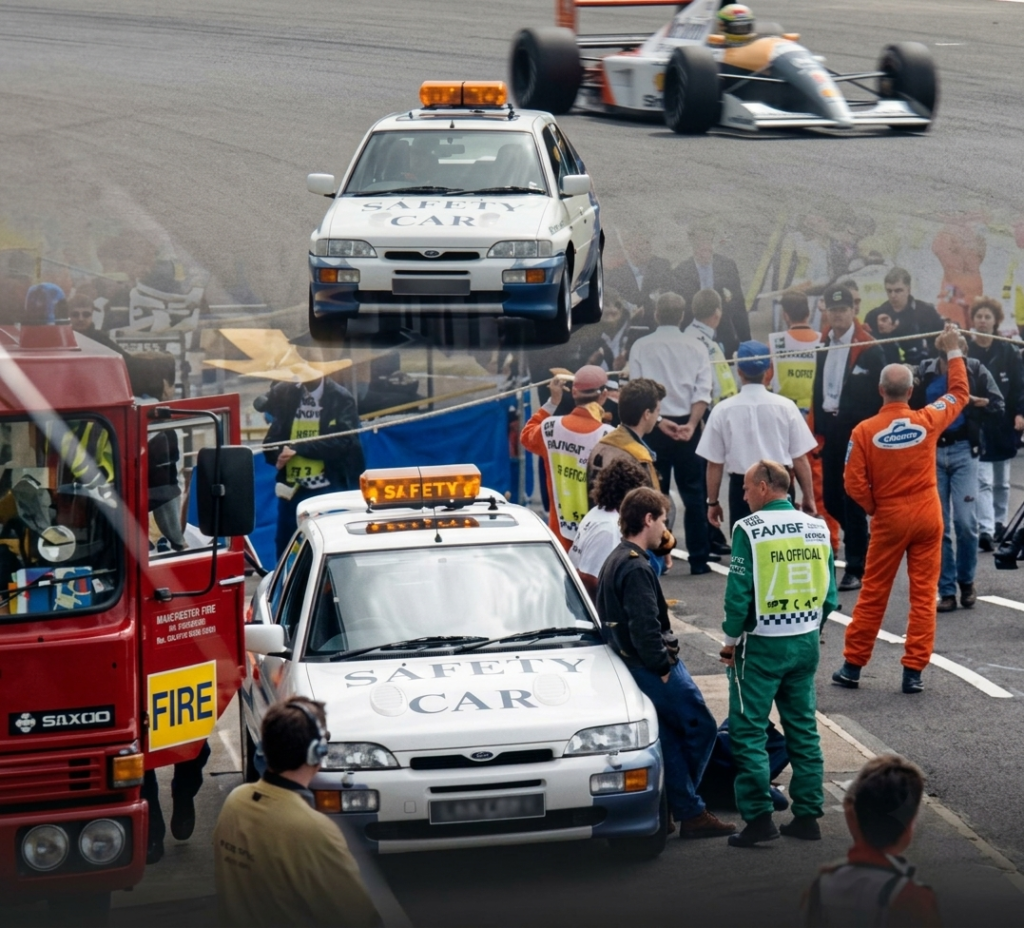
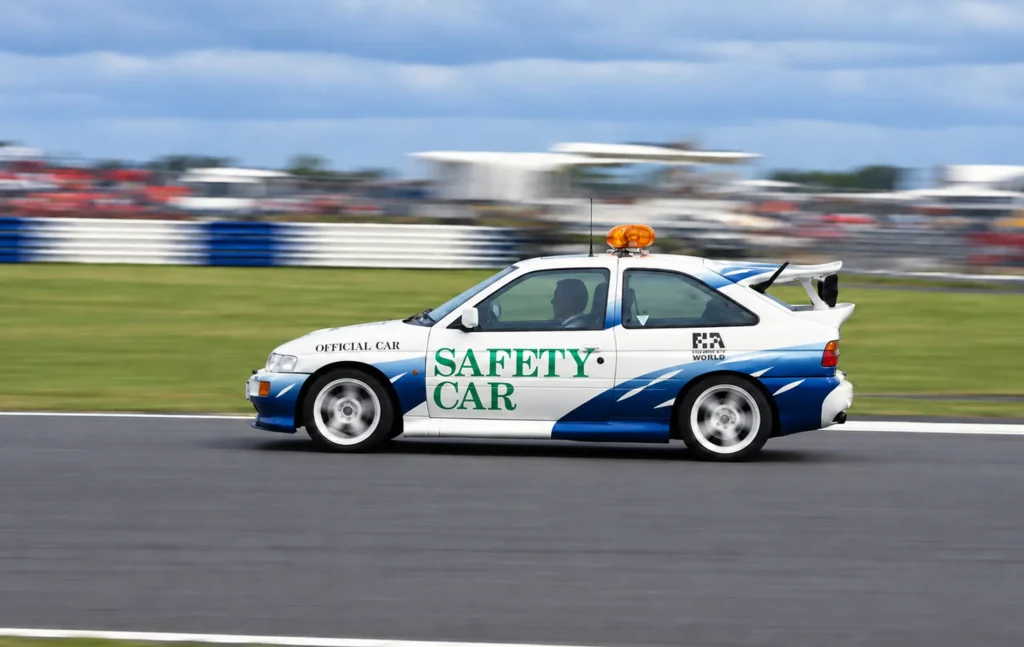
Period: 1993
Race: British Grand Prix
Silverstone received something considerably more serious.
The Ford Escort RS Cosworth served as the Safety Car at the 1993 British Grand Prix.
With its turbocharged engine, four-wheel drive and enormous rear wing, the Escort Cosworth was one of the most performance-focused road cars of its era.
Compared with the Tempra, this looked like it actually wanted to be there.
1994 — OPEL VECTRA
Period: 1994
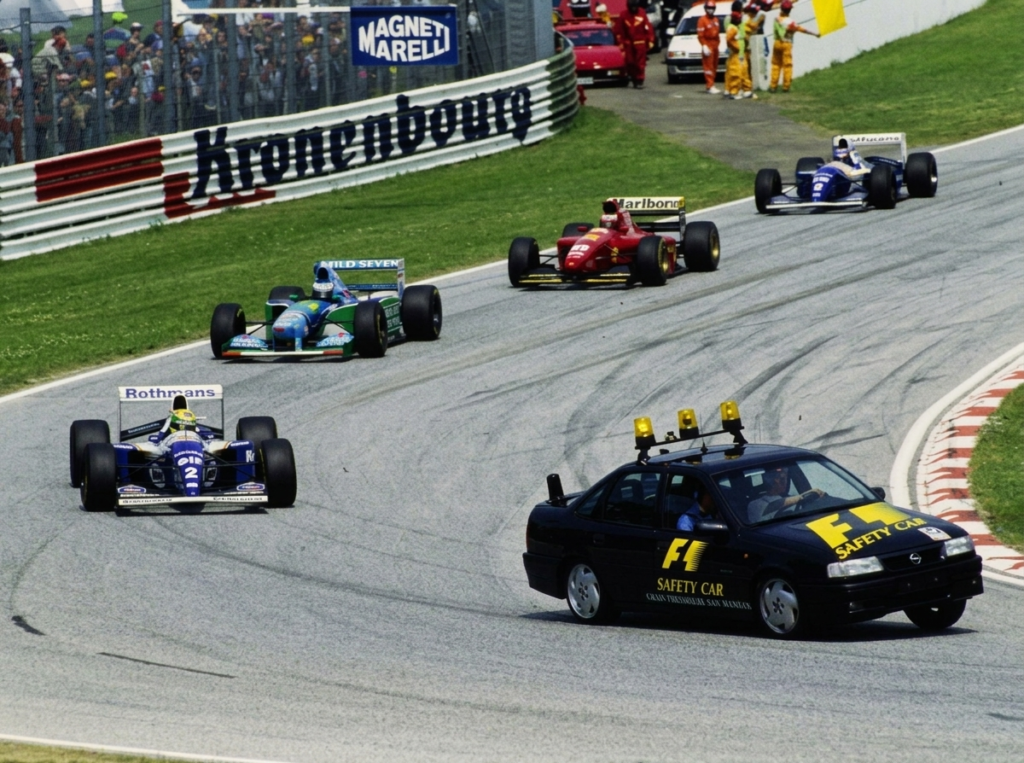
Race: San Marino Grand Prix
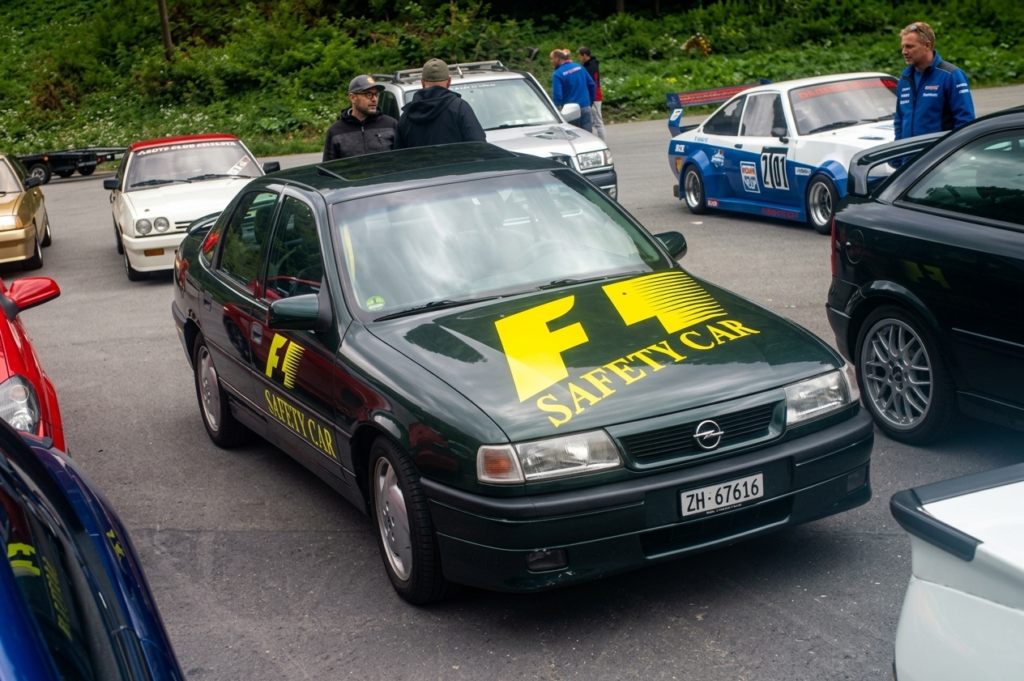
The 1994 San Marino Grand Prix used an Opel Vectra as its Safety Car.
This was hardly a supercar.
But it was another example of the fascinating variety that existed before F1 standardised the role.
The 1990s Safety Car could be a performance car one weekend and an ordinary-looking road car the next.
1994 — HONDA PRELUDE
Period: 1994
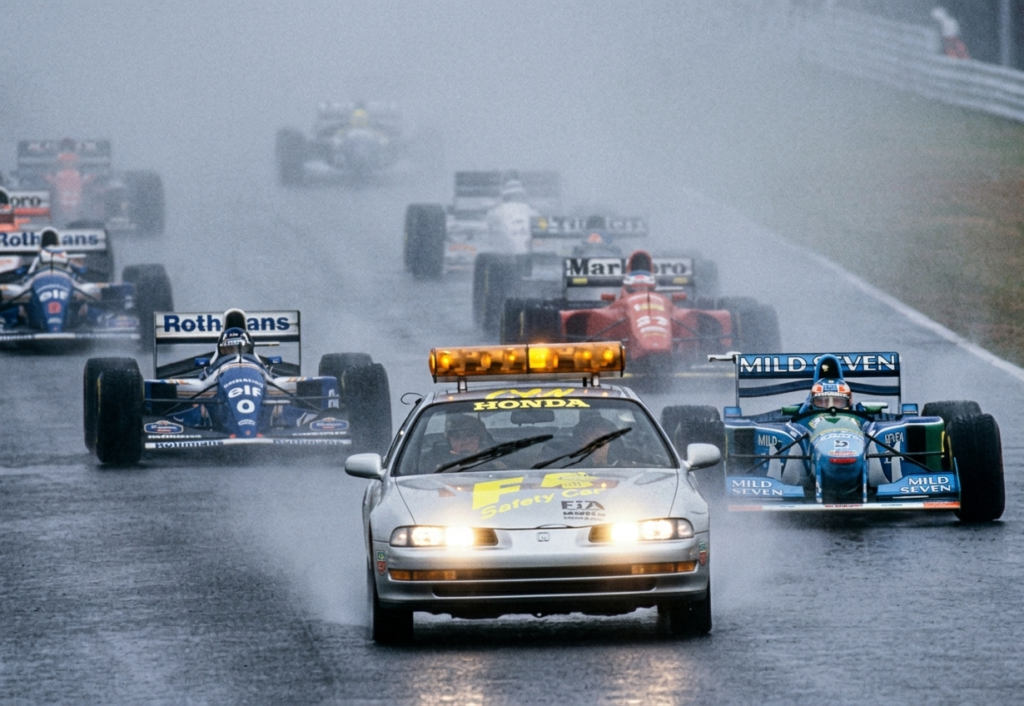
Race: Japanese Grand Prix
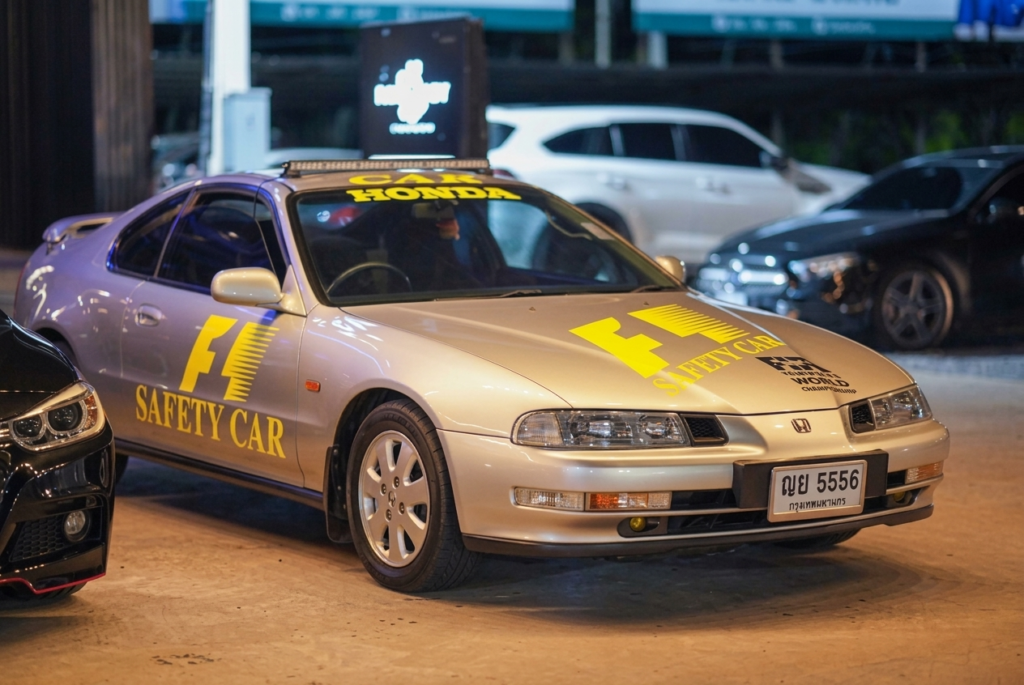
Suzuka got a Honda Prelude.
The Prelude was a sporty front-wheel-drive coupe, but seeing one leading a field of screaming V10- and V8-powered F1 machines was still an unusual sight.
Today, a Prelude leading a modern F1 grid would look almost surreal.
Back then, it was simply part of the job.
1995 — PORSCHE 911 GT2
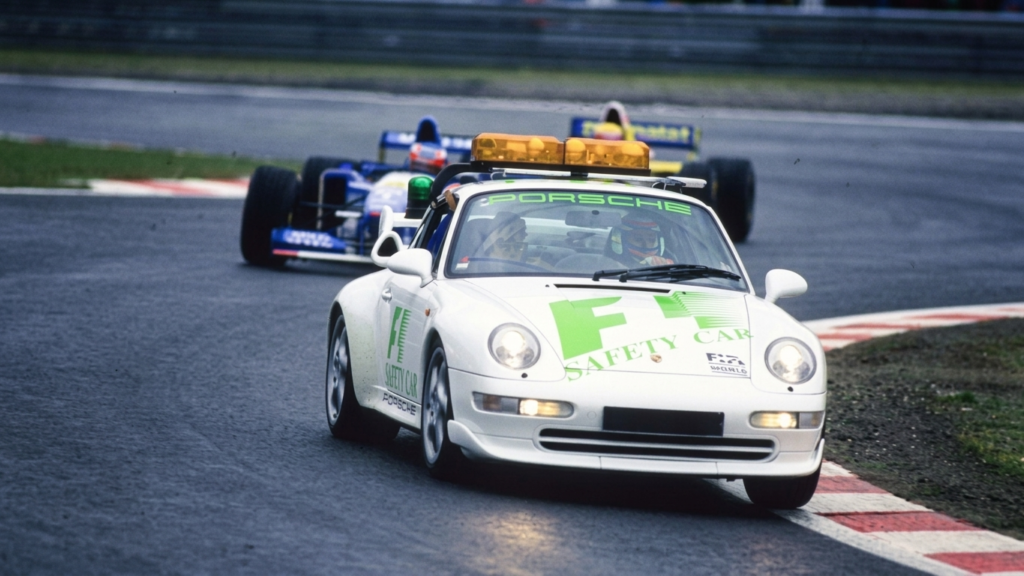
Period: 1995
Race: Belgian Grand Prix
Porsche returned with something considerably more serious than the original 914.
The Porsche 911 GT2 was used at the 1995 Belgian Grand Prix.
By this point, the Safety Car was becoming more closely associated with high-performance machinery, although the choice of vehicle could still vary from circuit to circuit.
1995 — LAMBORGHINI DIABLO
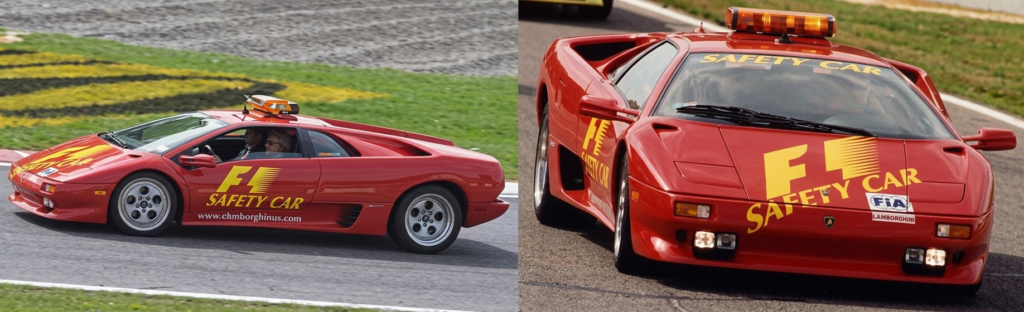
Period: 1995
Race: Canadian Grand Prix
Lamborghini returned to Safety Car duty with the Diablo.
If the Countach was dramatic, the Diablo was pure 1990s excess.
A V12 Lamborghini once again found itself leading Formula 1 cars around Montreal.
It was one of the last great moments of the pre-Mercedes Safety Car era.
1996 — RENAULT CLIO
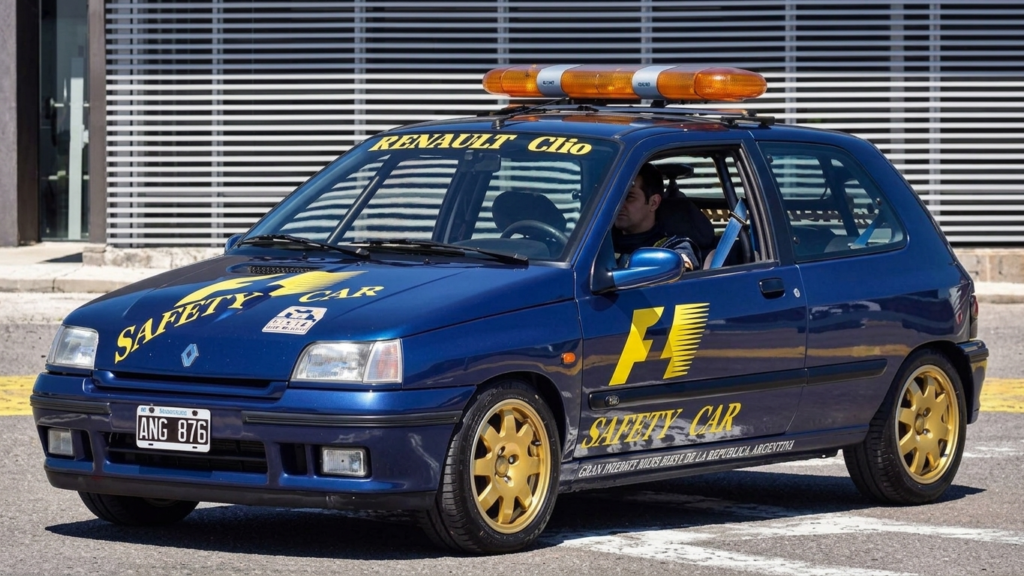
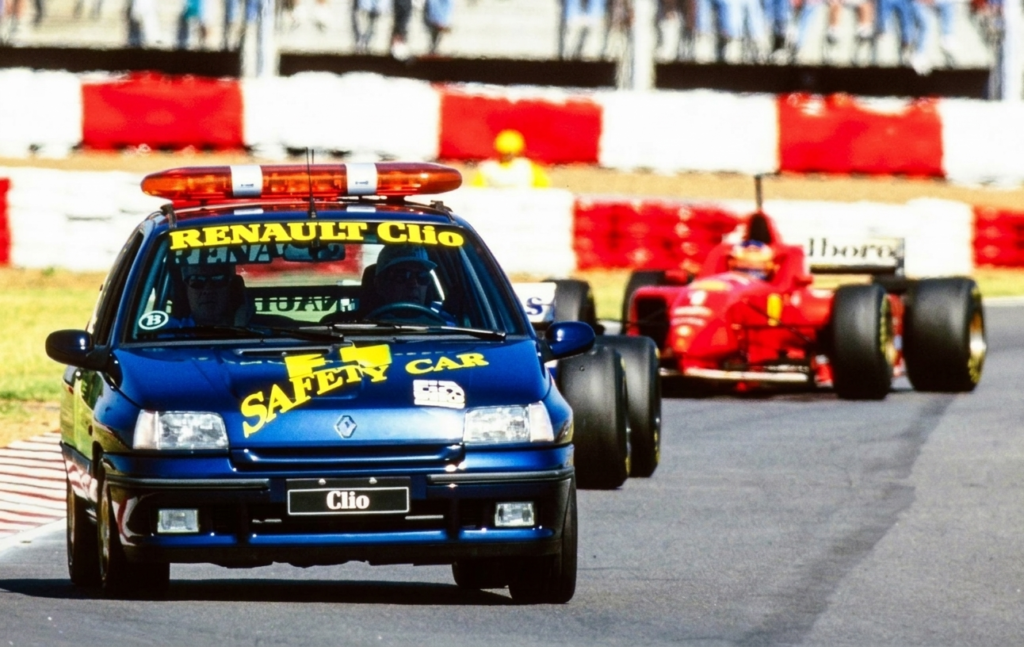
Period: 1996
Race: Argentine Grand Prix
And then came perhaps the funniest contrast of all.
The Renault Clio was used at the 1996 Argentine Grand Prix.
According to the FIA, this was not exactly the ideal solution. FIA official Herbie Blash later recalled that the Renault Clio was used when he first encountered the Safety Car in Race Control in 1996.
But this would be one of the last examples of the old system.
Something much bigger was about to arrive.
THE MERCEDES ERA BEGINS
1996–1997 — MERCEDES-BENZ C36 AMG
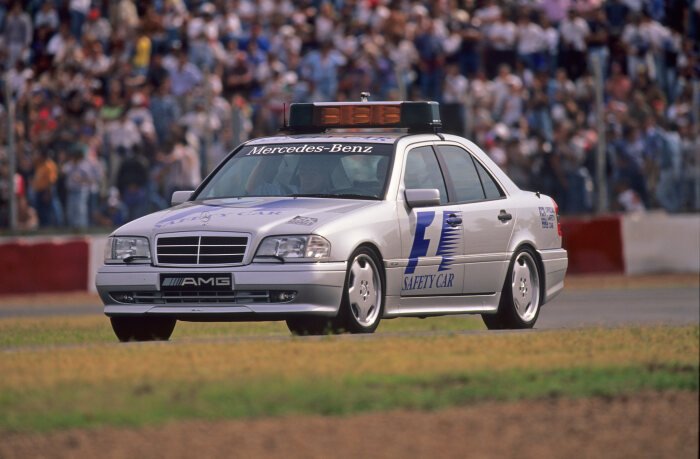
Period: 1996–1997
Midway through the 1996 season, Formula 1 and Mercedes entered an agreement that changed the Safety Car forever.
Mercedes became the official supplier, beginning with the Mercedes-Benz C36 AMG.
From this point forward, F1 no longer needed to hunt around for whatever suitable road car happened to be available at each circuit.
The Safety Car became a dedicated, professionally prepared machine.
And Mercedes’ relationship with F1 would last for decades.
1998–1999 — MERCEDES-BENZ CLK 55 AMG
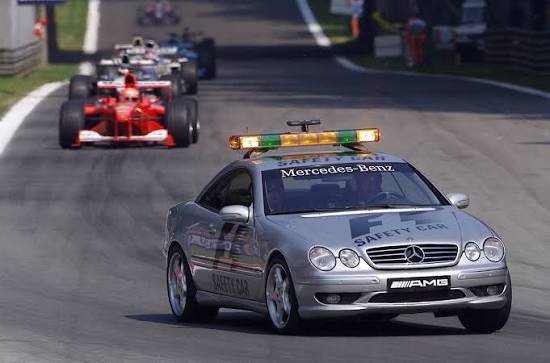
Period: 1998–1999
Mercedes moved from the C36 AMG to the CLK 55 AMG.
It was larger, more powerful and more closely aligned with the performance-luxury image Mercedes wanted to bring to F1.
2000–2002 — MERCEDES-BENZ CL 55 AMG
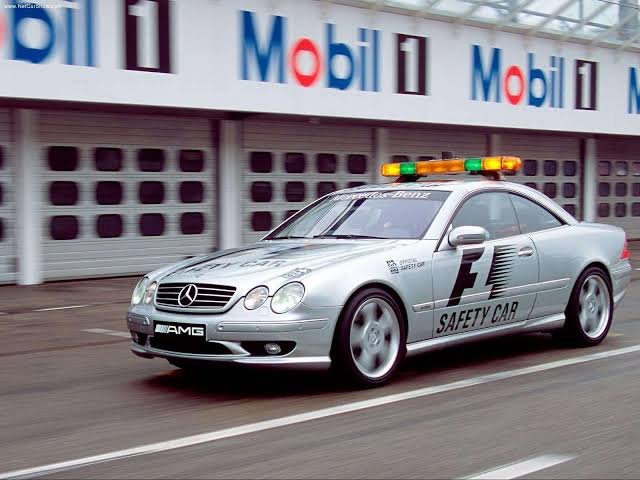
Period: 2000–2002
The next major step was the CL 55 AMG.
This was also the era when Bernd Mayländer became the familiar face behind the wheel of the F1 Safety Car.
Mayländer has remained the primary F1 Safety Car driver for almost the entire modern era.
2003 — MERCEDES-BENZ CLK 55 AMG
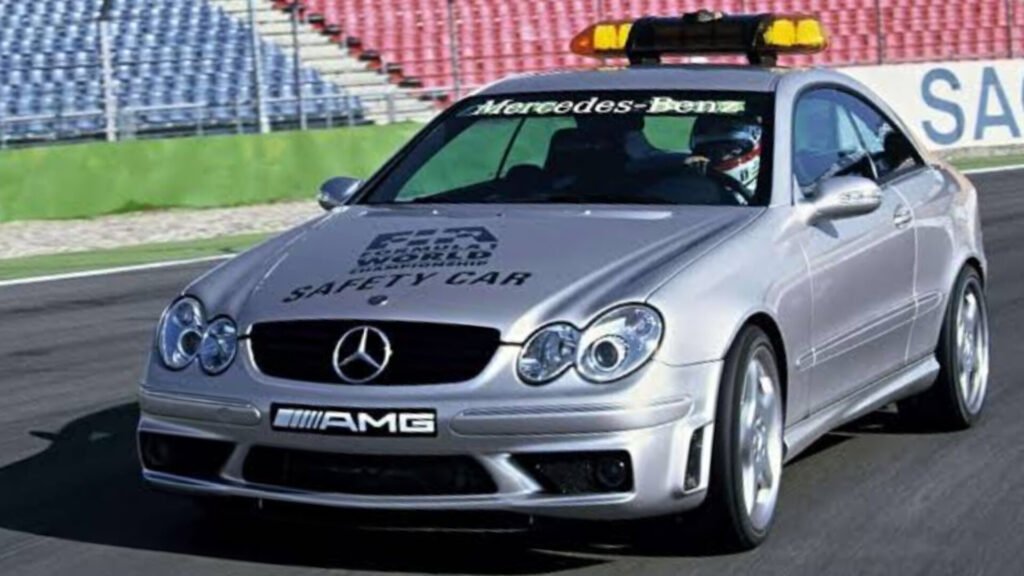
Period: 2003
Mercedes returned to the CLK 55 AMG for the 2003 season.
It was only used for a single season before another change arrived.
2004–2005 — MERCEDES-BENZ SLK 55 AMG
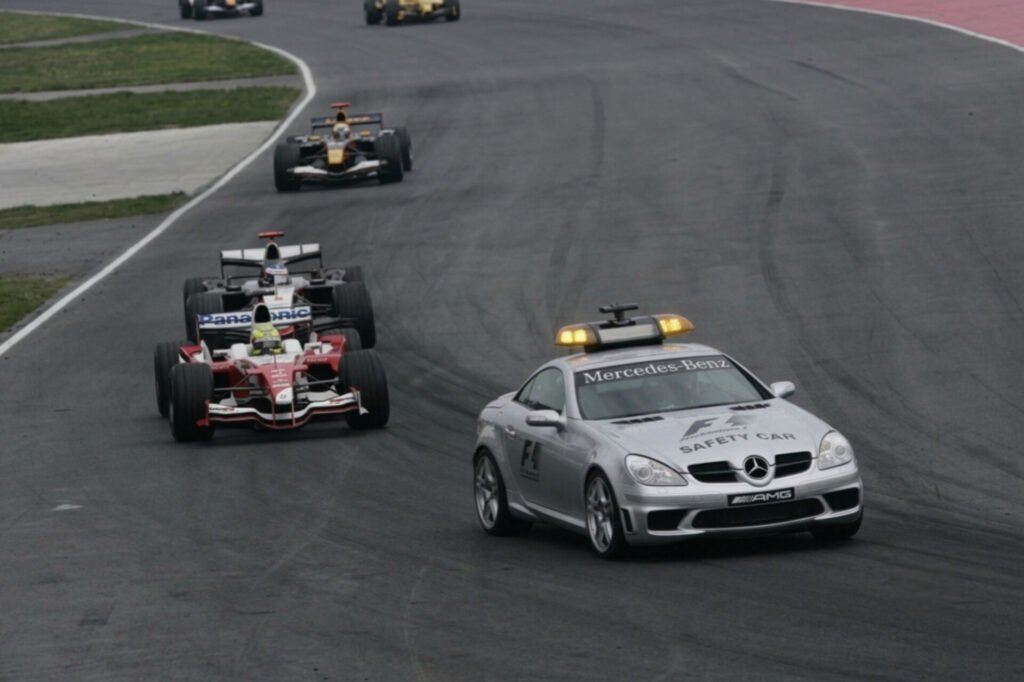
Period: 2004–2005
The compact SLK 55 AMG became the Safety Car.
It was a much smaller machine than some of its predecessors, but still carried the AMG V8 performance necessary for the job.
2006–2007 — MERCEDES-BENZ CLK 63 AMG
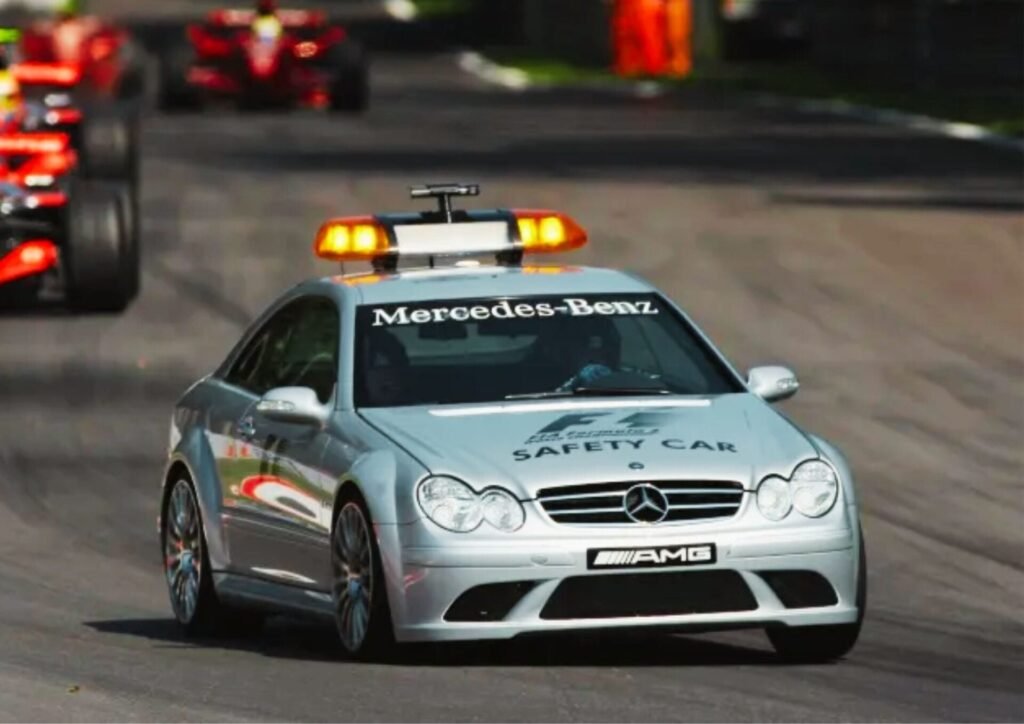
Period: 2006–2007
Mercedes then stepped up to the CLK 63 AMG.
This brought a larger naturally aspirated V8 into Safety Car duty and continued the gradual transformation from ordinary road car to purpose-prepared performance machine.
2008–2009 — MERCEDES-BENZ SL 63 AMG
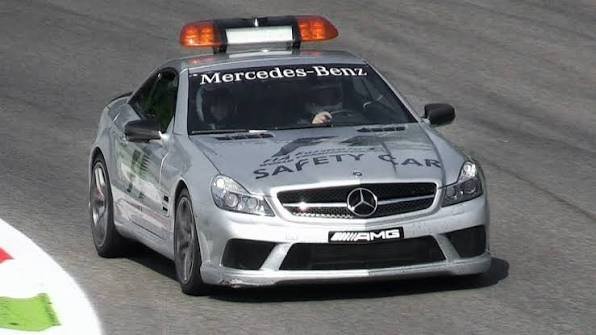
Period: 2008–2009
The SL 63 AMG took over for two seasons.
With its large-displacement V8 and roadster body, it looked considerably more exotic than the Safety Cars of the early 1990s.
2010–2011 — MERCEDES-BENZ SLS AMG
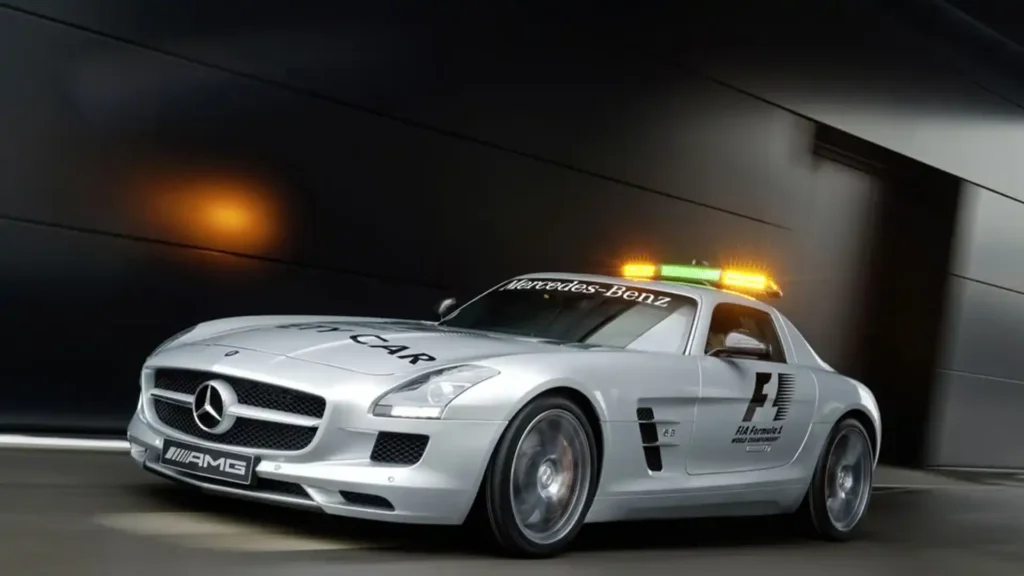
Period: 2010–2011
Then came one of the icons.
The Mercedes-Benz SLS AMG.
Gullwing doors. Long bonnet. Huge V8. Ridiculous proportions.
Suddenly, the F1 Safety Car looked every bit as special as the cars it was leading.
2012–2014 — MERCEDES-BENZ SLS AMG GT
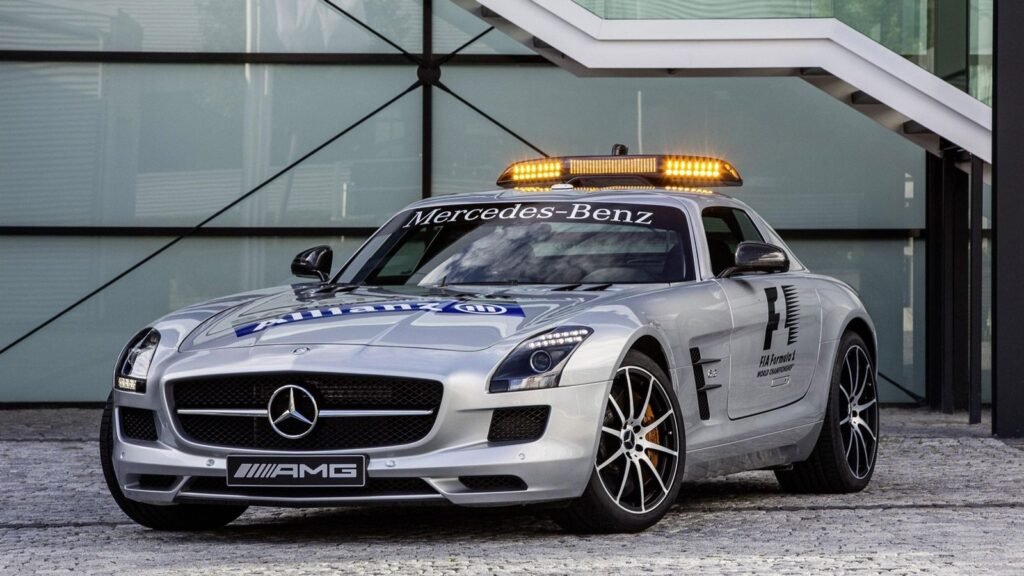
Period: 2012–2014
Mercedes evolved the SLS into the SLS AMG GT.
It retained the outrageous gullwing silhouette but gained more performance and sharper dynamics.
For three seasons, this was the machine responsible for keeping Formula 1 under control whenever the racing became too dangerous to continue at full speed.
2015–2017 — MERCEDES-AMG GT S
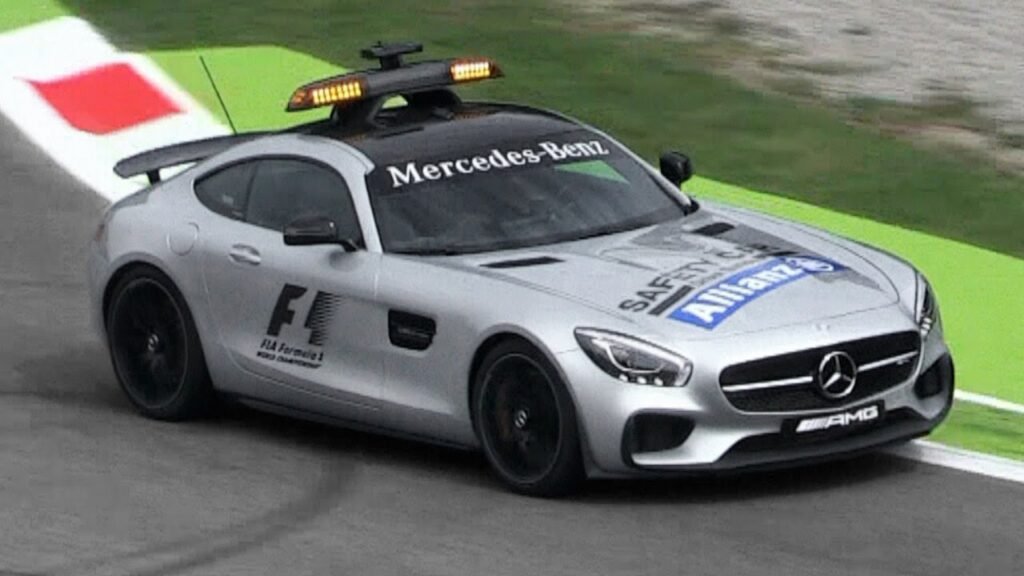
Period: 2015–2017
The SLS gave way to the Mercedes-AMG GT S.
This marked another shift in AMG’s design language, moving away from the long, dramatic SLS towards the smaller and more focused AMG GT.
2018–2021 — MERCEDES-AMG GT R
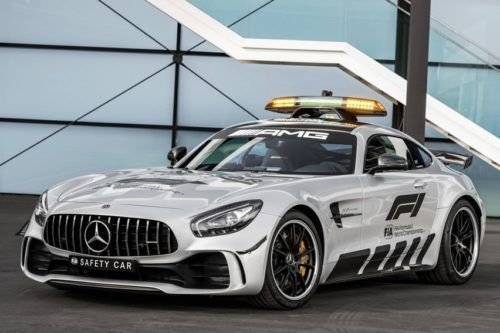
Period: 2018–2021
Then Mercedes turned the dial up again.
The AMG GT R became the Safety Car.
With a 4.0-litre twin-turbo V8, aggressive aerodynamics and track-focused hardware, this was no longer simply a fast luxury car with flashing lights.
It was a serious performance machine.
The 2021 season also introduced a major change: Mercedes began sharing Safety Car duties with Aston Martin.
ASTON MARTIN JOINS THE PARTY
2021–2023 — ASTON MARTIN VANTAGE
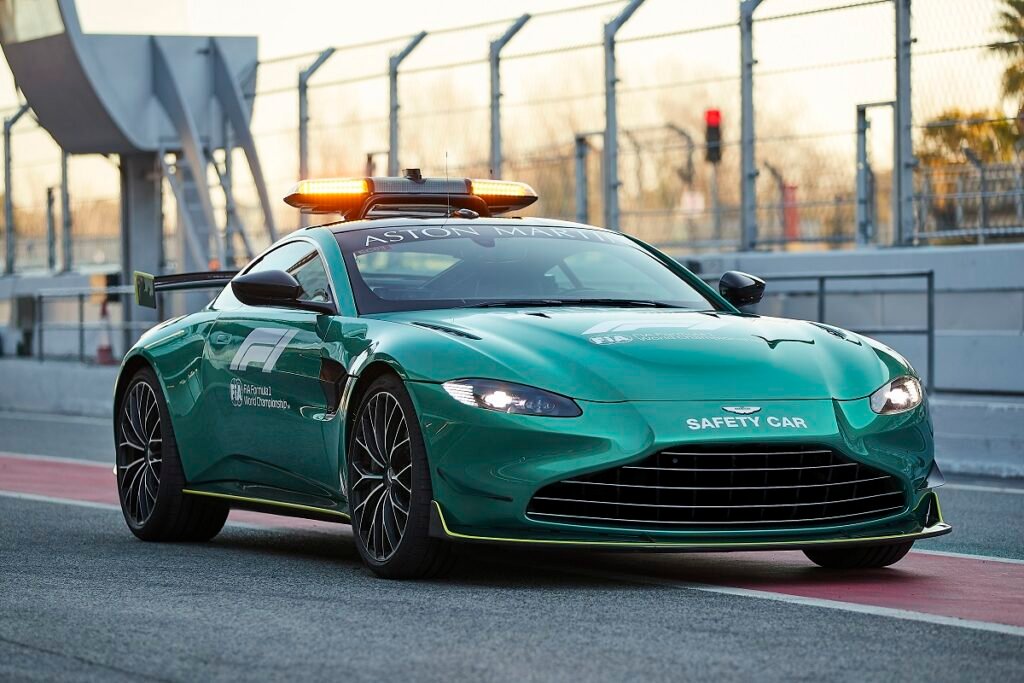
Period: 2021–2023
For the first time since Mercedes became the official supplier in 1996, another manufacturer joined the programme.
Aston Martin introduced the specially prepared Vantage.
It alternated Safety Car duties with Mercedes, giving F1 two very different flavours of performance car: German AMG muscle and British V8 sports-car drama.
2022–2025 — MERCEDES-AMG GT BLACK SERIES
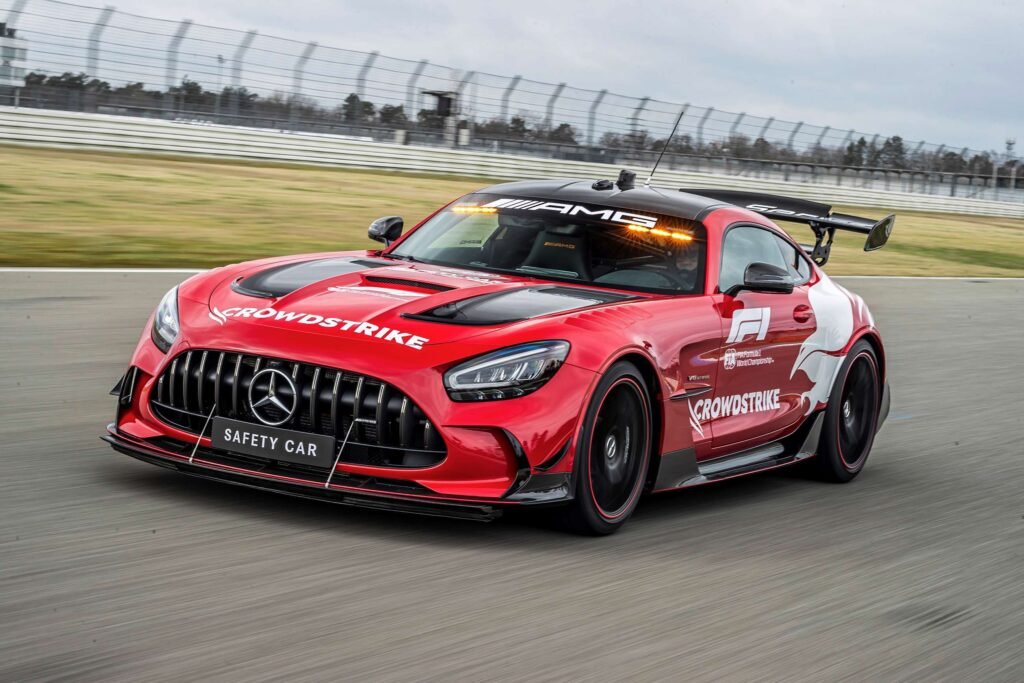
Period: 2022–2025
Mercedes answered with one of its wildest road cars yet.
The Mercedes-AMG GT Black Series replaced the AMG GT R as the German Safety Car.
With around 730 hp, extensive aerodynamic hardware and a heavily track-focused setup, it was arguably the closest thing to a road-going race car that Mercedes had ever put at the front of an F1 field.
2024–2025 — ASTON MARTIN VANTAGE
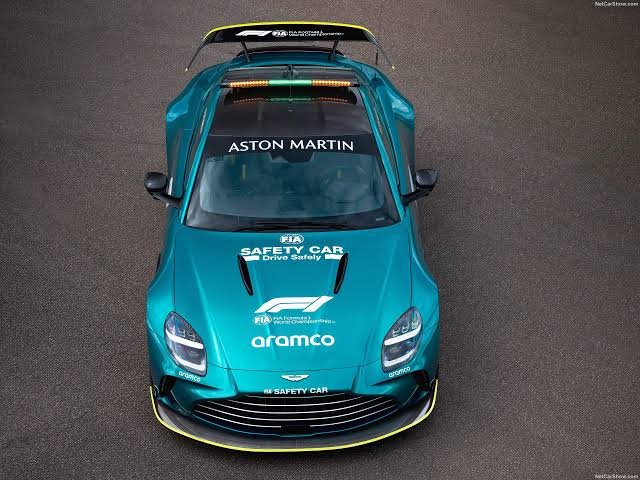
Period: 2024–2025
Aston Martin continued with the latest-generation Vantage Safety Car.
The updated car received substantially more power and torque than its predecessor, reaching 665 PS and 800 Nm, with a claimed 0–60 mph time of 3.4 seconds.
Even the Safety Car was getting serious enough to need supercar-level performance simply to do its job properly.
2026 — MERCEDES-AMG GT 63 PRO 4MATIC+
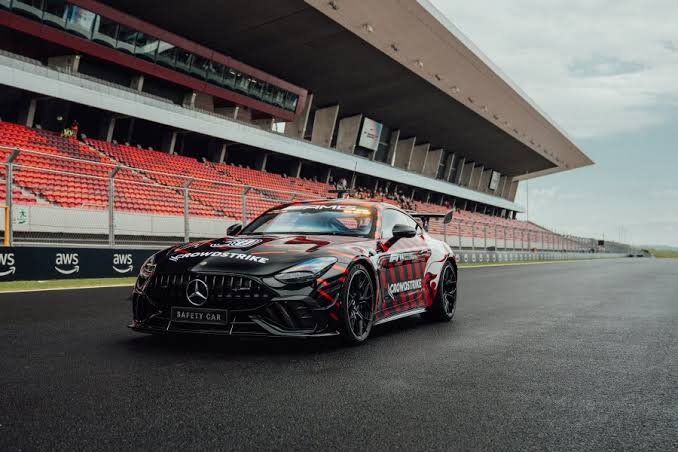
Period: 2026–present
And this is where the story currently stands.
For 2026, the official FIA Formula 1 Safety Car is the Mercedes-AMG GT 63 PRO 4MATIC+.
Formula 1 confirmed the car as its Official FIA F1 Safety Car during the 2026 season, including a special Cars-inspired livery at Monza.
The evolution is almost absurd when you put it next to the first Safety Car.
1973:
Porsche 914.
2026:
Mercedes-AMG GT 63 PRO 4MATIC+.
From a relatively modest mid-engined Porsche deployed during a rain-soaked Canadian Grand Prix to a modern AMG performance machine loaded with advanced safety and communication equipment.
That is more than five decades of evolution.
And the strangest part?
Somewhere between the Porsche 914 and today’s AMG, Formula 1 decided that a Fiat Tempra, Honda Prelude and Renault Clio were perfectly acceptable cars to put in front of the fastest racing machines on the planet.
The Safety Car didn’t just evolve.
It went completely insane.
THE COMPLETE TIMELINE
1973 — Porsche 914
1981–1983 — Lamborghini Countach
1993 — Fiat Tempra 16V
1993 — Ford Escort RS Cosworth
1994 — Opel Vectra
1994 — Honda Prelude
1995 — Porsche 911 GT2
1995 — Lamborghini Diablo
1996 — Renault Clio
1996–1997 — Mercedes-Benz C36 AMG
1998–1999 — Mercedes-Benz CLK 55 AMG
2000–2002 — Mercedes-Benz CL 55 AMG
2003 — Mercedes-Benz CLK 55 AMG
2004–2005 — Mercedes-Benz SLK 55 AMG
2006–2007 — Mercedes-Benz CLK 63 AMG
2008–2009 — Mercedes-Benz SL 63 AMG
2010–2011 — Mercedes-Benz SLS AMG
2012–2014 — Mercedes-Benz SLS AMG GT
2015–2017 — Mercedes-AMG GT S
2018–2021 — Mercedes-AMG GT R
2021–2023 — Aston Martin Vantage (shared duties)
2022–2025 — Mercedes-AMG GT Black Series
2024–2025 — Aston Martin Vantage (shared duties)
2026–present — Mercedes-AMG GT 63 PRO 4MATIC+
From Porsche to Lamborghini, Fiat to Ford, Honda to Renault, and finally Mercedes-AMG and Aston Martin, the F1 Safety Car has gone from an improvised solution into a high-performance machine that has effectively become a character of its own in Formula 1.

Adhe is part of the 88 Eight Box Editorial Team, covering JDM culture, motorsport, automotive technology, and industry news. The team focuses on delivering original automotive stories, reviews, and insights for enthusiasts worldwide.